You’re probably tired of generic pollen forecasts that don’t reflect what’s actually happening in your backyard. Commercial pollen monitoring stations can be miles away from your home, giving you data that’s about as useful as yesterday’s weather report. Building your own detection system puts real-time, hyper-local information directly in your hands – but the benefits go far beyond just knowing when to close your windows.
Cost-Effective Alternative to Commercial Pollen Sensors
While commercial pollen sensors like the PS2 deliver accurate monitoring capabilities, their $2,300 price tag puts them out of reach for most individuals and communities who need affordable pollen detection solutions.
You can create a cost-effective alternative to commercial pollen sensors using low-cost Optical Particle Counters (OPCs) that provide real-time data while employing machine learning techniques to build pollen proxies from air samples.
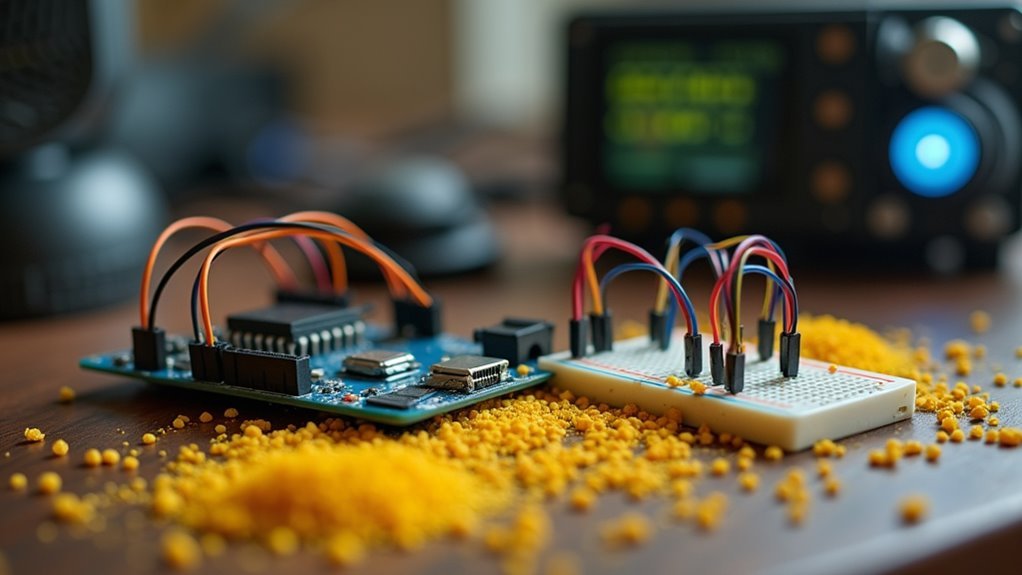
DIY pollen detection systems offer you customized solutions using readily available components and sensors tailored to your specific monitoring needs.
You’ll enhance detection capabilities by combining multiple sensor types, such as dust and particle detectors, while maintaining budget-friendly costs.
Community-driven projects and open-source software like NodeRed help you integrate your sensors with online pollen services.
Real-Time Data Collection and Monitoring Capabilities
You’ll gain unprecedented insight into pollen patterns through hourly concentration measurements that capture fluctuations throughout the day.
Your DIY system can automatically log this data without manual intervention, creating thorough records for analysis and trend identification.
This continuous environmental tracking guarantees you won’t miss sudden pollen spikes that could trigger severe allergic reactions.
Hourly Concentration Measurements
Every hour matters when you’re tracking pollen levels, and building your own detection system gives you the granular data needed to understand how concentrations fluctuate throughout the day.
Unlike daily averages from regional stations, hourly measurements reveal precise patterns that can dramatically improve your pollen monitoring strategy.
Your DIY system captures these critical temporal variations:
- Morning peak concentrations when trees release pollen at dawn
- Midday fluctuations influenced by wind patterns and humidity
- Evening drops as pollen settles or weather conditions change
- Overnight accumulation that affects next-day exposure levels
This detailed temporal analysis helps you identify specific high-risk periods and plan outdoor activities accordingly.
You’ll discover that pollen concentrations can vary dramatically within just a few hours, making hourly data essential for effective allergy management.
Automated Data Logging
Building on those precise hourly measurements, automated data logging transforms your pollen detection system into a continuous monitoring powerhouse that captures every fluctuation without manual intervention.
Your low-cost Optical Particle Counter records pollen data at high time resolutions, tracking even subtle changes throughout the day or during weather shifts. You’ll gain real-time pollen concentration readings that let you make informed decisions about outdoor activities instantly.
The automated data logging feeds into machine learning models like Neural Networks and Random Forests, greatly improving accuracy of your pollen readings.
You can integrate this system with online pollen services for immediate data access. Over time, you’ll identify vital patterns in pollen dispersal, helping you manage allergy symptoms more effectively than ever before.
Continuous Environmental Tracking
While traditional pollen monitoring relies on weekly sampling and delayed laboratory analysis, your continuous environmental tracking system captures real-time data streams that reveal the dynamic nature of airborne allergens.
You’ll gain unprecedented insights into how pollen in the air fluctuates throughout different times of day, weather conditions, and seasonal shifts.
Your system’s continuous monitoring capabilities provide:
- Hourly pollen concentration measurements that identify peak allergen periods
- Weather correlation data linking temperature, humidity, and wind patterns to pollen levels
- Immediate health alerts when dangerous concentrations threaten sensitive individuals
- Long-term trend analysis revealing seasonal patterns and climate change impacts
This real-time approach transforms pollen management from reactive to proactive, enabling you to anticipate exposure risks and implement timely protective measures.
Customization for Specific Environmental Needs
You’ll need to configure your pollen detection system to target the specific allergens that affect your local area, whether that’s oak, ragweed, or grass pollens.
Your system’s calibration settings must account for terrain factors like elevation, wind patterns, and vegetation density that influence how pollen disperses in your environment.
You can also program personal sensitivity thresholds that trigger alerts based on your individual allergy severity rather than generic population averages.
Local Allergen Targeting
Since pollen types and concentrations vary dramatically across different geographic regions, designing a detection system that targets your area’s specific allergens delivers far more actionable data than relying on broad regional forecasts.
Local allergen targeting allows you to customize your monitoring approach for the plants that actually impact your daily life.
Your DIY system can focus on specific threats in your environment:
- Regional species identification – Target ragweed in the Midwest or oak trees in the Southeast based on your location’s dominant allergenic plants
- Seasonal calibration – Program detection for your area’s unique pollen seasons and peak dispersal times
- Individual sensitivity matching – Configure sensors to prioritize allergens that specifically trigger your symptoms
- Microclimate adaptation – Account for local weather patterns affecting pollen distribution in your neighborhood
Terrain-Specific Calibration Settings
As you move beyond basic local targeting to implement your detection system, terrain-specific calibration settings become essential for achieving precise pollen measurements in your unique environment.
You’ll need to fine-tune sensor sensitivity based on your region’s dominant vegetation, humidity levels, and temperature patterns. These terrain-specific calibration settings help differentiate between various allergenic species that flourish in your area.
Your calibration protocol should incorporate local pollen phenology—the timing of flowering and pollen release cycles.
You’ll also want to adjust detection thresholds using local air quality data to distinguish pollen from other airborne particles effectively. Regular updates throughout seasons guarantee ideal performance.
Personal Sensitivity Thresholds
Once you’ve established terrain-specific calibration, personalizing your detection system’s sensitivity thresholds transforms it from a general monitoring tool into a precision instrument tailored to your unique allergic responses.
Your personal sensitivity thresholds enable customization based on specific triggers that affect you most. You can program alerts for particular pollen types while filtering out irrelevant data that clutters standard forecasts.
Key customization features include:
- Programming specific alerts for ragweed, grass, or tree pollen based on your individual triggers
- Setting concentration thresholds that match your reaction levels rather than general population averages
- Integrating real-time monitoring with existing weather data for proactive environmental adjustments
- Implementing data logging to track exposure patterns and identify seasonal trends affecting your symptoms
This personalization guarantees you receive actionable information precisely when environmental conditions threaten your comfort.
Integration With Smart Home Automation Systems
When you integrate your DIY pollen detection system with smart home automation, you’ll transform isolated data points into actionable intelligence that actively improves your living environment.
Your sensors can communicate through Zigbee or Wi-Fi protocols, seamlessly incorporating pollen data into existing platforms for thorough environmental assessment.
You’ll create automated responses that trigger air purifiers or adjust ventilation when pollen levels exceed your thresholds, effectively reducing indoor exposure.
Your system logs historical data, enabling seasonal trend analysis for informed outdoor activity decisions.
Integration with Alexa or Google Home lets you query current levels and receive personalized recommendations.
This creates an intelligent ecosystem that proactively manages your allergies rather than simply alerting you after problems occur.
Learning Opportunity for Environmental Science Principles

You’ll gain hands-on experience with atmospheric monitoring fundamentals when you build your own pollen detection system, exploring how environmental factors influence particle dispersion patterns.
The project teaches you particle classification methods as you work to distinguish pollen from other airborne contaminants using sensor technology and machine learning algorithms.
You’ll also develop essential data analysis techniques by processing real-time measurements and creating meaningful interpretations of environmental conditions.
Atmospheric Monitoring Fundamentals
Although atmospheric monitoring might seem complex at first glance, you’re fundamentally measuring what’s floating around in the air we breathe every day.
When you build your own pollen detection system, you’ll learn essential environmental science principles through hands-on experience. Your system captures airborne particles using sensors, then employs machine learning techniques to differentiate pollen from other particulate matter.
Understanding these fundamentals involves several key considerations:
- Site selection – choosing representative locations for accurate data collection
- Sensor calibration – ensuring your measurements reflect actual pollen concentrations
- Data interpretation – analyzing patterns to predict allergy-triggering conditions
- Quality assurance – validating results against established monitoring standards
You’ll discover how environmental factors influence pollen distribution and gain practical knowledge about air quality assessment that directly impacts public health decisions.
Particle Classification Methods
Particle classification methods form the analytical backbone of your pollen detection system, transforming raw sensor data into actionable environmental intelligence.
You’ll leverage supervised machine learning techniques like Neural Networks and Random Forest algorithms to distinguish pollen from dust and pollutants. Your system must accurately identify particles ranging from 10 to 30 micrometers—typical sizes for ragweed and oak pollen.
Text and data mining capabilities enhance your classification accuracy by processing extensive datasets from multiple sensor types. Low-cost Optical Particle Counters provide high-resolution temporal data, while laser sensors offer complementary measurement principles.
Object detection algorithms trained on thorough image datasets achieve remarkable accuracy in species identification. This multi-sensor integration creates robust pollen proxies that capture peak events and temporal trends, enabling real-time environmental monitoring.
Data Analysis Techniques
Three core analytical approaches drive effective pollen detection: statistical correlation analysis, machine learning classification, and temporal pattern recognition.
When you’re implementing data analysis techniques, you’ll find supervised machine learning methods like Neural Networks and Random Forest algorithms particularly effective for constructing reliable pollen proxies from your Optical Particle Counter data.
Your system’s performance can achieve impressive results:
- Neural Network models deliver Spearman correlation coefficients of 0.85 for Poaceae pollen tracking
- Random Forest algorithms provide coefficient of determination (R²) values reaching 0.67
- F1 scores hit 0.83 when distinguishing significant pollen events
- Object detection algorithms achieve 100% accuracy identifying specific pollen types
You’ll enhance monitoring robustness by incorporating real-time multi-sensor data, creating valuable insights for both allergy management and environmental research applications.
Machine Learning Applications in Particle Detection

While traditional pollen counting methods have dominated aerobiology for decades, machine learning techniques are revolutionizing how you can detect and analyze airborne particles.
These machine learning applications enable you to transform low-cost Optical Particle Counter data into accurate pollen proxies, achieving correlation coefficients up to 0.85 with actual counts.
Machine learning transforms affordable particle counter data into reliable pollen measurements with up to 85% accuracy correlation.
You’ll find Neural Networks and Random Forest models particularly effective for real-time monitoring.
These supervised methods can detect temporal trends and high pollen events with F1 scores reaching 0.83, giving you precise identification of significant occurrences.
Community-Based Data Sharing and Collaboration
Although individual pollen detection systems provide valuable local data, you’ll achieve far greater impact by connecting with broader community networks and collaborative initiatives.
Community-based data sharing initiatives transform isolated measurements into extensive regional datasets that enhance accuracy and reveal broader pollen patterns.
You can maximize your system’s potential through strategic partnerships:
- University collaborations – Access expert knowledge and advanced resources to improve your detection system’s design and functionality
- Open-source platforms – Share modifications, troubleshoot challenges, and learn from fellow hobbyists’ innovations
- Regional network integration – Contribute your data to established monitoring systems for scientific research
- Local community engagement – Raise awareness about environmental health while building collective knowledge
This collaborative approach creates lasting impact beyond personal allergy management.
Addressing Limitations of Current Market Solutions
Building a DIY pollen detection system becomes even more compelling when you consider the significant shortcomings of existing commercial options. High-end sensors like the PS2 cost around $2,300, making them financially inaccessible for most users.
Meanwhile, affordable alternatives such as the Plantower PMS3003 can’t effectively distinguish pollen from dust and pollutants, severely limiting their practical value.
This fundamental inability to accurately identify pollen among other airborne particles means you’re often getting unreliable data for air quality assessments. Many regions still rely on manual pollen counting because automated systems simply don’t deliver the accuracy needed at reasonable prices.
Enhanced Indoor Air Quality Management
Once you’ve assembled your DIY pollen detection system, you’ll gain powerful capabilities for managing indoor air quality that go far beyond simple monitoring.
Your custom setup enables real-time responses to changing pollen levels, creating a dynamic defense against airborne allergens.
Key management capabilities include:
- Automated HVAC integration – Your system triggers air filtration adjustments based on detected pollen concentrations
- Personalized exposure control – You’ll receive alerts during high pollen days to minimize symptom triggers
- Environment-specific optimization – Custom calibration guarantees monitoring matches your local flora and seasonal patterns
- Proactive intervention timing – Real-time data allows you to implement air quality measures before pollen levels peak
This integration transforms passive monitoring into active air quality management, giving you unprecedented control over your indoor environment.
Seasonal Allergy Prevention and Health Benefits
You’ll receive instant notifications when pollen levels spike in your area, allowing you to close windows, limit outdoor activities, and take preventive medications before symptoms worsen.
Your system can learn your specific sensitivity levels and create personalized thresholds that trigger alerts based on your unique allergy profile rather than generic recommendations.
Real-Time Allergy Alerts
When pollen levels spike unexpectedly, your DIY detection system delivers instant alerts that transform how you manage seasonal allergies.
Real-time monitoring eliminates guesswork, giving you precise data when you need it most.
Your personalized alert system provides:
- Immediate notifications when specific pollen types like grass or tree pollen reach dangerous thresholds
- Customizable warning levels based on your individual sensitivity and allergy triggers
- Hour-by-hour forecasts that help you time outdoor activities for minimal exposure
- Historical trend analysis to identify patterns in your local pollen environment
You’ll receive alerts directly to your smartphone, allowing you to adjust medication schedules, postpone outdoor exercise, or simply stay indoors during peak pollen periods.
This proactive approach reduces symptom severity and improves your quality of life throughout allergy season.
Personalized Pollen Thresholds
Setting your own pollen thresholds transforms generic allergy alerts into precision health tools tailored to your unique sensitivities. Unlike standard monitoring systems that use broad population averages, personalized pollen thresholds reflect your individual reactions to specific allergens.
You’ll establish custom trigger levels based on your actual symptoms rather than relying on one-size-fits-all warnings. Your DIY system learns your sensitivity patterns, identifying which pollen types and concentrations cause your reactions.
This precision allows you to take preventive action before symptoms escalate. You can time medication doses perfectly, plan outdoor activities strategically, and avoid exposure during your personal peak sensitivity periods.
Indoor Air Quality
Since indoor pollen levels can soar up to 10 times higher than outdoor concentrations, your DIY detection system becomes your first line of defense against invisible allergens infiltrating your living space.
This real-time monitoring transforms how you manage indoor air quality, enabling proactive responses when pollen counts spike.
Your personalized system empowers strategic decisions about:
- Window management – Opening or closing based on live pollen data
- Air purifier activation – Running filtration systems during peak allergen periods
- Activity planning – Timing outdoor exposure around favorable conditions
- Symptom prevention – Taking preemptive measures before allergic reactions occur
Open Source Development and Accessibility
The digital age has democratized pollen detection technology through open source development, transforming what was once exclusive laboratory equipment into accessible DIY projects.
You’ll find abundant open access content that enables you to build custom detection systems tailored to your specific environment and target species.
Platforms like EdgeImpulse let you develop machine learning algorithms without extensive technical expertise. You can leverage widely available components and community-sourced knowledge, dramatically reducing costs compared to commercial alternatives.
When you share your designs and findings online, you’re contributing to a growing database of proven techniques that benefits everyone.
This collaborative approach empowers you to create real-time pollen monitoring systems that provide localized health data, helping you and your community make informed decisions about outdoor activities and allergy management.
Scalable Network Design for Multiple Locations
While individual DIY systems provide valuable localized data, expanding your monitoring capabilities requires strategic network architecture that connects multiple detection points across broader geographic areas.
Your scalable network design should incorporate hierarchical monitoring stations with reference sites following standardized protocols to guarantee data reliability across locations.
When planning your multi-location network, you’ll need to take into account:
- Site placement factors including population density, vegetation types, and meteorological influences
- Standardized observation protocols at reference sites to maintain data consistency
- Regional pollen dynamics by analyzing existing networks like Germany’s monitoring system
- Network purpose formalization defining performance criteria before implementation
This approach enables extensive pollen concentration mapping, improving forecast accuracy and allergy alert systems while serving public health notifications effectively.
Advanced Sensor Fusion and Data Processing
Once you’ve established your multi-location network, combining data from multiple sensor types becomes vital for distinguishing pollen particles from dust, pollution, and other airborne contaminants that can trigger false readings.
Advanced sensor fusion dramatically improves detection accuracy by integrating optical, environmental, and meteorological data streams.
You’ll need machine learning algorithms like neural networks and random forests to analyze these combined signals and create reliable pollen proxies.
These algorithms excel at identifying high pollen events while filtering out false positives. Real-time data processing enables immediate responses, essential for allergy management and public health alerts.
Incorporating temperature and humidity readings provides deeper insights into pollen dynamics and seasonal patterns, making your detection system considerably more intelligent and trustworthy.
Future-Proofing Your Environmental Monitoring Setup
As environmental monitoring technologies evolve rapidly, you’ll want to design your pollen detection system with adaptability at its core. Building your own system creates flexibility that commercial alternatives can’t match, allowing you to incorporate emerging sensors and upgrade components as new technologies become available.
Your DIY approach enables seamless integration with future innovations:
- Modular sensor architecture – Add new detection capabilities without replacing the entire system
- Open-source platform compatibility – NodeRed and similar platforms guarantee long-term software support
- API integration flexibility – Connect with evolving online pollen services and data networks
- Community-driven improvements – Benefit from collaborative enhancements and shared knowledge
This adaptable foundation protects your investment while keeping pace with advancing environmental monitoring technologies, guaranteeing your system remains relevant for years to come.
Frequently Asked Questions
What Is the Science Behind Pollen?
You’ll find pollen is microscopic powder containing male plant gametes for reproduction. It’s released seasonally based on temperature, humidity, and wind. Different species produce varying grain sizes, causing allergic reactions when you’re exposed to airborne concentrations.
What Is the Difference Between Pollen and Pollen Grains?
You’ll find that pollen refers to the fine powder collectively produced by plants, while pollen grains are the individual microscopic units within that powder that contain male reproductive cells.
Why Do Pollen Concentrations Vary in the Air?
You’ll notice pollen concentrations fluctuate because seasonal flowering patterns, weather conditions like temperature and wind, geographic location, rainfall washing pollen away, and human landscaping activities all directly influence how much pollen’s airborne.
How Small Is Pollen?
You’ll find pollen grains are incredibly tiny, measuring just 10-100 micrometers with most around 25 micrometers. They’re so small they easily become airborne and penetrate deep into your respiratory system.