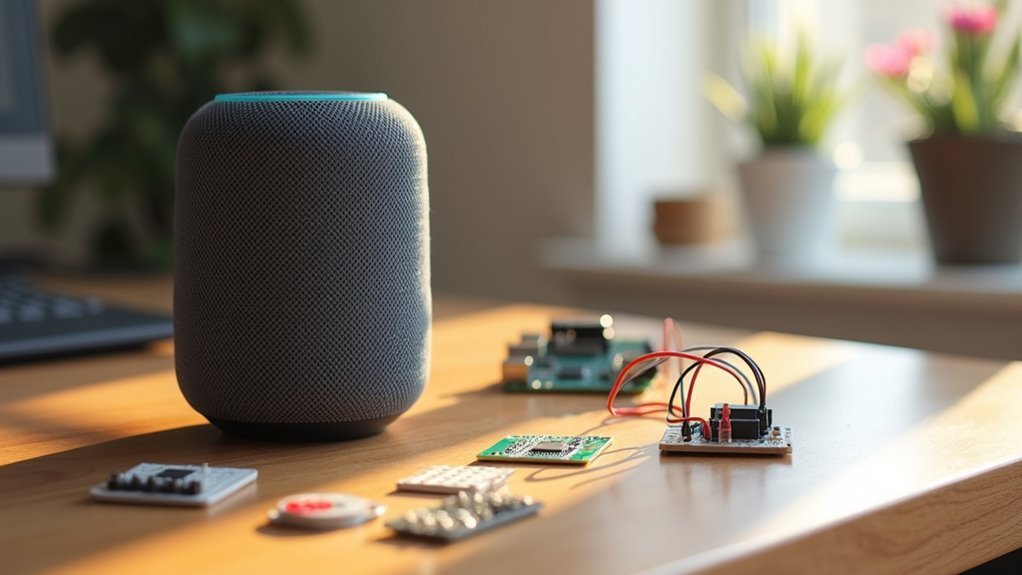
You’ve probably imagined walking into your home and simply saying “play my morning playlist” without touching a single device. Voice-activated music systems aren’t just for tech enthusiasts anymore—they’re becoming vital home features that transform how you experience audio entertainment. With the right setup, you’ll control volume, skip tracks, and discover new music using only your voice. However, choosing the wrong components or skipping critical configuration steps can leave you frustrated with a system that barely responds to your commands.
Choose Your Voice Assistant Platform
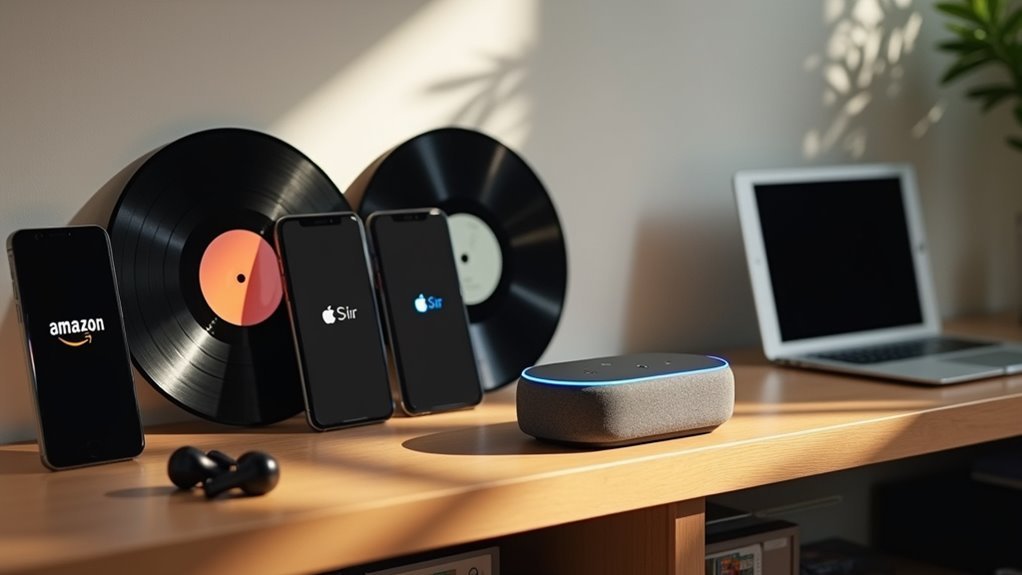
When building a voice-activated music system, you’ll need to select from three primary platforms: Amazon Alexa, Google Assistant, or Apple Siri. Each platform offers distinct advantages for your setup.
Amazon Alexa excels at controlling compatible home theater receivers, making it ideal if you have existing audio equipment.
Amazon Alexa stands out for seamlessly integrating with existing home theater setups, making it the top choice for current audio equipment owners.
Google Assistant shines with high-resolution streaming capabilities through Chromecast built-in devices, perfect for audiophiles seeking superior sound quality.
Apple Siri integrates seamlessly with Apple’s ecosystem.
All three voice assistants support major streaming services like Spotify, Apple Music, and Amazon Music.
You’ll connect your chosen platform by downloading the respective app—Amazon Alexa or Google Home—then following setup instructions to link your smart devices and music services for hands-free control.
Select Compatible Smart Speakers and Audio Equipment
You’ll need to research which smart speakers work with your chosen voice assistant platform to guarantee seamless integration.
Start by checking compatibility lists for Amazon Alexa, Google Assistant, or Apple Siri devices before making any purchases.
Verify that your selected speakers can connect to your home Wi-Fi network and support the audio streaming services you currently use.
Research Speaker Compatibility
Choosing the right smart speakers for your voice-activated music system requires careful attention to compatibility across multiple dimensions. You’ll need to verify that your speakers work seamlessly with popular voice assistants for maximum voice control functionality. Check streaming service compatibility, multi-room capabilities, and network connectivity options before making your purchase.
| Feature | Amazon Alexa | Google Assistant | Apple Siri |
|---|---|---|---|
| Voice Control | Natural language commands | Conversational AI responses | iOS device integration |
| Streaming Services | Amazon Music, Spotify, Apple Music | YouTube Music, Spotify, Pandora | Apple Music, Spotify |
| Multi-room Audio | Echo ecosystem sync | Google Home grouping | AirPlay 2 compatible devices |
Ensure your chosen speakers support both Wi-Fi and Bluetooth connectivity. This versatility allows connection to various audio equipment while maintaining reliable network performance for streaming and voice commands.
Choose Voice Assistant
Which voice assistant will best serve your music streaming needs? You’ll want to choose between Amazon Alexa and Google Assistant, as these are the most popular and widely compatible options available.
Both voice assistants offer excellent integration with smart speakers and audio equipment, making your selection process straightforward.
Consider your existing ecosystem when making this decision. If you’re already using Amazon services, Alexa provides seamless integration with Amazon Music and other Amazon products.
Google Assistant works exceptionally well with Google services and YouTube Music. Both voice assistant options support major streaming platforms like Spotify and Apple Music.
Ensure your chosen voice assistant supports the specific speakers and audio equipment you plan to use, as compatibility varies between manufacturers and models.
Verify Audio Connections
Three critical connection types determine whether your smart speakers and audio equipment will work seamlessly with your chosen voice assistant. You’ll need to check your audio equipment specifications to confirm they support Bluetooth, Wi-Fi, or wired connections for ideal compatibility.
| Connection Type | Range | Audio Quality | Setup Complexity |
|---|---|---|---|
| Bluetooth | 30 feet | Good | Easy |
| Wi-Fi | Whole home | Excellent | Moderate |
| Wired (3.5mm/RCA) | Cable length | Very good | Simple |
| Ethernet | Network reach | Excellent | Advanced |
| Optical/Digital | 15 feet | Superior | Moderate |
Consider powered speakers with built-in voice assistant capabilities to simplify your setup process. These eliminate connection compatibility concerns while enhancing your system’s audio quality and responsiveness to voice commands.
Download and Set Up Assistant Apps
Before your voice-activated music system can respond to commands, you’ll need to download the companion app for your chosen voice assistant. This essential step transforms your smartphone into a control center for your entire audio setup.
To download and set up assistant apps effectively, follow these steps:
Following a systematic approach to assistant app setup ensures seamless integration between your smartphone and smart audio devices.
- Download the appropriate app – Install the Amazon Alexa app for Alexa devices or the Google Home app for Google Assistant-compatible speakers.
- Connect to Wi-Fi – Confirm your smartphone connects to the same network as your smart speakers.
- Create your account – Log in or register for personalized settings and service access.
- Activate skills – Enable features like the BluOS skill for Alexa and link your music streaming services.
Regular app updates guarantee peak performance and compatibility.
Connect Devices to Your Wi-Fi Network

Several essential steps will secure your voice-activated music system connects seamlessly to your home network.
First, download your device’s specific controller app, like the BluOS Controller app for Bluesound Players. This app will guide you through the connection process step-by-step.
Next, verify your voice assistant device—whether Amazon Alexa or Google Assistant—is already set up and connected to the same Wi-Fi network. This matching connection is vital for proper communication between devices.
Follow the in-app instructions to connect devices to your wi-fi network and link your music service accounts. Your voice commands will only work effectively with stable bandwidth that supports uninterrupted audio streaming.
Finally, configure device names and groupings through the app’s settings to streamline voice command management across multiple devices throughout your home.
Install and Configure Music Streaming Services
You’ll need to choose streaming platforms that work with your voice assistant, then connect your service accounts to facilitate seamless integration.
Once you’ve linked your Spotify, Apple Music, or other compatible services, you can configure specific voice commands for playback control.
This setup process guarantees your voice assistant can access your music library and respond accurately to your spoken requests.
Choose Compatible Streaming Platforms
While setting up your voice-activated music system, selecting the right streaming platforms forms the foundation of your listening experience.
You’ll want to guarantee compatibility with major services that offer extensive streaming music libraries and seamless voice integration.
Consider these top compatible platforms for your system:
- Spotify – Offers thorough voice control with extensive playlist options and music discovery features
- Apple Music – Integrates smoothly with voice assistants and provides high-quality audio streaming
- Amazon Music – Works exceptionally well with Alexa devices and includes exclusive content
- Tidal – Delivers superior sound quality with lossless audio for audiophiles
You’ll need to verify each platform’s compatibility with your specific voice assistant before making your final selection for peak performance.
Link Service Accounts
After selecting your preferred streaming platforms, the next step involves connecting these services to your voice assistant through proper account linking. Download your chosen voice assistant app (Amazon Alexa or Google Assistant) and follow the setup prompts. You’ll need active streaming service credentials ready for integration.
| Voice Assistant | Streaming Service | Setup Location |
|---|---|---|
| Amazon Alexa | Spotify/Apple Music | Skills & Games section |
| Google Assistant | YouTube Music/Spotify | Services tab |
| Both | Amazon Music | Music settings |
Access the app’s settings to enable your specific music service and grant required permissions. Verify both platforms are updated to their latest versions for compatibility. Once linking’s complete, you can control your music effortlessly with commands like “Play my workout playlist” throughout your smart home setup.
Configure Voice Commands
Three essential voice command categories will transform how you interact with your music system: basic playbook controls, playlist management, and device-specific instructions.
When you configure voice commands, you’ll streamline your entire listening experience across all connected devices.
Start with these fundamental commands to maximize your system’s potential:
- Playback Controls – Say “Alexa, play my workout playlist” or “Hey Google, pause the music” for instant control.
- Volume Management – Use “Set volume to 5” or “Turn it up” for perfect sound levels.
- Custom Shortcuts – Configure voice commands through your assistant app for personalized interactions like “Start my morning routine.”
- Multi-Room Control – Direct music to specific locations with “Play jazz in the kitchen.”
Regular app updates guarantee your commands stay current with new features.
Link Audio Equipment to Voice Assistant
Everyone can transform their traditional audio setup into a smart, voice-controlled system by connecting compatible equipment to popular voice assistants like Amazon Alexa or Google Assistant. Start by downloading the respective app and connecting it to your Wi-Fi network.
| Step | Action |
|---|---|
| 1 | Verify your audio equipment compatibility with Alexa or Google Assistant |
| 2 | Download Amazon Alexa or Google Home app to your smartphone |
| 3 | Activate necessary skills like BluOS for specific device brands |
Once you’ve completed setup, use voice commands like “Alexa, play my favorite station” or “Hey Google, play music from Spotify” to control playback hands-free. Remember to regularly update your voice assistant and audio equipment settings for peak performance and access to new features.
Set Up Multi-Room Audio Capabilities

While linking your voice assistant creates the foundation for smart audio control, expanding to multi-room capabilities transforms your entire home into a synchronized entertainment hub.
Setting up multi-room audio with BluOS-enabled speakers requires strategic configuration:
- Connect all speakers to the same Wi-Fi network to guarantee seamless integration across your home.
- Configure room names through the BluOS Controller app for easy voice command recognition and control.
- Group speakers using simple voice commands like “Alexa, play music in the living room and kitchen.”
- Customize commands through BluVoice to tailor your multi-room audio experience according to your preferences.
Remember to regularly check for software updates in the BluOS app. These updates enhance performance and add new functionality to your multi-room audio setup, keeping your system running smoothly.
Configure Voice Commands and Custom Settings
Beyond establishing your multi-room network, you’ll need to fine-tune how your voice assistant responds to your specific commands. Start by downloading your chosen voice assistant’s app and connecting it to your Wi-Fi network. Activate the corresponding skill—like BluOS for Alexa—to enable seamless control over your music system.
| Command Type | Example Phrase |
|---|---|
| Play Music | “Play jazz in the kitchen” |
| Volume Control | “Set living room volume to 50%” |
| Room Selection | “Play music everywhere” |
| Playlist Management | “Shuffle my workout playlist” |
| System Control | “Stop music in bedroom” |
Set custom voice commands within the app for personalized experiences. Use simple, specific phrases to improve recognition accuracy. Regularly verify settings in both your assistant and music system apps to maintain peak performance and responsiveness.
Establish Default Rooms and Speaker Names
Once you’ve configured your voice commands, establishing clear default rooms and speaker names becomes your next priority for seamless control. This setup transforms how you interact with your music system, making voice commands more intuitive and precise.
To establish default rooms and speaker names effectively:
- Open the BluOS Controller app and navigate to speaker settings for each device.
- Assign specific room designations like “Living Room” or “Kitchen” to each speaker.
- Create custom speaker names that differentiate multiple devices clearly.
- Verify your Alexa-enabled device and BluOS Players connect to the same Wi-Fi network.
You’ll now command specific areas effortlessly with phrases like “Alexa, play jazz in the bedroom.” This targeted control enhances your listening experience throughout your home.
Test Voice Control Functionality
After setting up your speaker names and room assignments, you’ll need to verify that your voice assistant accurately responds to your commands and properly recognizes each device.
Test basic music playback commands like “Alexa, play jazz in the living room” to confirm the system understands both your intent and target location.
This testing phase reveals any recognition issues before you rely on voice control for daily music listening.
Command Response Accuracy
While voice-activated music systems offer impressive convenience, their effectiveness hinges on how accurately they interpret and execute your commands. To maximize command response accuracy, you’ll need to implement strategic approaches that enhance your system’s performance.
Here are four essential strategies to improve your voice system’s responsiveness:
- Use specific, clear commands – Speak distinctly and employ precise language that eliminates ambiguity for your assistant.
- Keep apps and devices updated – Regular software updates enhance functionality and overall system responsiveness.
- Test in different environments – Identify potential interference sources and environmental limitations affecting recognition.
- Stick with default settings initially – Simple configurations often yield better accuracy before customizing advanced features.
Continuously gather feedback and adjust your command strategies to create an increasingly intuitive music experience.
Device Recognition Testing
Before implementing your voice-activated music system in daily use, you’ll need to conduct thorough device recognition testing to verify that all components communicate effectively.
Start by confirming your voice assistant connects properly to your home Wi-Fi network and links to compatible music services and speakers.
Test responsiveness using specific voice commands like asking your assistant to play particular songs, artists, or radio stations.
Evaluate recognition accuracy by issuing commands from different rooms to assess how well the system adapts to varying acoustic conditions.
Enable all necessary skills or features in your assistant’s app to guarantee full voice control access.
Regular software updates for both your voice assistant and music system will enhance recognition technology and improve overall performance.
Optimize Audio Quality and Performance
Since your voice-activated music system’s audio quality depends heavily on its connected components, you’ll want to pair it with high-quality speakers or receivers that support your preferred streaming services.
To maximize your system’s potential, follow these essential steps:
- Choose lossless audio formats when available through your streaming service to enjoy superior sound fidelity over compressed alternatives.
- Update firmware regularly on your voice-activated devices and speakers to access the latest performance enhancements and audio quality improvements.
- Experiment with speaker placement and consider your room’s acoustics, as positioning dramatically affects clarity and overall performance.
- Fine-tune equalizer settings within your streaming app to customize sound output for your personal preferences and room characteristics.
These optimizations guarantee you’re getting the best possible listening experience from your voice-activated music system.
Implement Privacy and Security Settings
Two critical aspects of voice-activated music systems often get overlooked: privacy protection and security management. You’ll want to activate privacy settings in your voice assistant’s app to control how your voice data gets used and stored. This gives you better control over your personal information while enjoying your music.
| Privacy Feature | Action Required | Benefit |
|---|---|---|
| Physical Mute Button | Press when needed | Temporarily disables microphone |
| Local Processing | Enable in settings | Keeps audio data off cloud servers |
| Recording Preferences | Review regularly | Customizes voice data storage |
| Privacy Controls | Familiarize yourself | Better understanding of data management |
You should regularly review these settings and utilize physical mute buttons on devices like Google Nest Mini for added security during private moments.
Troubleshoot Common Voice Control Issues
When your voice-activated music system isn’t responding as expected, you’re likely dealing with one of three common culprits that can disrupt seamless control.
Network connection problems can prevent your commands from reaching the system, while voice command recognition issues may cause misinterpretation of your requests.
Device compatibility issues between your voice assistant and music components can also create frustrating gaps in functionality that need immediate attention.
Network Connection Problems
Network connection problems often represent the most frustrating obstacle between you and your voice-activated music system.
When your devices can’t communicate properly, voice commands fall flat and music playback becomes unreliable.
Follow these essential steps to resolve network connection problems:
- Connect to same Wi-Fi network – Confirm your voice control device and music system share identical network connections for seamless communication.
- Monitor signal strength – Regularly check your Wi-Fi stability, as weak signals cause intermittent connectivity issues and poor voice command responsiveness.
- Use management apps – Download appropriate apps like BluOS Controller to adjust settings, troubleshoot issues, and install firmware updates.
- Reset when necessary – If problems persist, reset both devices to restore default configurations and enable fresh connections.
Voice Command Recognition
Voice command recognition failures can transform your sophisticated music system into an unresponsive device, leaving you frustrated when simple requests go unheard or misunderstood.
You’ll improve accuracy by using clear, specific phrases rather than complex sentences when issuing voice commands. Check your device compatibility regularly to prevent communication breakdowns between your assistant and music system.
Enable necessary skills in your assistant’s app, as missing features directly impact voice control performance. Maintain stable internet connectivity since disruptions interfere with command recognition and execution.
When problems persist, verify your microphone isn’t muted through the device’s app settings. A non-functioning microphone prevents voice detection entirely, making troubleshooting essential for restoring your system’s responsiveness.
Device Compatibility Issues
Beyond microphone and connectivity problems, compatibility issues between your voice assistant and music system create another layer of complexity that can block seamless audio control.
Device compatibility issues often stem from mismatched network connections, inactive skills, or outdated software versions.
To resolve these compatibility challenges:
- Connect devices to the same Wi-Fi network – Your voice assistant and music system must share identical network connections for proper communication.
- Activate required skills – Enable BluOS or equivalent skills in your assistant’s app to establish functionality.
- Verify streaming service support – Check that your music platforms work with your specific voice assistant.
- Update software regularly – Install latest versions on both devices for improved compatibility and performance enhancements.
These steps eliminate most device compatibility issues you’ll encounter.
Expand Your System With Additional Smart Home Integration
While your voice-activated music system excels at audio control, you’ll discover its true potential when you connect it to other smart home devices.
Integration with smart lights and thermostats creates a seamless automated living experience that responds to single voice commands.
Smart home integration transforms individual devices into a unified ecosystem controlled by simple voice commands.
You can control multiple devices simultaneously, saying “Good morning” to trigger your music, adjust lighting, and set the perfect temperature.
Platforms like Amazon Alexa and Google Assistant expand your system’s capabilities by leveraging existing smart home setups.
Create custom commands tailored to specific tasks, like “Movie night” to dim lights and play ambient music across different rooms.
Regular voice control technology updates guarantee your system remains responsive to new devices and services, keeping your smart home current.
Frequently Asked Questions
How Can I Make Your Voice Activated?
You can’t make me voice-activated since I’m a text-based AI assistant. However, you can enable voice commands for your music system by connecting your Bluesound Player to compatible voice assistants like Alexa or Google Assistant.
What Is the Musica Voice Control App?
The Musica Voice Control app lets you manage music playbook through voice commands. You’ll access streaming services, control multi-room audio, and integrate with smart home devices using simple voice prompts for hands-free listening.
Which Sonos Products Are Voice-Enabled?
You’ll find three voice-enabled Sonos products: the Sonos One with built-in microphones, the portable Sonos Move with Bluetooth connectivity, and the Sonos Beam soundbar for TVs.
What Are Voice-Activated Devices?
You’ll find voice-activated devices are smart gadgets that respond to your spoken commands using voice recognition technology. They enable hands-free operation for tasks like playing music, controlling smart home devices, and providing information on demand.