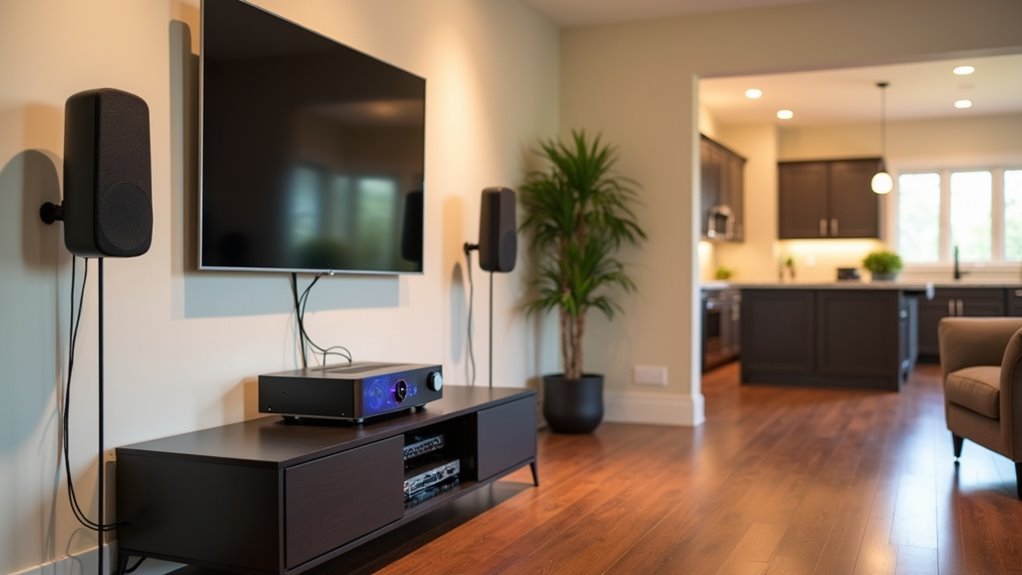
You’re probably tired of paying premium prices for multi-room audio systems that don’t quite match your vision. Building your own amplifier setup isn’t just about saving money—though you’ll cut costs dramatically. It’s about creating something that actually works the way you want it to, with the speakers you choose, in the exact configuration your home demands. The question isn’t whether you can build a better system than what’s commercially available.
Cost Savings Compared to Commercial Systems

While commercial multi-room audio systems can drain your wallet with costs reaching several hundred dollars per room, building your own DIY setup offers remarkable savings that’ll keep your budget intact.
You can achieve significant cost savings by purchasing components separately rather than investing in expensive commercial systems. For example, the Arylic Up2Stream Amp V4 costs just $99 compared to Sonos speakers at $199 or more each.
Your DIY approach allows complete customization while avoiding hefty integrated system pricing. You’ll eliminate ongoing subscription fees by using free or owned music libraries instead of required streaming services.
Complete Control Over Your Audio Setup
Beyond the financial advantages, DIY multi-room amplifier systems grant you unprecedented command over every aspect of your audio experience.
Your custom multi-room amplifier system lets you control audio zones individually, managing volume levels and playback options through a mobile app tailored to your preferences.
Individual zone control through personalized mobile apps delivers precise volume and playback management across your entire home audio network.
You’ll choose your preferred streaming protocols, whether Bluetooth or Wi-Fi, ensuring seamless compatibility with your devices and music services.
This approach enables personalized audio configurations by selecting specific amplifiers and speakers that match your sound quality standards and room acoustics.
You can integrate vintage equipment alongside modern components, maximizing existing investments while achieving long-term cost savings through open-source software and avoiding proprietary subscription fees.
Flexibility to Use Existing Equipment

One of the biggest advantages of building your own multi-room amplifier system is that you don’t need to replace your current speakers.
You can integrate high-quality vintage speakers like the Beovox S4500 or professional active monitors into a modern streaming setup using devices like the Arylic Up2Stream Amp V4.
This approach lets you repurpose equipment you’ve already invested in while gaining all the benefits of wireless multi-room audio.
Integrate Existing Speakers
Although purchasing an entirely new speaker ecosystem might seem like the obvious path forward, creating a multi-room amplifier system lets you breathe new life into speakers you already own and love.
When you integrate existing speakers into multi-room audio systems, you’re preserving their unique acoustic characteristics while gaining modern connectivity features.
Retrofitting existing speakers with products like the Arylic Up2Stream Amp V4 transforms vintage or traditional passive speakers into smart, connected components. This approach delivers significant cost savings compared to buying new smart speakers, with complete setups achievable under $200.
DIY amplifiers enable you to create a personalized audio experience that maintains sentimental attachments to favorite equipment while building a cohesive sound system throughout your home.
Repurpose Current Equipment
While new smart speakers flood the market with promises of convenience, repurposing your current equipment offers unmatched flexibility and control over your audio setup.
You can transform your vintage Beovox S4500s or any existing speakers into a sophisticated multi-room audio system using DIY amplifiers like the Arylic Up2Stream series. These solutions integrate modern streaming capabilities with your current equipment, adding Bluetooth connectivity and Wi-Fi functionality without extensive rewiring.
The beauty lies in customization—you’ll control each speaker individually or group them for synchronized playback across rooms.
This approach preserves the unique audio characteristics of your high-quality speakers while adding contemporary features. You’re not just saving money; you’re creating a personalized system that respects your existing investment.
Customization for Your Home’s Unique Layout
Since every home has distinct architectural features and room configurations, you’ll need to tailor your multi-room amplifier system to match these specific characteristics. Customization enables you to select components that perfectly fit each space’s size and acoustic requirements.
You can choose vintage speakers for classic rooms or modern active models for contemporary areas, guaranteeing ideal sound distribution throughout your entire home.
Your personalized multi-room audio system provides independent volume control for each room, allowing family members to enjoy different audio sources simultaneously. You’ll accommodate diverse listening preferences while maintaining harmony in your household.
Device management becomes effortless with dedicated apps that let you customize speaker names and adjust settings. This level of customization guarantees your system works seamlessly with your home’s unique layout and your family’s specific audio needs.
Learning Experience and Skill Development

Building a multi-room amplifier system transforms you from a passive consumer into an active audio engineer who understands the inner workings of sound reproduction.
You’ll develop hands-on electronics knowledge by working with components like the Arylic Up2Stream series, learning to integrate vintage speakers with modern streaming technology while troubleshooting connectivity issues.
This DIY approach sharpens your technical problem-solving skills as you navigate software configurations, wireless protocols, and the inevitable challenges that arise when bridging analog and digital audio worlds.
Hands-On Electronics Knowledge
Although you might initially feel intimidated by the technical aspects, creating a multi-room amplifier system offers an invaluable hands-on experience that’ll deepen your understanding of audio electronics.
You’ll gain practical knowledge about how audio components interact and function together in real-world applications.
Building your own system teaches you about various connectivity options and their practical implementations:
- Bluetooth and Wi-Fi integration with different speaker types
- Power management and proper wiring techniques
- Network configuration through mobile apps
This process greatly develops your troubleshooting skills as you encounter and resolve compatibility issues between hardware and software components.
Working with DIY amplifiers like Arylic devices helps you optimize audio quality across multiple rooms while mastering mobile technology for system control and management.
DIY Audio Engineering
When you immerse yourself in DIY audio engineering through multi-room amplifier projects, you’ll discover fundamental principles that govern how sound travels and transforms throughout your system.
You’ll learn how amplifiers boost signals, how speakers convert electrical energy into sound waves, and how wireless connectivity protocols like Bluetooth and Wi-Fi enable seamless audio distribution.
These DIY projects sharpen your problem-solving abilities as you troubleshoot performance issues and optimize configurations.
Working with components like the Arylic Up2Stream series teaches you about power ratings, impedance matching, and signal quality.
You’ll also develop user experience design insights by considering app functionality, speaker placement, and control accessibility.
Building your own multi-room audio system transforms abstract engineering concepts into tangible skills you can apply to future projects.
Technical Problem Solving
As you engage in multi-room amplifier construction, you’ll encounter a series of technical challenges that transform theoretical knowledge into practical expertise. Your technical problem-solving abilities will sharpen as you troubleshoot connectivity issues between Bluetooth and Wi-Fi devices.
Managing audio streaming through apps like 4STREAM develops your network management skills while teaching you essential device pairing protocols.
The hands-on audio hardware setup process teaches you:
- Proper wiring techniques with authentic cables and connectors
- Electrical safety practices for DIY projects
- Critical thinking for ideal sound distribution configurations
You’ll also navigate software-related audio issues, including compatibility problems across different web browsers and media players.
These challenges force you to adapt to software updates and develop systematic approaches to technical troubleshooting, creating valuable problem-solving methodologies.
Better Sound Quality Per Dollar Invested
While premium multi-room audio systems command hefty price tags, you’ll discover that building your own setup delivers superior sound quality for a fraction of the cost.
Your DIY system can cost under $200 while outperforming expensive proprietary alternatives. You’ll achieve better sound quality by selecting high-performance vintage speakers like Beovox S4500 or Yamaha HS3 models, which often cost less than entry-level smart speakers.
DIY audio systems under $200 can outperform expensive alternatives using quality vintage speakers that cost less than basic smart speakers.
Custom amplifiers such as the Arylic Up2Stream provide advanced connectivity features while maintaining exceptional audio quality.
The cost-effectiveness becomes clear when you realize your multi-room amplifier system delivers high-resolution audio streaming that meets or exceeds CD quality standards, all without ongoing subscription fees that wireless services typically require.
Avoiding Subscription Service Dependencies
Since subscription services can drain your budget with monthly fees that accumulate to hundreds of dollars annually, building your own multi-room amplifier system liberates you from these recurring costs entirely.
Custom multi-room systems eliminate dependency on proprietary ecosystems that often require ongoing payments for full functionality.
Your DIY amplifiers provide complete control over audio sources without subscription limitations:
- Access locally stored music files without internet connectivity requirements
- Integrate turntables, CD players, and other traditional audio equipment seamlessly
- Utilize multiple streaming protocols like AirPlay or Google Cast without brand restrictions
This approach guarantees local music playback remains independent of streaming service availability.
You’ll enjoy a versatile listening experience while avoiding subscription fees that commercial systems typically demand for premium features and multi-room functionality.
Future-Proofing Your Investment
Beyond escaping monthly fees, your DIY multi-room amplifier system becomes a smart long-term investment when you prioritize future-compatibility from the start. By selecting components supporting open streaming protocols like AirPlay and Google Cast, you’ll avoid proprietary lock-in that plagues commercial systems. Your customized system accommodates future technologies as they emerge, protecting against obsolescence.
| DIY Approach | Commercial Systems |
|---|---|
| Open protocols | Proprietary standards |
| Modular upgrades | Full replacements |
| Component flexibility | Limited options |
| Extended lifecycle | Planned obsolescence |
When you upgrade your system gradually, you’re spreading costs over time while maintaining cutting-edge performance. Quality amplifiers and speakers you choose today will integrate seamlessly with tomorrow’s wireless multi-room innovations, ensuring your multiroom audio system remains relevant for years ahead.
Integration With Vintage and High-End Components
One of the most compelling advantages of building your own multi-room amplifier system is the freedom to breathe new life into cherished vintage speakers and premium components that would otherwise gather dust.
Your custom setup allows seamless integration of classic models like the Beovox S4500 alongside modern high-end components such as Yamaha HS3 active speakers.
Custom multiroom setups seamlessly blend vintage classics like Beovox S4500 with modern high-end components for optimal audio distribution.
Devices like the Arylic Up2Stream Amp V4 bridge the gap between old and new:
- Connect vintage speakers directly to modern streaming services
- Maintain original sound signatures while enabling high-resolution playback
- Provide individual zone control for each component
This approach guarantees your multiroom system preserves the unique character of vintage speakers while maximizing audio distribution flexibility throughout your home.
Scalable Expansion Options
As your audio needs evolve, a DIY multi-room amplifier system grows with you rather than forcing expensive wholesale replacements.
With scalable expansion options, you can start small and gradually build your multi-room audio network based on budget and requirements. Modular components like the Arylic Up2Stream series let you add zones incrementally—each new amplifier will integrate seamlessly into your existing setup without compatibility issues.
This flexible approach means you’re not locked into one manufacturer’s ecosystem.
You’ll create flexible configurations that adapt to changing spaces and preferences while maintaining a customizable setup throughout.
Whether you’re adding speakers to new rooms or upgrading existing zones, your modular system accommodates growth efficiently, ensuring long-term satisfaction and cost-effectiveness.
No Manufacturer Lock-In Limitations
When you build your own multi-room amplifier system, you’ll escape the restrictive boundaries that proprietary systems impose on your audio choices. Instead of being locked into one manufacturer’s ecosystem, you’ll gain the freedom to mix and match components from different brands based on your specific needs and preferences.
Break free from manufacturer lock-in and create a personalized multi-room audio system tailored to your exact preferences and budget.
This flexibility transforms your audio experience in several key ways:
- Component Selection: Choose the best amplifiers, speakers, and controllers from various manufacturers.
- Upgrade Freedom: Replace individual pieces without overhauling your entire system.
- Technology Access: Integrate cutting-edge innovations from multiple brands as they become available.
You’re no longer bound by a single manufacturer’s product timeline or limitations. This independence allows you to create a truly customized multi-room setup that evolves with your needs and budget.
Personal Satisfaction From Building
You’ll discover genuine satisfaction when you build your own multi-room amplifier system, experiencing complete creative design freedom as you select components that match your exact preferences and aesthetic vision.
The hands-on construction process develops your technical skills while deepening your understanding of audio engineering principles and component interactions.
There’s an unmistakable sense of accomplishment when you power up your completed system for the first time, knowing you’ve transformed individual components into a cohesive, personalized audio solution.
Creative Design Freedom
Building your own multi-room amplifier system releases complete creative control over every aspect of your audio setup. This creative design freedom lets you craft a DIY system that perfectly matches your vision, whether you’re integrating vintage speakers or selecting modern custom components that complement your home’s aesthetic.
Your multi-room audio setup becomes uniquely yours through:
- Component selection – Choose amplifiers, speakers, and controllers that align with your design preferences.
- Streaming protocols – Select connectivity options that match your specific usage patterns.
- Integration flexibility – Blend existing equipment with new audio technology seamlessly.
You’re not constrained by manufacturers’ design decisions or limited color options. Instead, you can create a system that reflects your personal style while delivering exceptional sound quality throughout your home.
Technical Skill Development
As you immerse yourself in constructing your multi-room amplifier system, you’ll develop valuable technical skills that extend far beyond audio equipment.
You’ll master electronics fundamentals while learning complex wiring techniques and connectivity protocols like Bluetooth and Wi-Fi. This hands-on experience with DIY amplifiers, speakers, and cables sharpens your problem-solving abilities when troubleshooting system configurations.
Working with audio management software enhances your system integration capabilities and user interface navigation skills.
You’ll gain valuable insights into optimizing sound quality through strategic speaker placement and understanding room acoustics. Each challenge you encounter—whether configuring network connections or fine-tuning audio distribution—builds your technical expertise.
This thorough learning experience transforms you into a more capable technician, equipped with practical skills applicable to various electronic projects and audio engineering challenges.
Accomplishment Through Completion
Pride swells through every connection you make and every component you successfully integrate into your custom multi-room amplifier system. This DIY project delivers profound satisfaction that store-bought systems simply can’t match.
You’ve transformed raw components into a fully functional audio system through your own expertise and determination.
The accomplishment extends beyond just sound quality. You’ll experience:
- Personal fulfillment from solving complex technical challenges independently
- Enhanced confidence in your ability to tackle future electronics projects
- Genuine ownership of every aspect of your system’s design and performance
Your finished system represents tangible proof of your capabilities while delivering impressive cost savings.
The knowledge you’ve gained becomes invaluable for future modifications and upgrades, making this accomplishment both immediately rewarding and eternally beneficial.
Tailored Features for Your Specific Needs
When you design your own multi-room amplifier system, you’ll discover the freedom to craft features that perfectly match your home’s unique layout and your personal listening habits.
You control every audio source selection, speaker placement, and volume configuration based on how you actually use each room. This customization extends to connectivity protocols—choose AirPlay for Apple devices or Google Cast for Android integration.
Budget-friendly component selection means you prioritize what matters most while maintaining excellent sound quality.
You can repurpose vintage speakers alongside modern wireless units, creating a unique blend of old and new.
Most importantly, you can expand gradually over time, adding rooms and features as your needs change without being trapped in a single manufacturer’s ecosystem or expensive proprietary requirements.
Long-Term Maintenance and Upgrade Benefits
Unlike commercial systems that force you to replace entire setups when components fail, your custom multi-room amplifier system lets you swap out individual parts with ease. This approach provides superior flexibility for long-term maintenance while delivering better durability through quality component selection.
Your DIY system offers several key advantages:
Building your own multi-room amplifier system puts you in complete control of performance, costs, and future upgrades.
- Component Independence – Upgrade components individually without overhauling the entire system
- Cost Control – Avoid subscription fees that commercial solutions often require
- Personal Control – Troubleshoot and repair issues yourself using familiar components
When technology advances, you’re not locked into a manufacturer’s ecosystem. Instead, you can upgrade speakers or amplifiers as needed.
This personal control means you’ll develop expertise with your specific setup, making future maintenance straightforward and cost-effective compared to proprietary alternatives.
Frequently Asked Questions
What Do I Need for Multi-Room Audio?
You’ll need reliable Wi-Fi, network-ready wireless speakers or soundbars, and a mobile device with control apps. Verify compatibility with streaming services like Spotify and protocols like AirPlay 2 for seamless playback.
How Does Multiroom Work?
You’ll connect speakers wirelessly through your network, then control them via mobile apps or voice commands. The system uses streaming protocols like AirPlay to synchronize music playback across multiple rooms simultaneously.
How Do Multi Zone Amplifiers Work?
Multi-zone amplifiers receive audio signals and distribute them through separate output channels to different rooms. You’ll control each zone’s volume and source independently, while the amplifier processes and amplifies signals for ideal sound quality.
How to Control Speakers in Different Rooms?
You’ll control speakers using dedicated mobile apps like 4STREAM or HEOS. Connect speakers to Wi-Fi, assign custom names for easy identification, and use voice assistants like Alexa for hands-free management.