You’re overwhelmed by the endless smart home devices cluttering your living space, each requiring its own app and creating a management nightmare. The solution isn’t buying fewer gadgets—it’s finding the right dashboard tool that’ll consolidate everything into one seamless control center. While dozens of options flood the market, only seven platforms truly deliver the reliability, features, and user experience that’ll transform your fragmented smart home into an effortlessly coordinated ecosystem.
Amazon Echo (4th Generation) Dashboard Features

The Amazon Echo (4th Generation) transforms your living space into a connected command center, letting you control compatible smart home devices through simple voice commands and the extensive Alexa app.
This smart home dashboard supports Wi-Fi, Bluetooth, Zigbee, and Matter protocols, ensuring broad compatibility across manufacturers. You’ll access built-in motion and temperature sensors that trigger home automation actions and provide real-time environmental feedback.
Custom routines streamline your daily activities—you can program multiple smart home controls simultaneously, like dimming lights while adjusting your thermostat.
The Echo’s home security features include smoke alarm detection and glass-breaking alerts, sending immediate notifications through your dashboard interface.
Whether you’re managing lighting, climate, or security systems, this Amazon Echo delivers centralized control that responds instantly to your voice commands or app-based inputs.
Google Nest Hub Max Control Interface
While Amazon’s Echo relies primarily on voice commands and smartphone apps, Google’s Nest Hub Max elevates smart home control with its expansive 10-inch HD display that puts visual management at your fingertips.
Google’s Nest Hub Max transforms smart home management with its expansive 10-inch display, putting visual control directly at your fingertips.
This smart home hub transforms how you interact with your smart home automation system through its intuitive touch interface that’s genuinely user-friendly for everyone.
You’ll appreciate the built-in camera for video calls and home monitoring, while the voice-activated Google Assistant responds to hands-free commands.
The real advantage lies in viewing live feeds from your security cameras and video doorbells directly on-screen, creating a thorough security management center.
Unlike other smart displays, you can effortlessly navigate between apps, settings, and device controls, making the Google Nest Hub Max an exceptional centralized control solution.
Apple HomeKit Dashboard Capabilities
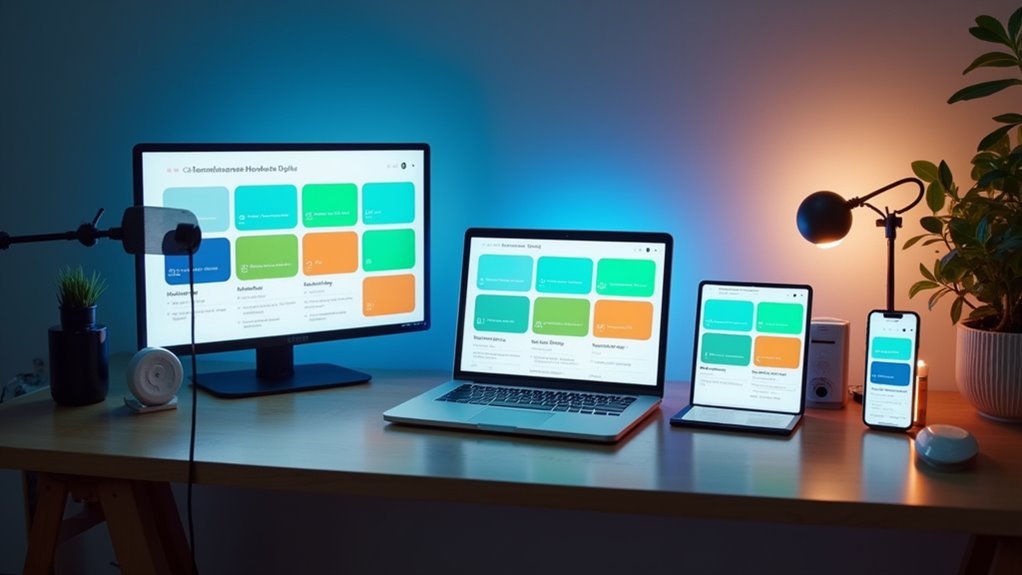
Apple’s HomeKit Dashboard revolutionizes smart home management by seamlessly integrating all your compatible devices into one unified control center accessible across your iPhone, iPad, and Mac.
You’ll control lights, thermostats, cameras, and countless other smart homes devices from this centralized dashboard with remarkable ease.
The Apple HomeKit platform excels at complex automations, letting you create sophisticated routines triggered by time, location, or sensor data.
You can simply ask Siri to control any connected device using natural voice commands. Security remains paramount with end-to-end encryption protecting all your data and communications.
What’s particularly impressive is HomeKit’s expanding compatibility with third-party devices supporting the Matter standard, ensuring your investment works across multiple ecosystems while maintaining Apple’s signature privacy standards.
Samsung SmartThings Hub Management
Samsung’s SmartThings Hub stands out as one of the most versatile smart home management platforms available, supporting Wi-Fi, Zigbee, and Z-Wave protocols to connect devices from virtually any manufacturer.
Samsung’s SmartThings Hub delivers unmatched versatility by supporting multiple protocols for seamless cross-manufacturer device integration.
You’ll find exceptional connectivity across brands, seamlessly integrating popular smart devices like Nest thermostats and Philips Hue lighting systems.
The SmartThings app empowers you to create sophisticated home automation routines, triggering actions based on motion detection, time schedules, or device status changes.
You can effortlessly adjust thermostats, control lighting, and manage security systems through complex automated sequences.
Supporting the Matter protocol enhances interoperability between different manufacturers’ devices, ensuring future-proof connectivity.
If you’re concerned about Samsung’s discontinued hub, the Aeotec Smart Home Hub replicates full SmartThings functionality, allowing uninterrupted access to this powerful ecosystem.
Home Assistant Open Source Platform
Unlike proprietary platforms, Home Assistant offers complete control over your smart home environment through its open-source architecture that supports over 2,000 devices and services from virtually every manufacturer.
This highly customizable platform eliminates vendor lock-in while providing unparalleled flexibility for managing your smart home devices.
You’ll appreciate the user-friendly dashboard that adapts to your preferences, delivering tailored control over every connected device.
Home Assistant runs on various hardware options, including Raspberry Pi or the dedicated Home Assistant Yellow device for simplified setup.
The platform’s strong community drives rapid innovation through regular updates, though you might encounter occasional breaking changes.
With extensive compatible devices and limitless customization possibilities, you’re getting the most versatile smart home solution available.
Hubitat Elevation Advanced Controls
While Home Assistant excels in open-source flexibility, Hubitat Elevation takes a different approach by focusing on local processing and advanced automation capabilities. You’ll get granular smart home control without cloud dependency, ensuring faster response times and enhanced privacy for your devices.
The C-8 model’s connectivity features make it particularly powerful for advanced controls:
| Feature | Benefit |
|---|---|
| Z-Wave Plus 800 | Expanded device compatibility |
| Zigbee 3.0 | Broader ecosystem integration |
| Ethernet Required | Stable, fast connectivity |
Hubitat Elevation’s interface offers extensive customization options for power users who want detailed control over device behaviors and automations. You can create complex interactions between devices while managing everything through their dedicated smartphone app. This combination of local processing and advanced controls makes Hubitat ideal for users prioritizing privacy and sophisticated automation capabilities.
TP-Link Kasa Smart Home Dashboard
TP-Link’s Kasa Smart Home Dashboard delivers streamlined device management through its intuitive mobile app interface.
You’ll control plugs, bulbs, switches, and cameras from one centralized location while monitoring your smart home ecosystem efficiently.
The dashboard excels at real-time monitoring and energy usage tracking, helping you optimize consumption and reduce costs.
You can create automated routines that trigger multiple devices simultaneously based on schedules or specific actions.
Key features include:
- Cross-platform compatibility with Android and iOS devices
- Real-time monitoring of device status and energy usage
- Automated scenes and routines for seamless device coordination
- Voice control integration with Amazon Alexa and Google Assistant
- Centralized management of diverse TP-Link Kasa smart home devices
Voice assistants enhance convenience by enabling hands-free control, making daily interactions with your connected devices more natural and efficient.
Frequently Asked Questions
What Is the Most Used Smart Home Platform?
Amazon Alexa’s the most widely used smart home platform you’ll encounter. You’ll find it’s got the broadest device compatibility, making it your top choice for controlling various smart home products seamlessly.
Which Smart Home Hub Is Best?
You’ll find the Amazon Echo 4th gen offers the best overall value, supporting Wi-Fi, Bluetooth, Zigbee, and Matter for under $100. It’s your most versatile choice for extensive smart home control.
Which Brand Is Best for Home Automation?
You’ll find Amazon Alexa’s the top choice for home automation since it’s compatible with over 100,000 smart devices. If you’re an Apple user, HomeKit offers better security and seamless integration.
What Is the Best App for Smart Homes?
You’ll find Amazon Alexa app works best for most smart homes due to its extensive device compatibility. However, you should consider Google Home or Apple HomeKit depending on your existing ecosystem and specific needs.