You’ve probably wondered why MQTT keeps appearing in every Home Assistant tutorial and smart home discussion. While Home Assistant works perfectly fine without it, there’s a compelling reason why seasoned automation enthusiasts consistently recommend this integration. The combination reveals capabilities that transform your smart home from a collection of connected devices into something far more sophisticated—and the benefits extend well beyond what you might initially expect.
Real-Time Device Communication Benefits
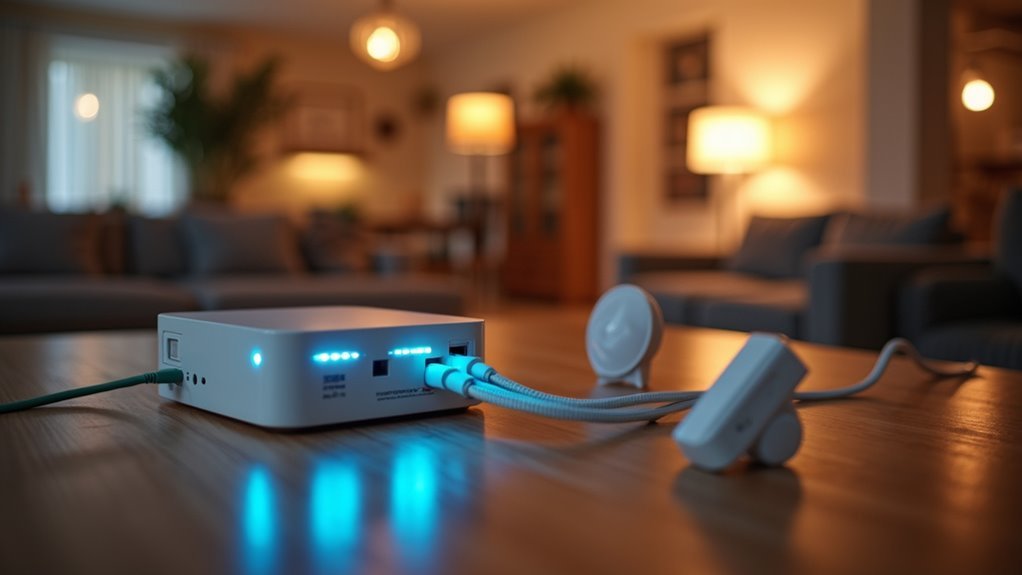
When you integrate MQTT with Home Assistant, you’ll immediately notice how the publish/subscribe model transforms your smart home’s responsiveness.
Multiple devices receive updates simultaneously without any delay or data loss, creating seamless real-time communication throughout your system.
The lightweight message structure minimizes bandwidth usage, ensuring your commands execute instantly. You’ll experience guaranteed message delivery through MQTT’s QoS options, so critical automation tasks never miss important signals. This reliability becomes essential when controlling security systems or time-sensitive devices.
MQTT’s event-driven architecture enables your smart home systems to react to state changes immediately.
When motion sensors detect movement or temperature readings change, connected devices respond without hesitation. This enhanced interactivity dramatically improves your user experience, making your Home Assistant automation feel truly responsive and intelligent.
Message Retention and Reliability Features
When you’re building a reliable home automation system, MQTT’s message retention and delivery features guarantee your devices stay synchronized even during network outages or system restarts.
You’ll benefit from the broker’s ability to store messages for offline devices and deliver them once they reconnect, preventing any data loss in your Home Assistant setup.
The protocol’s three Quality of Service levels let you customize message delivery reliability based on your specific needs, from basic fire-and-forget messaging to guaranteed exactly-once delivery.
Guaranteed Message Delivery
Since reliable communication forms the backbone of any successful home automation system, MQTT’s guaranteed message delivery features become essential when you’re integrating devices with Home Assistant.
The MQTT protocol offers three Quality of Service levels that let you choose how messages are delivered – whether they’re sent once without confirmation, delivered at least once, or assured exactly once delivery.
You’ll benefit from message retention capabilities that store important messages for devices connecting later, guaranteeing nothing’s missed during temporary disconnections.
Last Will and Declaration messages automatically notify Home Assistant when devices unexpectedly disconnect, maintaining system awareness.
This lightweight message structure makes MQTT perfect for IoT applications requiring reliable communication, while its efficient transport ensures consistent data flow across varying network conditions in your smart home.
Broker Storage Benefits
Message persistence stands as one of MQTT’s most valuable features for Home Assistant users, as brokers automatically store retained messages and deliver them to devices that connect after the initial publication.
Your MQTT broker maintains the last known state of devices through message retention, safeguarding you’ll never lose critical data when systems restart or experience temporary disconnections.
The broker’s storage capabilities provide three key advantages:
- Immediate State Recovery – New subscribers instantly receive the most recent device data without waiting for updates
- Bandwidth Efficiency – The lightweight message structure minimizes bandwidth usage while maximizing storage effectiveness
- Multi-Device Coordination – QoS (Quality of Service) settings guarantee reliable communication across multiple clients simultaneously
This robust storage system assures your Home Assistant setup maintains continuous awareness of all connected devices.
Quality Service Levels
MQTT’s Quality of Service (QoS) levels give you precise control over message delivery reliability, building upon the broker’s storage foundation to assure your Home Assistant system receives data exactly as intended.
You can choose from three QoS levels: QoS 0 for basic delivery, QoS 1 for guaranteed delivery, and QoS 2 for exactly-once delivery. This quality service flexibility guarantees your MQTT integration handles everything from simple sensor updates to critical automation commands.
The lightweight architecture maintains efficiency even with higher QoS levels, accommodating resource constraints without sacrificing reliability.
Message retention works seamlessly with the publish/subscribe model, storing important data for delayed subscribers. When network issues occur, QoS 1 and 2 assure message delivery, preventing data loss in your smart home ecosystem.
Independence From Home Assistant Availability
While Home Assistant serves as your central automation hub, MQTT provides an essential layer of independence that keeps your smart devices operational even when the main system goes offline. The publish/subscribe model enables devices to communicate directly through the MQTT broker, ensuring uninterrupted service during Home Assistant reboots or outages.
MQTT’s publish/subscribe architecture ensures your smart home devices maintain functionality independently, even during Home Assistant downtime or system maintenance.
This independence offers several advantages:
- Critical functions continue operating – Your automated lighting, heating, and security systems won’t stop working when Home Assistant goes down.
- Enhanced system resilience – Devices can publish and subscribe to topics without requiring Home Assistant as an intermediary.
- Custom solutions remain autonomous – You can develop MQTT-based automations that operate independently, giving you greater control and reliability.
MQTT transforms your devices from dependent components into resilient, self-managing elements of your smart home ecosystem.
Lightweight Protocol for IoT Devices

You’ll find MQTT’s lightweight design particularly valuable when connecting battery-powered sensors and other resource-constrained IoT devices to Home Assistant.
The protocol’s minimal bandwidth requirements mean your devices won’t struggle with network overhead, while its reduced processing demands help preserve precious CPU cycles.
This efficiency translates directly into extended battery life for your wireless sensors, making MQTT an ideal choice for sustainable smart home deployments.
Minimal Bandwidth Requirements
Anyone working with IoT devices knows that bandwidth limitations can make or break a smart home setup. MQTT’s minimal bandwidth requirements make it perfect for connecting your devices to Home Assistant without overwhelming your network.
This lightweight protocol delivers exceptional efficiency through three key advantages:
- Lean message structure – MQTT transmits only essential data, eliminating unnecessary overhead that clutters your network.
- Publish/subscribe model – Devices don’t constantly ping servers for updates, reducing traffic considerably.
- Smart message retention – Critical data gets delivered even when connections are spotty.
You’ll conserve bandwidth while maintaining reliable data delivery across all your IoT devices.
Whether you’re running sensors on WiFi or cellular connections, MQTT guarantees your Home Assistant integration won’t strain your network resources.
Reduced Processing Overhead
Beyond network efficiency, MQTT’s streamlined architecture drastically cuts the processing power your IoT devices need to communicate with Home Assistant. The lightweight messaging protocol eliminates direct client connections, greatly reducing processing requirements across your smart home network.
You’ll find that devices operating in constrained environments can maintain efficient communication without straining their limited resources.
MQTT’s publish/subscribe model minimizes resource consumption by removing the computational burden of managing multiple device connections. Your sensors, switches, and controllers can focus their processing power on core functions rather than complex networking tasks.
The protocol’s simple design guarantees reliable message delivery while maintaining minimal overhead. This efficiency translates to faster integration with Home Assistant, allowing you to deploy IoT solutions quickly without overwhelming your devices’ capabilities or compromising system performance.
Battery Life Optimization
When your IoT devices rely on battery power, MQTT’s lightweight design becomes a game-changer for energy conservation.
You’ll find that battery-operated devices using MQTT achieve noticeably longer operational periods through efficient communication protocols that minimize power consumption.
The publish/subscribe model enables your devices to maintain persistent connections without constantly polling for updates. This means they’ll only wake up when necessary, spending more time in sleep mode.
Here’s how MQTT optimizes your device’s battery life:
- Minimal message overhead reduces data transmission requirements, directly lowering energy usage.
- Quality of Service levels let you balance message reliability with power efficiency based on your specific needs.
- Extended sleep periods allow devices to conserve energy between essential communications, maximizing battery longevity.
Publish-Subscribe Architecture Advantages

The elegance of MQTT’s publish-subscribe architecture lies in its fundamental separation of message producers and consumers, eliminating the complexity of direct device-to-device connections that plague traditional communication models.
MQTT’s publish-subscribe model elegantly decouples producers from consumers, eliminating the tangled web of direct device connections.
When you implement MQTT in your home automation setup, multiple clients can simultaneously subscribe to identical topics without experiencing data loss or performance degradation. This lightweight protocol minimizes bandwidth consumption, making it perfect for your resource-constrained IoT devices operating on limited networks.
You’ll benefit from MQTT’s event-driven communication that delivers real-time responses to device state changes, enabling immediate automation triggers.
The message retention feature guarantees your subscribers receive critical updates even when they’re temporarily offline, providing reliable communication continuity throughout your smart home ecosystem.
Multiple Client Support Without Data Loss
Because MQTT inherently decouples message publishers from subscribers, you can connect dozens of smart devices to your Home Assistant broker without worrying about communication bottlenecks or lost data.
This architecture guarantees seamless multiple clients operation across your smart home ecosystem.
MQTT’s robust design prevents data loss through three key mechanisms:
- Message retention – Your devices receive critical messages even when they’re temporarily offline or reconnect after network interruptions.
- Quality of Service levels – You’ll choose delivery guarantees that match each device’s requirements, from fire-and-forget to exactly-once delivery.
- Minimal bandwidth usage – The lightweight protocol supports numerous simultaneous connections without overwhelming your network.
This reliable foundation allows real-time communication between all your Home Assistant devices, creating a responsive smart home environment.
Enhanced Flexibility for Device Management
You’ll gain unprecedented control over your smart home devices when you connect MQTT with Home Assistant, as your devices can operate independently even when Home Assistant goes offline.
This setup lets you access and control the same device from multiple clients simultaneously, whether you’re using different apps, dashboards, or automation systems.
MQTT’s protocol-agnostic nature means you can integrate devices built with different programming languages and communication standards into one unified system without compatibility headaches.
Device Independence From HA
When your Home Assistant instance goes offline for maintenance or unexpected reboots, MQTT-connected devices continue operating seamlessly through the broker’s independent infrastructure.
This device independence guarantees your smart home doesn’t grind to a halt when Home Assistant needs attention.
The publish/subscribe model creates a robust foundation for flexible integration that keeps your devices communicating even without Home Assistant’s direct involvement.
This architecture delivers three key advantages:
- Uninterrupted functionality – Devices maintain their core operations through the centralized message broker
- Reduced system dependencies – Your smart devices aren’t tightly coupled to Home Assistant’s availability
- Simplified device management – You can restart, update, or troubleshoot Home Assistant without disrupting your entire automation ecosystem
MQTT transforms your setup from a hub-dependent system into a truly resilient smart home network.
Multi-Client Device Access
While Home Assistant provides centralized control, MQTT’s publish/subscribe architecture reveals something even more powerful: the ability for multiple clients to interact with your devices simultaneously.
You’re no longer limited to single-point access through Home Assistant alone.
With MQTT’s multi-client support, your smartphones, tablets, and additional automation systems can all subscribe to device updates independently. When your smart thermostat publishes temperature data, every connected client receives real-time information without interfering with each other’s communication.
This flexibility becomes invaluable in complex setups where you need diverse integration points. Your devices operate autonomously, publishing status updates that multiple automation platforms can consume.
Whether you’re managing a small apartment or large-scale installation, MQTT’s multi-client architecture guarantees seamless communication across all your connected systems.
Protocol-Agnostic Device Integration
Beyond enabling multi-client access, MQTT transforms your home automation into a truly protocol-agnostic ecosystem where devices communicate through a universal language regardless of their underlying technology.
You’ll achieve seamless device integration across diverse platforms and programming languages, breaking down compatibility barriers that traditionally fragment smart home setups.
This enhanced interoperability delivers three key advantages:
- Universal Communication – Your Zigbee sensors, Wi-Fi switches, and custom Arduino projects all speak the same MQTT language through the broker.
- Simplified Integration – You won’t need multiple protocols or bridges when adding new devices to Home Assistant.
- Future-Proof Automation – Your system’s resilience increases as devices operate independently, maintaining functionality even during Home Assistant outages.
MQTT’s protocol-agnostic approach eliminates vendor lock-in while maximizing your automation possibilities.
Simplified Integration Across Programming Languages
Since MQTT operates as a language-agnostic protocol, you can implement it across virtually any programming environment without wrestling with compatibility issues.
Whether you’re developing in Python, JavaScript, Java, or C++, MQTT’s lightweight design and publish/subscribe model guarantee seamless communication between diverse devices and systems.
You’ll find extensive libraries and frameworks available for each programming language, accelerating your development process.
The standardized message formats eliminate cross-language communication barriers, letting you build custom solutions that interact effortlessly with existing systems.
MQTT’s event-driven architecture supports real-time data flow, enabling you to create responsive applications that handle multiple clients simultaneously.
This integration flexibility means you’re not locked into specific platforms, giving you freedom to develop innovative IoT solutions across any programming environment.
Event-Driven Data Flow Capabilities
MQTT’s event-driven architecture transforms how your smart home devices communicate by responding instantly to state changes rather than waiting for scheduled checks.
Smart homes become truly intelligent when devices respond instantly to change instead of blindly checking on schedules.
This real-time approach eliminates the inefficiency of continuous polling, allowing your devices to publish updates the moment something happens.
The publish/subscribe model creates seamless data flow between your devices and Home Assistant through three key advantages:
- Immediate Response – Your devices trigger updates instantly when conditions change, guaranteeing Home Assistant receives real-time information.
- Simultaneous Distribution – Multiple clients receive the same updates without creating communication overhead.
- Persistent Messaging – Retained messages guarantee devices get the latest data even after being offline.
This event-driven system keeps your smart home responsive while your devices operate independently of Home Assistant’s availability.
Quality of Service Control Options
While your devices communicate through MQTT’s event-driven system, you’ll need precise control over how reliably those messages reach their destination.
Home Assistant leverages MQTT’s three quality of service levels to match your specific home automation requirements.
You’ll use QoS 0 for non-critical telemetry data where occasional message loss won’t impact your system’s functionality.
QoS 1 becomes essential when controlling lights or appliances, ensuring Home Assistant receives confirmation that your commands executed successfully.
For critical alerts or scenarios where message duplication causes problems, QoS 2 guarantees exactly-once message delivery.
Each QoS level trades performance for reliability. Higher levels consume more bandwidth and processing power, so you’ll choose based on whether your application prioritizes speed or guaranteed message delivery in your home automation setup.
Seamless Migration and Testing Environment Setup
Planning your MQTT migration requires setting up a dedicated testing environment where you can validate device configurations without disrupting your current Home Assistant setup.
Setting up a dedicated testing environment prevents disruption to your live Home Assistant setup during MQTT migration validation.
This non-production environment lets you verify that migrating to device-based discovery works smoothly before implementing changes live.
Your migration strategy should include these essential steps:
- Ensure all devices have a `unique_id` and proper device context for seamless integration with Home Assistant’s discovery system.
- Send `{migrate_discovery: true}` during the shift to retain previous settings while unloading conflicting discovered items.
- Clean up old single component discovery topics after migration to prevent duplication issues.
Monitor your Home Assistant logs throughout the testing environment validation process.
These logs provide significant insights into MQTT message handling status and help confirm successful configuration changes before going live.
Frequently Asked Questions
What Does MQTT Do With Home Assistants?
MQTT enables your Home Assistant to communicate with IoT devices through lightweight messaging. You’ll get real-time data flow, automated control, message retention during disconnections, and seamless integration with multiple devices simultaneously.
What Is the Point of MQTT?
You’ll use MQTT as a lightweight messaging protocol that enables efficient device-to-device communication in IoT networks. It’s designed for real-time data exchange with minimal bandwidth, ensuring reliable messaging even with poor connectivity conditions.
When Should I Use MQTT?
You should use MQTT when building networked IoT devices, creating event-driven automation systems, managing multiple device connections simultaneously, requiring message persistence, or implementing custom protocols beyond standard integrations.
What to Use MQTT For?
You’ll use MQTT for connecting smart devices like sensors, switches, and lights in your home automation system. It’s perfect for real-time messaging, remote control, and creating automated workflows between different IoT devices.