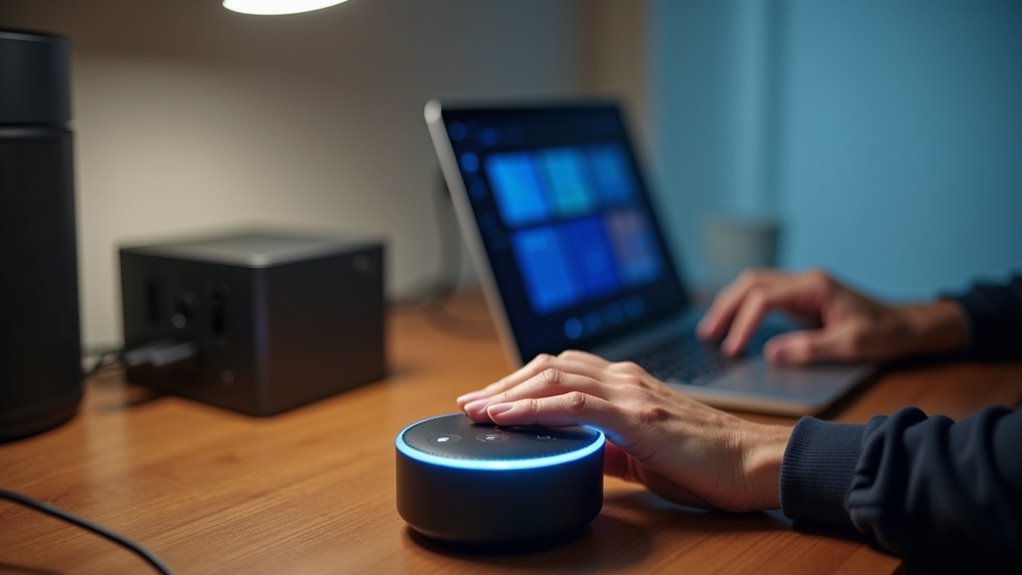
You’re tired of manually controlling your smart home devices through apps and switches, and you’ve decided it’s time to set up voice controls for Home Assistant. While the process might seem challenging at first, transforming your home into a voice-responsive environment is more straightforward than you’d expect. The key lies in understanding which components you’ll need and how they work together, but there’s one vital decision that’ll determine whether your setup succeeds or fails completely.
Prerequisites and System Requirements

Before diving into voice control setup, you’ll need several key components in place. First, verify you have a working Home Assistant installation on supported platforms like Raspberry Pi or x86/x64 computers.
Essential prerequisites include a functional Home Assistant installation running on compatible hardware like Raspberry Pi or x86/x64 systems.
Avoid containerized deployments since they lack access to the add-on store, which is essential for voice functionality.
You’ll need audio hardware for input and output. Standard microphones and speakers work well, or you can use an ESP32-S3 Box for a dedicated solution.
The system requires specific add-ons including Whisper for speech-to-text and Piper for text-to-speech conversion.
Unlike Home Assistant Cloud services, this setup operates entirely offline, using local processing for voice recognition.
This guarantees your voice commands stay private while maintaining reliable functionality without internet dependency.
Installing Whisper and Piper Add-ons
Two essential add-ons power Home Assistant’s voice control system: Whisper handles speech-to-text conversion while Piper manages text-to-speech output.
First, enable Advanced mode in your Home Assistant settings, then navigate to the Add-ons section and click the Add-On Store.
| Step | Whisper | Piper |
|---|---|---|
| Search | Find “Whisper” add-on | Find “Piper” add-on |
| Install | Click install button | Click install button |
| Configure | Enable “Start on boot” and “Watchdog” | Set language preferences |
| Start | Click start button | Click start button |
After installation, configure language preferences for both add-ons to guarantee accurate recognition and responses. Restart Home Assistant to activate changes, then check the Voice assistants section to create your new assistant integrating both Whisper and Piper functionalities.
Configuring Language Settings for Speech Recognition

You’ll need to select the appropriate language model in the Whisper add-on settings to match your primary spoken language.
Consider your regional accent when choosing the language variant, as this affects recognition accuracy for your specific pronunciation patterns.
Guarantee the language you select in Whisper matches what you’ve configured for your Home Assistant voice assistant to facilitate seamless communication.
Language Model Selection
When setting up voice controls for Home Assistant, selecting the appropriate language model for speech recognition directly impacts how accurately your system will understand and process your voice commands.
Your language model selection determines the voice assistant’s ability to interpret speech correctly in your preferred language.
Access the Whisper add-on to configure your language model selection. Choose a model that aligns with your desired language, though you’ll need to verify availability since limited models exist for certain languages.
When adding your voice assistant, specify your language preference—such as Ukrainian—to guarantee precise speech-to-text processing.
After configuring your settings, restart Home Assistant to activate changes.
Consider creating device and room aliases in multiple languages to improve recognition accuracy and enhance user experience across diverse linguistic environments.
Regional Accent Configuration
While selecting your language model provides the foundation for speech recognition, configuring regional accent settings guarantees your voice assistant captures the nuances of how you naturally speak.
You’ll need the Whisper add-on installed and properly configured to access accent-specific language options.
Navigate to your Whisper add-on configuration and specify the language option that matches your regional accent. This Settings adjustment directly impacts recognition accuracy.
Remember that voice recognition quality depends on your CPU load and the specific language model you’ve chosen.
For best results, regularly update your language Settings and keep Home Assistant current.
If you’re using multiple accents or languages, create aliases for devices and rooms. This enhancement improves user experience and ensures your commands are consistently recognized regardless of pronunciation variations.
Setting Up Audio Input and Output Sources
You’ll need to configure your audio hardware to enable voice commands in Home Assistant.
Start by setting up the Assist Microphone add-on with your chosen input and output sources in the Configuration tab.
Focus on selecting high-quality microphones with noise reduction and test different microphone types to find what works best for your specific environment.
Microphone Configuration Setup
Before your voice assistant can respond to commands, you’ll need to properly configure your audio input and output sources through the Assist Microphone add-on.
Navigate to the Configuration tab and select your appropriate Input and Output devices for ideal microphone configuration. Verify your chosen audio sources work seamlessly with Whisper and Piper add-ons for reliable speech-to-text and text-to-speech functionality.
Test different microphone types in your environment. Directional microphones work best in noisy spaces, while omni-directional options capture voice from multiple angles.
After selecting your audio devices, create a voice assistant pipeline to integrate everything together. Remember to regularly update your Assist Microphone add-on and connected devices to maintain peak performance and compatibility with Home Assistant’s evolving features.
Speaker Output Selection
Configuring your speaker output correctly guarantees Home Assistant delivers clear, audible responses to your voice commands.
Navigate to the Assist Microphone add-on and access the Configuration tab to set your Output source to your preferred audio device. You’ll need to select both Input and Output sources for seamless communication.
Consider routing audio output through smart devices like Sonos speakers, but remember these should handle sound responses only, not voice recognition.
Test various audio output configurations to find what delivers maximum clarity and responsiveness in your environment.
Once you’ve configured your sources, restart your Home Assistant server to apply changes and make sure everything functions properly for your voice control setup.
Audio Quality Optimization
Three critical factors determine your Home Assistant voice control’s effectiveness: microphone quality, strategic placement, and proper audio configuration.
You’ll need high-quality microphones for accurate voice recognition, as they considerably impact performance across different environments. Configure the Assist Microphone add-on carefully, setting appropriate input and output sources to enhance your system’s audio processing capabilities.
For large rooms, directional microphones work best since they minimize background noise and improve wake word detection in noisy conditions.
Test various microphone placements strategically, especially considering distances over 50 meters from your Home Assistant server for ideal audio capture without interference.
Regularly assess and update your audio configurations to adapt to changing room acoustics and advancing technology, ensuring consistent voice recognition performance.
Creating Your Voice Assistant Pipeline
The heart of your Home Assistant voice control system lies in creating a well-structured voice assistant pipeline that seamlessly connects speech-to-text, text-to-speech, and wake word detection components.
Navigate to the Voice assistants section and establish a new pipeline integrating these essential elements for your voice commands.
Select the `faster-whisper` add-on for Speech-to-text processing, guaranteeing real-time voice command recognition while configuring it to match your desired language settings.
Use the `Piper` add-on for Text-to-speech functionality, converting processed text responses into audible sound for user interaction.
Implement the `openWakeWord` add-on as your Wake Word Engine, detecting specific phrases that activate your voice assistant.
Confirm all components are properly configured and enabled, including setting Input and Output sources in the Assist Microphone add-on for peak performance.
Enabling Wake Word Detection With Openwakeword

With your voice assistant pipeline components configured, you can now activate OpenWakeWord to enable hands-free voice control throughout your smart home.
Navigate to Home Assistant’s Add-on Store and install the OpenWakeWord add-on. After installation, configure the microphone input settings to guarantee proper audio capture.
OpenWakeWord supports custom wake words, letting you personalize your activation phrase beyond standard options. Choose something distinctive that won’t trigger accidentally during normal conversations.
Position your microphone strategically to capture the wake word from across the room without interference from background noise.
Once configured, OpenWakeWord integrates seamlessly with your existing pipeline. You’ll enjoy complete hands-free voice control for home automation, activating your assistant simply by speaking your chosen wake word.
Test the setup by speaking your phrase and issuing basic commands.
Connecting Physical Voice Devices via Bluetooth
Once you’ve established wake word detection, expanding your voice control setup becomes straightforward by connecting physical Bluetooth devices to Home Assistant.
First, make sure your Home Assistant server has Bluetooth capabilities or pair it with an ESPHome device as a Bluetooth proxy. Power on your voice assistant device and keep it within range during onboarding for successful connection.
Ensure your Home Assistant server supports Bluetooth or use an ESPHome proxy before powering on your voice device nearby.
Enable Bluetooth in Home Assistant’s configuration, then navigate to the Discovered section in your UI to locate available devices.
Add the Bluetooth device integration when it appears. Verify your Bluetooth settings are properly configured so Home Assistant recognizes and communicates with your physical voice devices.
Once connected, you’ll control Home Assistant functions and automations through voice commands via these Bluetooth devices.
Onboarding Home Assistant Voice Preview Edition
Home Assistant Voice Preview Edition offers a streamlined approach to voice control that builds naturally on your existing Bluetooth setup. You’ll need administrative rights and the latest Home Assistant version before starting the onboarding process.
| Step | Requirement | Action |
|---|---|---|
| Preparation | USB-C cable | Connect device to power |
| Network Setup | 2.4 GHz Wi-Fi | Enter SSID credentials |
| Authorization | Center button | Press to confirm connection |
Install the Home Assistant Companion app with Bluetooth and location permissions enabled for mobile onboarding. Access your Home Assistant UI to discover and integrate the voice assistant device. The setup wizard will guide you through connecting to Home Assistant Cloud for simplified configuration, or you can choose the DIY option for manual setup control.
Configuring Mobile Device Integration
The Home Assistant Companion app serves as your primary bridge between mobile devices and your smart home system.
The Companion app transforms your smartphone into a powerful control center for managing your entire smart home ecosystem.
Install the latest version on your iPhone or Android device to begin integration. You’ll need to grant Bluetooth and precise location permissions for seamless onboarding and communication with your server.
Connect your mobile device to the same 2.4 GHz Wi-Fi network as your Home Assistant server. This enables automatic device discovery and proper integration.
Once connected, plug your device into a power source using a USB-C cable, then navigate to the Discovered section in your Home Assistant UI to add the mobile integration.
Finally, set Home Assistant as your digital assistant app in your device settings. This activates voice assistant functionality, allowing you to control your smart home through voice commands.
Testing Voice Commands and Troubleshooting
How do you know if your voice commands are working properly? Start testing voice commands by using the speech bubble icon in your Home Assistant interface after rebooting. Issue commands and verify successful execution through the assistant’s responses.
For effective testing voice commands, confirm your microphone’s correctly configured and positioned to minimize background noise, which greatly affects recognition accuracy. If commands aren’t recognized, check your Home Assistant server’s CPU load, as high usage impacts speech-to-text processing performance.
When troubleshooting issues, verify the Whisper add-on is running and updated—it’s responsible for converting speech to text.
Consult Home Assistant logs for error messages related to voice command processing to identify configuration or add-on problems that need addressing.
Optimizing Performance for Multiple Room Setup
When expanding your voice control system beyond a single room, you’ll need to strategically plan your hardware placement and server capacity to maintain responsive performance.
Use high-quality directional microphones to minimize background noise and guarantee accurate wake word detection from distances exceeding 50 meters. Install multiple microphones in larger rooms to prevent audio interference and handle simultaneous voice inputs effectively.
Position your microphones and speakers strategically to eliminate echo and improve sound response throughout your space.
Your voice assistant requires a robust Home Assistant server capable of processing continuous audio streams from all connected devices simultaneously. Deploy separate microphones in each room for ideal coverage.
Regularly test and adjust configurations for add-ons like Whisper and Piper to maintain high accuracy and responsiveness as system load varies across your multi-room setup.
Frequently Asked Questions
How Do I Set up Voice Control?
First, you’ll install Whisper and Piper add-ons for speech processing. Then configure the Assist Microphone add-on, create a voice assistant pipeline, connect to Wi-Fi, set language preferences, and reboot Home Assistant.
How Do I Set up Voice Assistant?
You’ll install Whisper and Piper add-ons, then configure a new voice assistant in Home Assistant settings with your preferred language. After rebooting, set Home Assistant as your Android phone’s default digital assistant app.
How Do I Add Controls to Home Assistant?
You’ll add controls by steering to Settings, then Devices & Services, and clicking “Add Integration.” Search for your device brand, follow setup instructions, or use auto-discovery to detect compatible devices automatically.
How Can I Make a Voice Assistant at Home?
You’ll need Home Assistant Voice Preview Edition with a compatible server and audio devices. Install Whisper for speech-to-text and Piper for text-to-speech add-ons, then configure the Assist Microphone add-on.