
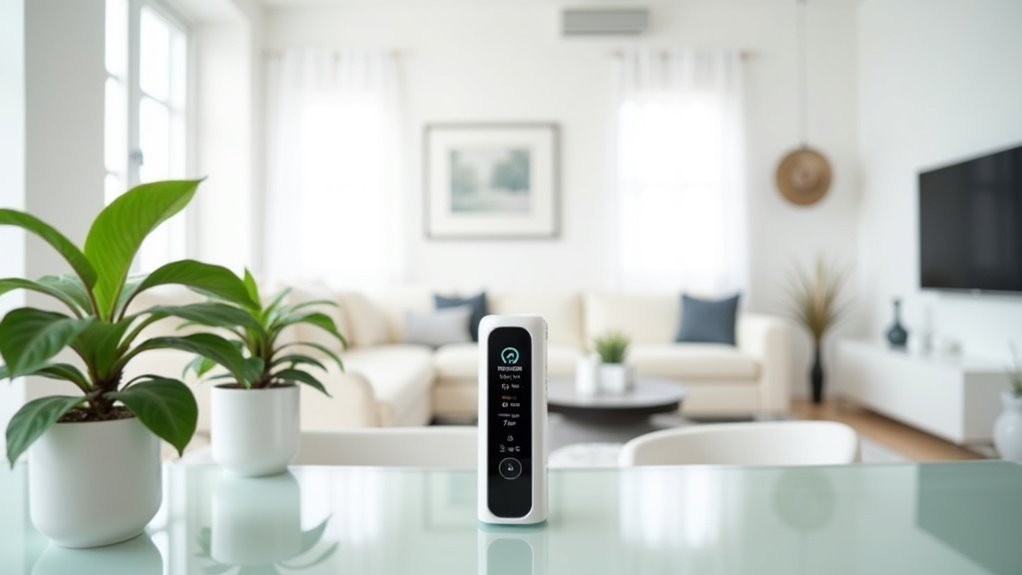
You’re breathing indoor air right now, but do you really know what’s in it? Most people assume their home’s air is clean, yet indoor environments can harbor pollutants two to five times more concentrated than outdoor air. From invisible gases like carbon dioxide and radon to microscopic particles that slip past your notice, your indoor air quality directly impacts your health, sleep, and daily performance. Seven proven monitoring methods can reveal what you can’t see.
Use Dedicated Indoor Air Quality Monitors

While smartphone apps can provide basic air quality estimates, dedicated indoor air quality monitors offer the precision and real-time measurements you need to truly understand your home’s environment.
Models like the Airthings View Plus and SAF Aranet 4 use advanced NDIR sensor technology for accurate CO2 detection, preventing cognitive impairment from elevated levels. These devices also feature VOC sensors while tracking humidity and temperature for thorough environmental assessment.
Most monitors include companion apps that help you analyze air quality trends and receive threshold alerts. This data enables proactive management of indoor air pollution, particularly important for homes with children and elderly residents.
Investing in reliable monitors provides the health impact awareness necessary to address air quality issues and maintain ideal indoor environments.
Install Smart CO2 Sensors for Ventilation Management
You’ll want to leverage NDIR (Non-Dispersive Infrared) technology when selecting smart CO2 sensors, as this proven method delivers the most accurate readings for effective ventilation management.
Set up threshold alerts at 1000 ppm to receive immediate notifications when CO2 levels climb high enough to impact your cognitive function and comfort.
Take advantage of your sensor’s companion app to analyze historical trends and patterns, which will help you optimize your ventilation schedule and identify problem areas in your home.
NDIR Sensor Technology Benefits
Precision defines NDIR (Non-Dispersive Infrared) sensor technology’s greatest advantage for indoor air quality monitoring.
These sensors measure CO2 levels by detecting infrared light absorption, delivering accurate measurements that outperform other sensor types. You’ll benefit from their exceptional seven-year lifespan, which reduces replacement costs and maintenance needs.
Smart CO2 sensors using NDIR technology automatically trigger ventilation management when concentrations exceed 1000 ppm thresholds.
This real-time response guarantees your HVAC system introduces fresh air precisely when needed, maintaining ideal indoor air quality without constant manual adjustments.
You’ll also reduce energy costs through intelligent air quality monitoring.
NDIR sensors enhance your HVAC system’s operation by providing reliable data that prevents unnecessary ventilation cycles, balancing air quality improvements with energy efficiency for cost-effective environmental control.
CO2 Threshold Alert Setup
Setting up CO2 threshold alerts transforms your indoor air quality monitoring from passive observation to active environmental control. You’ll want to configure your CO2 sensors with alerts at 1,000 ppm, indicating when ventilation adjustments become necessary. Smart home devices can automatically respond to these thresholds, optimizing your home’s air quality without manual intervention.
| CO2 Level (ppm) | Alert Action |
|---|---|
| Below 800 | Good air quality |
| 800-1,000 | Monitor air quality |
| 1,000-1,500 | Ventilation needed |
| Above 1,500 | Immediate action |
Modern CO2 sensors provide real-time monitoring through app integrations, sending alerts directly to your smartphone. The SAF Aranet 4 offers trend data spanning a week, helping you identify patterns in your indoor air quality. This historical information enables proactive ventilation management in tightly sealed environments.
App-Based Trend Analysis
Smart CO2 sensors transform raw air quality data into actionable insights through sophisticated app-based trend analysis.
You’ll access detailed monitoring data through companion apps that visualize seven-day historical trends, revealing patterns in your indoor air quality fluctuations.
These smart sensors utilize advanced algorithms to process CO2 levels continuously, enabling you to identify peak concentration periods and ventilation deficiencies.
The app’s trend analysis feature helps you correlate high CO2 readings with specific activities or times, making it easier to optimize your ventilation schedule.
You can configure customized alerts based on your data patterns, ensuring proactive air quality management.
Monitor Particulate Matter With PM2.5 Detectors
When you’re serious about protecting your family’s health, PM2.5 detectors become essential tools for monitoring the most dangerous airborne particles in your home.
These devices specifically measure particulate matter with diameters of 2.5 micrometers or smaller—particles that penetrate deep into your lungs and bloodstream, creating significant health risks including respiratory diseases and cardiovascular issues.
Most PM2.5 detectors use laser scattering technology to deliver real-time readings, letting you track air quality fluctuations throughout the day.
Regular monitoring helps identify pollution sources like cooking, cleaning, and smoking, enabling you to take proactive measures to improve indoor air quality.
The Environmental Protection Agency recommends maintaining PM2.5 levels below 12 µg/m³, making these detectors vital for creating safe indoor environments.
Track Volatile Organic Compounds With VOC Sensors

You’ll want to understand how VOCs affect your health since these invisible chemicals from paints, cleaners, and building materials can cause headaches, dizziness, and respiratory problems.
When you’re selecting a VOC monitor, you need one that can detect low concentrations in the parts per billion range to catch dangerous levels before they impact your well-being.
This becomes especially critical if you’re living in a newly constructed or renovated home where off-gassing materials can push VOC levels beyond safe limits.
VOC Health Impacts
Because volatile organic compounds lurk in everyday household items from paint and cleaning products to furniture and carpeting, you’re likely breathing them in without realizing their potential impact on your health.
VOCs can trigger significant health issues that affect your daily well-being and long-term wellness.
Exposure to these compounds creates three primary health concerns:
- Immediate symptoms – Headaches, nausea, and dizziness from short-term exposure to elevated VOC levels
- Respiratory issues – Worsened asthma symptoms and breathing difficulties, particularly dangerous for sensitive individuals
- Allergic reactions – Skin irritation, eye watering, and throat irritation from ongoing indoor pollution
Continuous monitoring with indoor air quality monitors enables source identification and helps you take corrective action through improved ventilation before serious health complications develop.
Choosing VOC Monitors
Since identifying VOC sources requires precise measurement capabilities, selecting the right monitor becomes essential for protecting your indoor air quality.
You’ll want VOC sensors that deliver accurate readings when detecting volatile organic compounds from household products like paints and cleaners. The Airthings View Plus stands out with its color-coded LED indicator and reliable performance.
Look for monitors offering data logging to track trends over time, threshold alerts for immediate warnings, and mobile apps for convenient monitoring. Regular calibration guarantees your device maintains accuracy, as many budget sensors fail within 6-12 months.
Prioritize monitors with dedicated VOC sensors rather than basic air quality devices, since precise measurement capabilities make the difference between reliable protection and false security when safeguarding your home’s air quality.
Measure Humidity and Temperature Levels
While maintaining good indoor air quality involves multiple factors, humidity and temperature levels form the foundation of a healthy living environment.
You’ll want to keep your humidity levels between 30% and 50% to prevent mold growth and dust mite proliferation while avoiding dry skin and respiratory issues.
Here’s how to effectively monitor these essential factors:
- Use a hygrometer for accurate real-time readings of your indoor moisture levels.
- Install temperature sensors alongside humidity monitors since every 1°C increase allows air to hold 7% more moisture.
- Choose a thorough indoor air quality monitor that tracks both metrics simultaneously, providing valuable data for ventilation and HVAC adjustments.
Modern monitors deliver extensive data that helps you maintain ideal moisture levels and make informed decisions about your home’s air quality.
Implement Radon Detection Systems
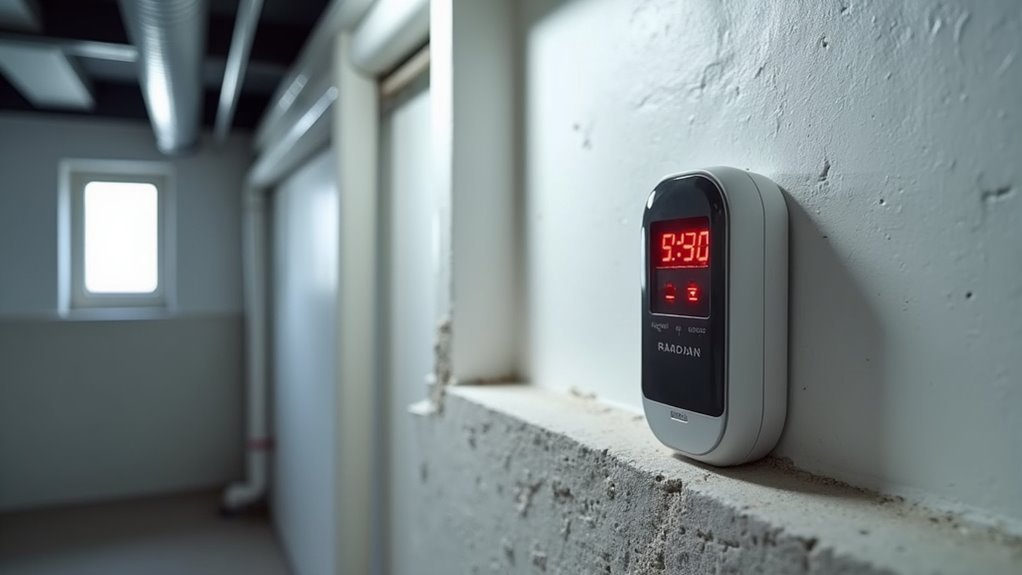
Beyond monitoring visible environmental factors like humidity and temperature, you need to address invisible threats that can seriously impact your health.
Radon detection systems are essential for maintaining ideal indoor air quality since this colorless, odorless gas causes the second-highest lung cancer rates after smoking.
The Environmental Protection Agency recommends keeping radon below 4 pCi/L, requiring immediate mitigation above this threshold.
You can choose between short-term tests for quick results or long-term tests for thorough monitoring.
Passive radon detectors like charcoal canisters offer simple placement options to monitor levels effectively.
Active radon detection systems provide real-time data and instant alerts when thresholds are exceeded, enabling immediate response to protect your family’s health.
Leverage Mobile Apps for Real-Time Air Quality Data
How can you stay informed about air quality conditions that directly affect your indoor environment? Mobile apps provide real-time data that helps you make informed decisions about your home’s air quality.
The EPA’s AirNow app delivers localized readings by searching your zip code, utilizing hundreds of air quality monitors across the US.
Here are three key benefits of using air quality apps:
- Real-time monitoring – Track current pollutant levels and air quality trends in your area
- Automated alerts – Receive notifications when elevated pollutant concentrations could impact your indoor air quality
- Forecasting capabilities – Plan ahead using predictive data to optimize your indoor environment
Apps like AirCare, Airly, and IQAir AirVisual also access AirNow’s extensive database, giving you multiple options for monitoring outdoor conditions that influence your home’s air quality.
Frequently Asked Questions
What Is the Best Way to Measure Indoor Air Quality?
You’ll get the best results using dedicated air quality monitors that track PM2.5, VOCs, and CO2 with NDIR sensors. Choose devices offering real-time readings, trend analysis, and alerts for accurate health assessments.
What Are the Methods of Indoor Air Quality Monitoring?
You can monitor indoor air quality using dedicated devices with sensors that measure PM, VOCs, and CO2. Choose portable monitors for flexibility or smart-connected systems for real-time alerts and historical data tracking.
What Are the Symptoms of Poor Air Quality in a House?
You’ll notice persistent coughing, eye irritation, and respiratory difficulties when air quality’s poor. High humidity creates mold growth, while chemical odors indicate VOCs. Rapid dust accumulation and visible mold signal immediate ventilation problems.
Is an Indoor Air Quality Monitor Worth It?
Yes, you’ll find an indoor air quality monitor worth the investment. It’ll help you detect harmful pollutants, identify ventilation issues, and make informed decisions about your home’s air quality for better health.

Leave a Reply