
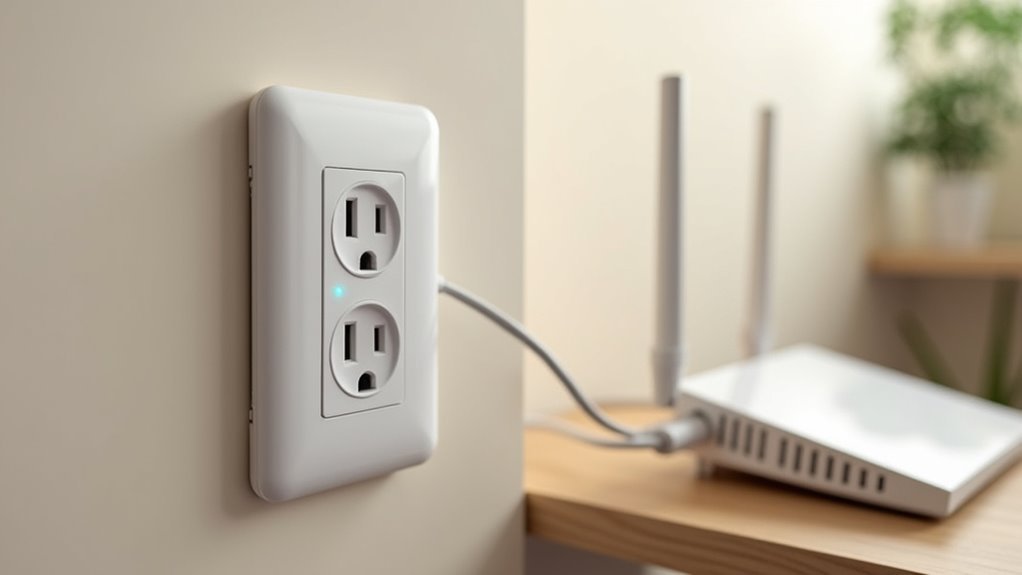
You’ve probably wondered how a simple power outlet can suddenly understand your voice commands and respond to Alexa. The transformation isn’t magic—it’s a combination of specific technologies working together behind the scenes. While you might think it’s just about plugging in a smart device, there’s actually a complex network of components, protocols, and certifications that determine whether your outlet will seamlessly integrate with Amazon’s voice assistant or leave you talking to unresponsive walls.
Understanding Smart Plug Technology and Voice Control Integration

When you’re looking to modernize your home automation setup, Alexa-compatible power outlets represent one of the most accessible entry points into smart home technology.
These Smart Plug devices connect directly to your home’s Wi-Fi connectivity using 2.4 GHz frequency, eliminating the need for additional hubs or complex installations.
Voice control integration with Alexa transforms how you interact with everyday appliances. The Amazon Smart Plug exemplifies this technology’s easy to use design, maintaining a compact form that won’t block adjacent outlets.
Through the dedicated app, you’ll set up routines that automate your devices according to scheduled times, enhancing energy monitoring capabilities.
Smart home ecosystems become more efficient when you assign friendly device names, enabling seamless voice command recognition and remote smartphone control for ultimate convenience.
Wi-Fi Connectivity Requirements for Alexa-Enabled Outlets
Before you install your first Alexa-enabled power outlets, you’ll need to verify your home’s Wi-Fi network meets specific connectivity requirements.
These smart outlets demand a stable connection to function properly with voice commands through the Alexa app.
A reliable Wi-Fi connection ensures your Alexa-enabled outlets respond instantly to every voice command you issue.
Your Wi-Fi connectivity must support these essential specifications:
- 2.4 GHz bands only – These outlets won’t connect to 5 GHz networks
- 802.11 b/g/n standards – Required for reliable integration with Alexa ecosystem
- Strong signal strength – Guarantees consistent performance throughout your home
- Automatic reconnection capability – Allows seamless restoration after power outages
You’ll connect your smart plug to your home Wi-Fi network through the Alexa app during initial setup.
Maintaining strong signal coverage is vital for proper functionality, especially since these devices automatically reconnect after Wi-Fi interruptions.
Essential Hardware Components for Voice Assistant Compatibility

You’ll need specific hardware components to guarantee your smart outlet works seamlessly with Alexa’s voice commands.
The most critical requirement is Wi-Fi connectivity that operates on the 2.4 GHz frequency, providing the stable connection necessary for reliable communication with your voice assistant.
Your outlet must also include built-in microcontrollers that process voice commands and manage the wireless network connection to your home’s Wi-Fi system.
Wi-Fi Connectivity Requirements
Although modern routers broadcast on both 2.4GHz and 5GHz frequencies, Alexa-compatible power outlets exclusively require a 2.4GHz Wi-Fi connection to function properly.
Smart plugs can’t connect to 5GHz networks, making this frequency requirement essential for successful setup.
Your Alexa-compatible power outlets depend on specific wireless standards for reliable connectivity:
- 802.11 b/g/n compatibility – These wireless protocols guarantee seamless communication between your smart plugs and home network.
- Continuous power supply – Smart plugs must stay plugged in to maintain Wi-Fi connectivity and Alexa app functionality.
- Direct network connection – No additional smart home hub needed for voice commands or remote control.
- Mobile app management – The Alexa app handles all setup and configuration across Fire OS, Android, and iOS devices.
This streamlined connectivity approach makes integrating smart plugs into your existing network straightforward.
Built-in Voice Processing
When you install Alexa-compatible power outlets, you’re getting sophisticated voice processing hardware that transforms ordinary electrical connections into intelligent command centers.
These smart outlets contain specialized microcontrollers that handle voice commands directly, eliminating the need for additional hubs. The built-in voice processing capabilities work alongside Wi-Fi connectivity to guarantee seamless communication with Alexa’s cloud services.
You’ll benefit from low power consumption design that delivers quick response times when issuing commands. The dedicated firmware enables precise voice recognition, making your outlets responsive to specific Alexa routines.
Additionally, these intelligent devices maintain automatic reconnection capabilities after power outages, preserving your settings and schedules. This integrated approach makes your power outlets truly Alexa compatible rather than simply connected accessories.
Setup Process for Converting Standard Outlets to Smart Controls
Converting standard outlets to smart controls requires no electrical expertise or special tools—simply insert an Alexa-compatible smart plug directly into your existing wall outlet.
The setup process involves these straightforward steps:
- Download the Alexa app on your Fire OS, Android, or iOS device after plugging in your smart plug.
- Connect directly to your 2.4GHz Wi-Fi network through the app’s guided instructions (5GHz networks aren’t supported).
- Assign a custom name to your smart plug for easy identification and voice commands.
- Configure routines and schedules to automate your smart home devices.
Once configured, you’ll have complete remote control over connected appliances through Alexa-enabled devices.
The smart controls enable voice commands like “Alexa, turn on the coffee maker” and automated routines for lights, fans, or other electronics.
Network Protocol Options: Wi-Fi Vs Zigbee Vs Z-Wave

Since Alexa-compatible smart plugs connect through different network protocols, you’ll need to choose between Wi-Fi, Zigbee, and Z-Wave options based on your specific home automation needs.
Wi-Fi plugs offer the simplest setup since they connect directly to your 2.4GHz network without requiring additional hubs, making them ideal for basic Alexa control.
However, Zigbee and Z-Wave smart devices provide superior network reliability and compatibility with broader smart home ecosystems. These protocols require dedicated hubs but deliver lower power consumption and extended connectivity range.
During internet outages, Zigbee and Z-Wave maintain local control while Wi-Fi connections fail.
Consider your priorities: Wi-Fi for simplicity or Zigbee/Z-Wave for thorough smart home integration.
Safety Certifications and Electrical Specifications for Smart Plugs
Before plugging any smart device into your wall outlets, you’ll want to verify that your Alexa-compatible smart plugs meet essential safety certifications and electrical specifications.
These requirements guarantee your devices operate safely while protecting your home’s electrical system.
Meeting proper safety requirements ensures your smart plugs function reliably while safeguarding your home’s entire electrical infrastructure from potential hazards.
Key safety and electrical specifications to verify include:
- UL safety certifications – Look for these rigorous testing standards that confirm consumer electronics meet fire and electrical safety requirements.
- Fire-resistant materials and surge protection – These features prevent overheating and electrical fires during power fluctuations.
- Electrical specifications – Standard ratings of 120VAC, 60Hz, and 15A maximum output handle typical power consumption safely.
- 2.4GHz Wi-Fi connection compatibility – Required for proper smart home integration, as most smart plugs don’t support 5GHz networks.
Choose compact design models that won’t obstruct adjacent outlets.
Frequently Asked Questions
Do You Need Special Plugs for Alexa?
You don’t need special plugs for Alexa compatibility. Any device with a physical switch that operates within standard electrical specifications will work when connected through Alexa-compatible smart plugs or outlets.
Why Won’t My Smart Plug Work With Alexa?
Your smart plug won’t work with Alexa if it’s not Alexa-compatible, lacks proper Wi-Fi connection, needs app updates, wasn’t set up correctly, or lost connection after power outages.
What Is the Difference Between a Smart Outlet and a Smart Plug?
You’ll install a smart outlet as a permanent hardwired replacement for your existing wall outlet, while you’ll simply plug a smart plug into any standard outlet for portable smart functionality.
How Do Smart Plugs Work With Alexa?
You plug smart plugs into regular outlets, then connect them to your home’s 2.4 GHz Wi-Fi network through the Alexa app. You’ll control connected devices using voice commands without needing additional hubs.

Leave a Reply