

You’ve probably encountered situations where Home Assistant doesn’t support that specific smart device you just bought or can’t integrate with your favorite service’s API. That’s where custom components become your solution – they’re user-created integrations that fill the gaps in Home Assistant’s official offerings. While the platform ships with hundreds of built-in integrations, there’s always something missing that could make your smart home setup truly perfect.
Understanding Custom Components and Their Purpose

While Home Assistant ships with hundreds of built-in integrations, you’ll eventually encounter devices or services that aren’t natively supported. That’s where custom components come into play.
These user-created integrations extend your platform’s functionality beyond what’s available out of the box, giving you personalized automation solutions tailored to your specific needs.
Custom components fill the gaps left by official integrations, allowing you to connect virtually any smart device or web service to your Home Assistant setup.
Whether you’re looking to integrate a niche IoT device, access a specific API, or create unique automation workflows, these community-driven solutions provide the flexibility you need.
They transform Home Assistant from a standard platform into a truly customized smart home hub that works exactly how you want it to.
Essential File Structure and Organization Requirements
Before you can start building your own custom components, you need to understand how to properly organize the files that make up these integrations. Your custom components must live within the `config/custom_components` directory, where each component gets its own subfolder named after the component itself.
Every custom component requires specific essential files to function properly. You’ll need an `__init__.py` file, a `manifest.json` file, and depending on your component’s functionality, additional entity files like `sensor.py`.
Three core files form the foundation of every Home Assistant custom component: __init__.py, manifest.json, and your entity-specific modules.
The `manifest.json` file is particularly critical as it contains your component’s name, version, dependencies, and requirements.
Remember that your folder name must match your component’s name exactly—Home Assistant uses this naming convention to identify components correctly.
After adding any custom component, you’ll need to restart Home Assistant completely.
Installation Methods Through HACS and Manual Setup
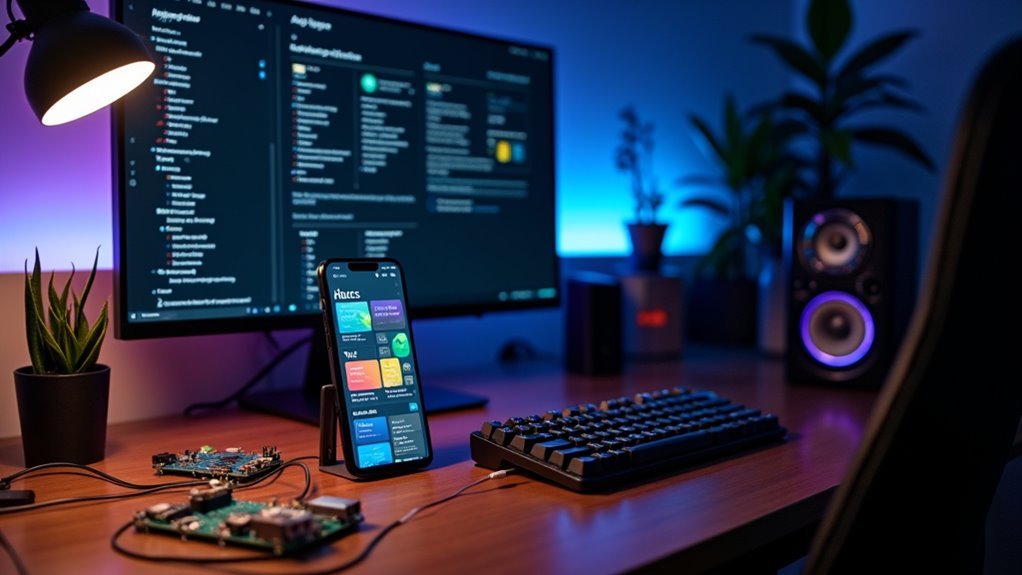
You’ve got two main paths for installing custom components in Home Assistant: using HACS for automated management or handling the installation manually.
HACS streamlines the process by letting you add GitHub repository links directly through its interface, while manual installation requires you to place component files in your `config/custom_components` folder.
Both methods will get your custom components running, but they differ markedly in convenience and update management.
HACS Repository Installation
Two primary methods exist for installing custom components in Home Assistant: through the Home Assistant Community Store (HACS) and manual setup.
HACS repository installation offers the most streamlined approach for integrating Custom Home Assistant components. You’ll need to navigate to HACS within your Home Assistant interface and add the GitHub repository link under the repository section. This method provides seamless integration and automatic updates for your custom components.
Once you’ve added the repository, HACS will handle the download and placement of component files automatically. You’ll still need to restart Home Assistant after installation to load the new component properly.
Always follow the specific installation instructions provided in the component’s GitHub repository, as different components may have unique setup requirements or dependencies that require additional configuration steps.
Manual File Placement
While HACS provides automated installation, manual file placement gives you direct control over the installation process and works well when HACS isn’t available or when you’re working with components not hosted in supported repositories.
To manually install custom components, you’ll place files directly into the `config/custom_components` folder. Verify your folder structure matches these requirements:
| Component Element | Location | Requirement |
|---|---|---|
| Main folder | `custom_components/` | Must match component name |
| Python files | Inside component folder | Include `__init__.py` |
| Manifest | Component root | Required `manifest.json` |
| Dependencies | Component folder | All supporting files |
| Configuration | Home Assistant config | Platform-specific setup |
After placing files in custom_components, restart Home Assistant for recognition. Always validate your configuration post-installation to prevent loading errors or compatibility issues.
Development Environment Setup With Dev Containers
Setting up a development environment for Home Assistant custom components becomes markedly easier when you use dev containers, which provide a consistent and isolated workspace that eliminates the common frustrations of dependency conflicts and version mismatches.
Your Dev Container automatically handles dependency installation and guarantees your environment matches the exact Home Assistant version you’re targeting.
You’ll need three essential files: devcontainer.json for container configuration, configuration.yaml for Home Assistant settings, and launch.json for debugging setup.
These files enable effective breakpoint management and code tracking throughout your development process.
The built-in tools and extensions enhance your coding experience greatly.
Dev containers come equipped with powerful built-in tools and extensions that significantly streamline your Home Assistant development workflow.
Plus, dev containers promote collaboration by creating standardized environments that make troubleshooting issues and implementing feedback much more straightforward when working with other developers.
Creating Your First Basic Integration Component

Once your development environment is ready, you’ll create your first basic integration component by establishing the proper directory structure and vital files that Home Assistant requires.
Start by creating a new folder in `config/custom_components` with your component’s name. Inside this directory, you’ll need three vital files: `__init__.py` for the main component logic, `manifest.json` for metadata configuration, and entries in `configuration.yaml` for setup options.
The manifest file is particularly important for your custom components as it defines the component’s name, version, dependencies, and supported Home Assistant versions. This guarantees proper compatibility and installation.
Once you’ve structured these files correctly according to Home Assistant’s architecture, your basic integration will be ready for initial testing and further development.
Device Registry and Entity Management
When you’re building custom components, understanding how the device registry tracks your devices becomes essential for proper integration management.
The registry automatically bundles entities based on their shared device properties, which determines how your custom devices appear and function within Home Assistant’s interface.
You’ll need to configure these entity properties correctly to guarantee your devices are properly organized and accessible to users.
Device Registry Tracking
While Home Assistant automatically manages device discovery and registration, understanding how the device registry tracks your custom components is essential for creating professional integrations.
The device registry serves as Home Assistant’s central hub for managing all connected devices, organizing multiple entities under single device entries. When you develop custom components, you’ll define entity properties that determine how devices appear and function within the system.
Since Home Assistant doesn’t use separate device classes, your entities must encapsulate all device behaviors and properties. Each device can contain multiple entities—like temperature and humidity sensors grouped together.
You’ll need to properly configure these entity properties to guarantee your custom devices integrate seamlessly, appear correctly in the UI, and provide users with intuitive device management capabilities.
Entity Property Bundling
Since entities define device characteristics rather than separate device classes, you’ll need to master entity property bundling to create cohesive device representations in Home Assistant.
Entity property bundling guarantees related entities group together effectively within the device registry. This approach streamlines device management and enhances user interaction across your custom components.
Key aspects of entity property bundling include:
- Device identification – Assign consistent device identifiers across related entities
- Property coordination – Align entity properties to maintain logical device groupings
- Registry integration – Utilize the device registry to track multi-entity devices properly
- Entity relationships – Define clear connections between entities sharing the same physical device
- Management optimization – Implement bundling strategies that simplify device control and monitoring
Understanding entity property bundling helps you create custom components that integrate seamlessly with Home Assistant’s device management system.
Debugging Techniques and Common Troubleshooting Issues
Debugging custom components becomes much more manageable once you establish a proper development environment and understand the most frequent failure points.
You’ll find that setting up a development container with `devcontainer.json` and `launch.json` files dramatically improves your debugging techniques by enabling breakpoints and real-time code tracking.
When components fail to load, you’ll typically see “integration not found” errors.
Check your `config/custom_components` folder structure first, confirming the folder name matches your component’s intended name exactly. Version compatibility issues often cause these problems.
Always validate your `configuration.yaml` before restarting Home Assistant, as configuration errors prevent proper loading.
Review Home Assistant logs for specific error messages, and verify all dependencies are satisfied to guarantee successful integration.
Community Resources and Documentation Navigation
Beyond troubleshooting your custom components locally, you’ll need reliable sources for learning advanced techniques and staying current with Home Assistant’s evolving architecture. Community resources provide invaluable support for both beginners and experienced developers maneuvering complex integration challenges.
Community resources bridge the gap between local troubleshooting and mastering Home Assistant’s constantly evolving development landscape.
Key community resources include:
- Home Assistant Forums – Official discussion boards with dedicated developer sections
- GitHub Repositories – Extensive code examples and real-world component implementations
- HACS Store – Curated custom components with user reviews and documentation
- Developer Documentation – Technical guides covering device registries and entity properties
- Discord Channels – Real-time community support and development feedback
While documentation traversal can feel overwhelming initially, you’ll find that understanding core concepts like device registries and entity properties becomes easier through consistent community engagement and hands-on practice.
Advanced Features With Dataupdatecoordinator and Config Flows
When you’re ready to build production-grade custom components, implementing DataUpdateCoordinator and Config Flows transforms your integrations from simple scripts into sophisticated, user-friendly solutions.
DataUpdateCoordinator manages API calls efficiently by defining refresh intervals, reducing unnecessary system load while enhancing performance and reliability. This coordinator guarantees your entities update smoothly without overwhelming external sources.
Config Flows create guided setup experiences that dynamically adjust based on user input. You’ll provide built-in validation and error handling during configuration, catching problems early and improving user experience considerably.
When you integrate DataUpdateCoordinator with Config Flows, you’re streamlining data fetching while guaranteeing users can easily configure and manage components. This combination delivers professional-grade integrations that handle errors gracefully, optimize resource usage, and provide intuitive setup processes that rival official Home Assistant components.
Frequently Asked Questions
What Are Custom Components?
You can create custom components as Python-based add-ons that extend Home Assistant’s functionality beyond built-in integrations. They’re installed through HACS or manually, requiring configuration.yaml entries to connect specialized devices and services.
What Are Custom Components in Aem?
You’ll create custom components in AEM by building reusable content blocks using HTL templates, Java servlets, and client libraries. They’re designed through component dialogs, enabling authors to configure content properties and structure pages efficiently.
How Do I Install Custom Add Ons in Home Assistant?
Place the custom add-on folder in your `config/custom_components` directory, then restart Home Assistant. You can also use HACS by adding the GitHub repository link for easier management and installation.
What Are Custom Components in React Native?
You create custom components in React Native to build reusable UI elements that encapsulate specific functionality. They’re JavaScript or TypeScript modules that use React’s state and lifecycle methods for enhanced behavior.



Leave a Reply