
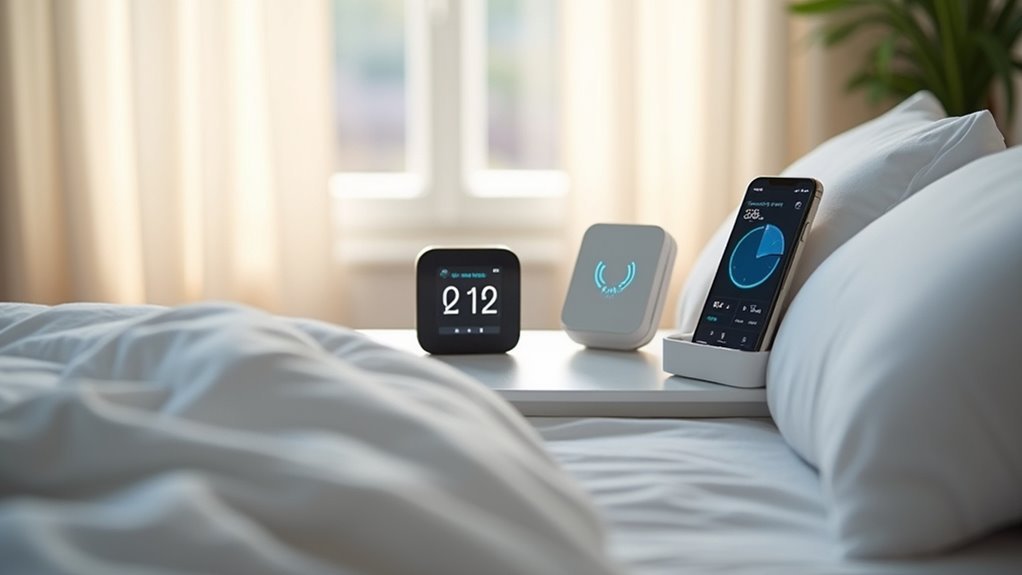
You’re spending roughly eight hours in your bedroom every night, yet you probably know more about your car’s engine temperature than the air you’re breathing while you sleep. Poor air quality, fluctuating temperatures, and excessive humidity can sabotage your rest without you ever realizing it. Your body’s trying to recover and recharge, but these invisible environmental factors might be working against you in ways that’ll surprise you.
The Hidden Environmental Threats Disrupting Your Sleep Quality

Although you might believe your bedroom provides the perfect sanctuary for rest, invisible environmental threats are quietly sabotaging your sleep quality every night.
High carbon dioxide levels above 1000 ppm decrease your sleep quality by 4%, while elevated noise creates a 4.7% drop in sleep efficiency.
When your bedroom temperature exceeds the ideal 60-67°F range, you’ll experience a 3.4% reduction in sleep efficiency.
Poor indoor air quality, particularly PM2.5 exposure, correlates with a 3.2% decline in your sleep effectiveness.
What’s most concerning is that you’re likely unaware of these issues.
People consistently rate their bedroom conditions as “just right,” despite objective measurements revealing harmful air quality and noise levels that systematically undermine restorative sleep.
Air Quality Monitoring: Tracking PM2.5 and Carbon Dioxide Levels
While you sleep soundly through the night, invisible pollutants are actively degrading your rest quality in measurable ways.
Your bedroom’s air quality directly impacts how well you sleep, making monitoring essential for ideal rest.
Poor air quality silently sabotages your sleep quality, making bedroom air monitoring crucial for achieving truly restorative rest.
Two critical pollutants deserve your attention:
- PM2.5 particles reduce sleep efficiency by 3.2% and trigger respiratory issues that disrupt sleep patterns.
- Carbon dioxide levels above 1000 ppm impair cognitive function and decrease sleep quality by 4%.
- Ideal CO2 concentration should remain around 900 ppm to prevent sleep disturbances.
Regular air quality monitoring helps you identify pollution sources before they compromise your sleep.
Temperature Control Systems for Optimal Sleep Efficiency

Your bedroom’s temperature directly impacts your sleep quality, with research showing that even a 1°C increase can reduce sleep efficiency by 0.16%.
You’ll want to maintain temperatures between 60-67°F using your HVAC system, fans, or thermostat adjustments to prevent the 3.4% drop in sleep efficiency linked to overheated rooms.
Smart temperature control systems can automatically regulate your bedroom environment, helping your body’s natural thermoregulation process for faster sleep onset.
Ideal Temperature Ranges
Since your body’s core temperature naturally drops during sleep onset, maintaining your bedroom between 60 and 67 degrees Fahrenheit creates the perfect environment for this essential physiological process.
This temperature range enhances your sleep efficiency by supporting natural thermoregulation.
Research shows that even small deviations from this ideal range can greatly impact your rest quality:
- A 1°C increase in bedroom temperature reduces sleep efficiency by 0.16%
- Extreme temperatures cause restlessness and frequent sleep disruptions
- Stable temperature control prevents uncomfortable night wakings
You’ll want to avoid both overheating and excessive cooling, as either extreme disrupts your sleep patterns.
Smart thermostats can automatically maintain your perfect temperature throughout the night, while proper ventilation ensures consistent air circulation for maximum comfort.
HVAC System Optimization
Beyond setting your thermostat to the ideal range, your HVAC system’s performance directly determines whether you’ll achieve consistent sleep-promoting temperatures throughout the night.
Proper air circulation prevents hot spots and guarantees even temperature distribution across your bedroom. You’ll want to keep CO2 levels below 1000 ppm, as higher concentrations can disrupt sleep quality even when temperatures seem perfect.
Regular maintenance and recalibration prevent those frustrating temperature fluctuations that wake you up. Clean filters and properly functioning components maintain steady airflow and consistent cooling.
Don’t forget seasonal adjustments – your system needs different settings as outdoor conditions change. Proper insulation works alongside your HVAC to minimize temperature swings.
When your system efficiently circulates cool air while maintaining stable conditions, you’re creating the foundation for restorative sleep.
Humidity Sensors and Their Impact on Nighttime Rest
While you mightn’t feel the subtle changes in your bedroom’s moisture levels, humidity sensors reveal how dramatically these fluctuations affect your sleep quality.
Even a 0.1% increase in relative humidity directly correlates to a 0.1% reduction in your sleep quality, making precise monitoring vital for ideal rest.
These sensors help you maintain perfect conditions by tracking three critical factors:
- Relative humidity levels – keeping them between 30% and 50% prevents discomfort and respiratory irritation
- Sleep efficiency patterns – identifying when high humidity causes daytime sleepiness and restlessness
- Air quality changes – detecting moisture-related pollutants that compromise your breathing during sleep
Since you might become habituated to humid environments without realizing their impact, objective humidity monitoring guarantees you’re creating the best possible sleep environment for consistent, restorative rest.
Noise Level Detection and Sleep Performance Correlation
Although your ears may adapt to constant background sounds, noise level detection systems expose the true impact these disturbances have on your sleep performance. High ambient noise levels cause a 4.7% decline in sleep efficiency, clearly linking sound exposure to reduced sleep quality.
Traffic and airplane noise particularly disrupt your sleep patterns, making you more likely to sleep less than seven recommended hours.
You likely misjudge your bedroom’s actual noise levels, making objective measurement essential for identifying sleep disturbances. White and pink noise can counter environmental sounds by masking disruptions, improving your sleep onset.
Monitoring bedroom noise levels helps optimize your sleep environment, as consistent background sounds greatly affect your sleep efficiency and overall well-being.
Building Your DIY Environmental Monitoring Array
You’ll need to carefully select the right sensors for temperature, humidity, CO2, sound, and air quality monitoring to create an effective bedroom environmental array.
Setting up data loggers will enable continuous recording and trend analysis of your sleep environment over time.
Proper calibration and regular maintenance of your monitoring equipment guarantees accurate readings and reliable long-term performance.
Essential Sensor Selection Guide
Building an effective bedroom environmental monitoring array starts with selecting the right combination of sensors that’ll capture extensive data about your sleep environment. You’ll need electronic temperature and humidity meters as your foundation, ensuring they’re calibrated regularly for precise readings.
When sleep efficiency compared across different environmental conditions, accurate monitoring becomes essential.
Your sensor selection should include:
- Data loggers for continuous recording at user-defined intervals, providing thorough analysis capabilities
- Air quality sensors that measure CO2 and particulate matter (PM), since elevated levels directly impact sleep quality
- Snapshot devices paired with continuous monitors for both quick checks and detailed long-term tracking
Consider measurement frequency, accuracy requirements, and building management system compatibility when choosing equipment to optimize your monitoring array’s performance.
Data Logger Setup
Data loggers form the backbone of your DIY monitoring system, capturing continuous environmental readings that reveal how your bedroom’s conditions fluctuate throughout the night.
Select a data logger that records temperature, humidity, CO2, and PM levels at intervals you define. Position it away from direct sunlight and airflow sources to guarantee accurate representation of your bedroom environment’s true conditions.
Calibrate your device quarterly following manufacturer guidelines to maintain precision.
Choose models with easy data downloading capabilities, allowing you to analyze trends and identify environmental factors affecting your sleep quality.
Consider integrating with building management systems for real-time monitoring and automated control. This setup transforms raw environmental data into actionable insights for optimizing your sleep sanctuary.
Calibration and Maintenance
Setting up your monitoring array is only half the battle—maintaining accurate readings requires consistent calibration and upkeep of your sensors. Your devices need regular attention to deliver reliable environmental data for ideal sleep conditions.
Follow these essential maintenance practices:
- Quarterly calibration – Recalibrate digital thermometers and humidity meters every three months according to manufacturer guidelines.
- Account for sensor lag – Remember that some humidity sensors experience 4-5 minute delays when conditions change, so allow time for accurate readings.
- Battery maintenance – Check and replace batteries in psychrometers and electronic meters regularly to prevent measurement drift.
Data loggers require less frequent calibration but benefit from periodic verification. Consider using historical weather data alongside your readings to contextualize unusual variations and verify your calibration efforts are producing meaningful results.
Essential Sensors for Comprehensive Bedroom Analysis
When you’re serious about optimizing your sleep environment, you’ll need the right sensors to measure what matters most.
Temperature sensors maintain ideal conditions between 60-67°F, preventing extreme temperatures from disrupting your sleep quality.
Humidity monitors are critical since each 0.1% humidity increase correlates with a 0.1% decrease in sleep quality.
You’ll want CO2 sensors because levels above 1000 ppm impair cognitive function and reduce sleep quality by 0.29% per 100 ppm increase.
Sound level meters detect ambient noise that can cause a 4.7% decline in sleep efficiency.
Air quality monitors track PM2.5 particles, as high exposure reduces sleep efficiency by 3.2%.
These environmental factors directly impact your sleep quality when left unmonitored.
Data Collection Methods Using Wearable Sleep Trackers
You’ll find that wrist actigraphs offer exceptional accuracy when measuring your movement patterns during sleep, providing reliable data that correlates strongly with traditional polysomnography results.
These devices continuously track essential sleep parameters including total sleep time, sleep efficiency, wake episodes, and sleep stage shifts throughout the night.
You can collect real-time data over extended periods, allowing you to identify patterns between your bedroom’s environmental conditions and corresponding changes in sleep quality metrics.
Wrist Actigraph Accuracy
The precision of wrist actigraphs in sleep monitoring stems from their advanced accelerometer technology, which effectively distinguishes between sleep and wake states through movement detection.
You’ll find these devices provide reliable data that correlates well with both your subjective sleep reports and clinical polysomnography results.
When monitoring how indoor air pollution affects your sleep quality, wrist actigraphs offer several advantages:
- Continuous tracking – They capture sleep pattern variations over extended periods without interruption
- Environmental correlation – They detect how factors like temperature and air quality impact your nightly rest
- Research validation – Studies consistently show their accuracy in measuring sleep duration and efficiency
You can trust wrist actigraphs to eliminate confounding factors by establishing baseline sleep quality measurements, giving you clearer insights into how your bedroom environment truly affects your rest.
Sleep Parameter Tracking
Beyond mere accuracy, wearable sleep trackers generate extensive datasets that transform how you monitor sleep quality in relation to bedroom environmental conditions. These devices continuously collect physiological parameters like heart rate and breathing patterns, creating detailed profiles of your sleep outcomes.
You’ll gain objective measurements of sleep efficiency, wake episodes, and sleep stages over extended periods, replacing unreliable subjective assessments.
The real power emerges when you correlate this sleep data with environmental factors such as temperature and carbon dioxide levels. Statistical analysis reveals significant associations between your sleep quality and bedroom conditions, identifying patterns you’d otherwise miss.
This continuous tracking approach provides actionable insights for targeted interventions, enabling you to optimize your sleep environment based on concrete data rather than guesswork.
Real-Time Data Collection
While traditional sleep studies confine you to artificial laboratory settings, wearable sleep trackers revolutionize data collection by capturing real-time physiological measurements in your natural bedroom environment.
These devices continuously monitor your sleep patterns throughout multiple nights, establishing clear correlations between environmental factors and your sleep quality.
Your wearable tracker provides extensive data including:
- Sleep duration and wake frequency measurements
- REM and deep sleep stage identification
- Sleep efficiency calculations based on environmental conditions
This continuous monitoring reveals how temperature, humidity, and CO2 levels directly impact your rest quality.
You’ll discover objective patterns that often contradict your subjective sleep perceptions, providing valuable insights for optimizing your bedroom environment and improving overall sleep performance.
Interpreting Environmental Data for Sleep Optimization
Since environmental data collection means nothing without proper interpretation, you’ll need to understand how each metric directly impacts your sleep quality to make meaningful improvements. When levels of carbon dioxide exceed 900 ppm, you’ll experience a 0.29% decline in sleep quality for every 100 ppm increase. Similarly, relative humidity affects your rest, with each 1% increase reducing sleep quality by 0.1%.
| Environmental Factor | Impact on Sleep Quality |
|---|---|
| Temperature (+1°C) | 0.16% efficiency decrease |
| High Noise Levels | 4.7% efficiency decline |
| PM2.5 Pollutants | 3.2% efficiency reduction |
You can optimize your bedroom by maintaining CO2 below 900 ppm, keeping temperatures between 60-67°F, controlling humidity levels, implementing soundproofing measures, and ensuring proper air filtration to minimize pollutants.
Cost-Effective Solutions for Bedroom Air Quality Improvement
Understanding these environmental impacts allows you to implement targeted improvements without breaking the bank.
You don’t need expensive equipment to enhance your bedroom’s air quality and achieve high-quality sleep.
Start with these simple strategies:
- Open your bedroom door – This basic step prevents CO2 buildup that can decrease sleep quality by 4%
- Maintain ideal temperature – Keep your room between 60-67°F to avoid the 0.16% sleep efficiency loss per degree increase
- Add an air purifier – Remove PM2.5 particles that cause a 3.2% reduction in sleep efficiency
These cost-effective solutions address the primary air quality issues affecting your sleep.
You’ll notice improved rest quality without major renovations or significant financial investment in your bedroom environment.
Smart Home Integration for Automated Environmental Control
You can transform your bedroom into a precisely controlled environment by integrating smart home systems that automatically manage temperature and air quality.
Smart thermostats will maintain your ideal sleep temperature of 60-67°F throughout the night, while automated air quality monitors trigger purifiers when CO2 levels exceed 1000 ppm.
These systems work together seamlessly, making real-time adjustments without any intervention from you.
Automated Temperature Control Systems
While traditional thermostats require manual adjustments throughout the night, automated temperature control systems revolutionize your sleep environment by maintaining the ideal 60 to 67-degree range without any intervention on your part.
These smart systems learn your habits and enhance your bedroom temperature for both comfort and energy efficiency.
You’ll benefit from several key features:
- Adaptive learning – Systems analyze your patterns to automatically adjust settings, reducing energy consumption by 10-15%
- Weather responsiveness – External temperature changes trigger internal adjustments to maintain consistent conditions
- Air quality monitoring – Advanced systems track humidity and send alerts when your environment becomes unfavorable for sleep
Remote scheduling capabilities let you customize temperature settings that align with your sleep cycles, ensuring peak rest while maximizing energy savings.
Real-Time Air Quality Monitoring
Real-time air quality monitoring systems extend beyond temperature control to track the invisible factors that greatly impact your sleep quality.
These systems continuously monitor carbon dioxide levels, alerting you when concentrations exceed 1000 ppm—a threshold linked to impaired decision-making and declining sleep quality. For every 100 ppm increase, your sleep quality drops by 4%.
Smart monitors also track particulate matter (PM2.5) and volatile organic compounds, as high PM2.5 exposure reduces sleep efficiency by 3.2%.
When high levels of carbon dioxide or other pollutants are detected, automated ventilation systems adjust airflow accordingly.
Additionally, these systems monitor environmental noise, providing alerts when ambient sound threatens your rest—excessive noise can decrease sleep efficiency by 4.7%, enabling timely environmental adjustments.
Real-Time Alerts and Threshold Settings for Sleep Disruption
Although maintaining ideal bedroom conditions requires constant vigilance, smart monitoring systems can automatically track key environmental factors and send instant notifications when they drift outside sleep-friendly ranges.
You can configure threshold alerts for multiple environmental parameters that directly impact your rest:
- Carbon dioxide levels – Receive notifications when CO2 exceeds 1000 ppm, preventing the reduced sleep quality and impaired decision-making associated with poor air circulation.
- Temperature fluctuations – Get alerted when your bedroom rises above the ideal 60-67°F range to prevent discomfort-induced sleep disruption.
- Humidity changes – Monitor alerts for rising relative humidity, since even a 0.1% increase correlates with decreased sleep quality.
Setting appropriate noise levels thresholds helps maintain your sleep sanctuary, as excessive sound can cause a 4.7% decline in sleep efficiency.
Long-Term Health Benefits of Environmental Sleep Monitoring
Beyond immediate comfort improvements, consistent environmental sleep monitoring creates measurable health advantages that compound over months and years.
Your sleep environment directly impacts cognitive function and physical health through important factors like air quality and temperature control. When you maintain CO2 levels below 1000 ppm, you’re preventing the 4% sleep quality decline that higher concentrations cause.
Maintaining optimal CO2 levels below 1000 ppm prevents a measurable 4% decline in sleep quality from poor air circulation.
Similarly, keeping your bedroom between 60-67°F protects against the 0.16% efficiency loss per degree increase.
Long-term monitoring helps you identify patterns in PM2.5 exposure and noise levels that reduce sleep efficiency by 3.2% and 4.7% respectively.
These improvements accumulate, reducing your risk of sleep-related health issues while enhancing overall well-being and quality of life over time.
Troubleshooting Common Issues With DIY Sensor Networks
While DIY sensor networks offer cost-effective environmental monitoring, you’ll encounter specific challenges that can compromise data accuracy and system reliability. Understanding these common issues helps you maintain effective bedroom environment tracking.
Key troubleshooting areas include:
- Sensor placement and calibration – Position sensors strategically since environmental factors vary greatly within rooms, and regularly calibrate humidity and temperature devices that may have 4-5 minute time-lags during condition changes.
- Data accuracy verification – Cross-reference subjective assessments with objective sensor data, as people often misrepresent humidity, temperature, and noise levels affecting their sleep quality.
- System compatibility – Confirm sensors integrate properly with existing building management systems while considering required monitoring frequency and accuracy standards.
Regular maintenance prevents measurement errors that could undermine your environmental monitoring efforts.
Frequently Asked Questions
Why Is It Important to Evaluate Environmental Factors?
You’ll improve your sleep quality by tracking temperature, humidity, air quality, and noise levels. These factors directly impact your sleep efficiency, and you can’t rely on subjective feelings to accurately assess your bedroom’s conditions.
What Are the Environmental Factors Affecting Sleep?
You’ll encounter several environmental factors that affect your sleep: carbon dioxide levels, ambient noise, bedroom temperature, particulate matter exposure, and relative humidity. Each factor greatly impacts your sleep quality and efficiency.
Why Are Environmental Factors Important?
Environmental factors directly impact your sleep quality and cognitive function. You’ll experience measurable declines in sleep efficiency from noise, poor air quality, elevated CO2, and temperature fluctuations, affecting your overall health and daily performance.
What Is the Best Bedroom Environment?
You’ll sleep best when your bedroom’s between 60-67°F with 30-50% humidity. Keep CO2 below 1000 ppm, minimize noise, and maintain clean air free from particulates and VOCs for ideal rest.


Leave a Reply