
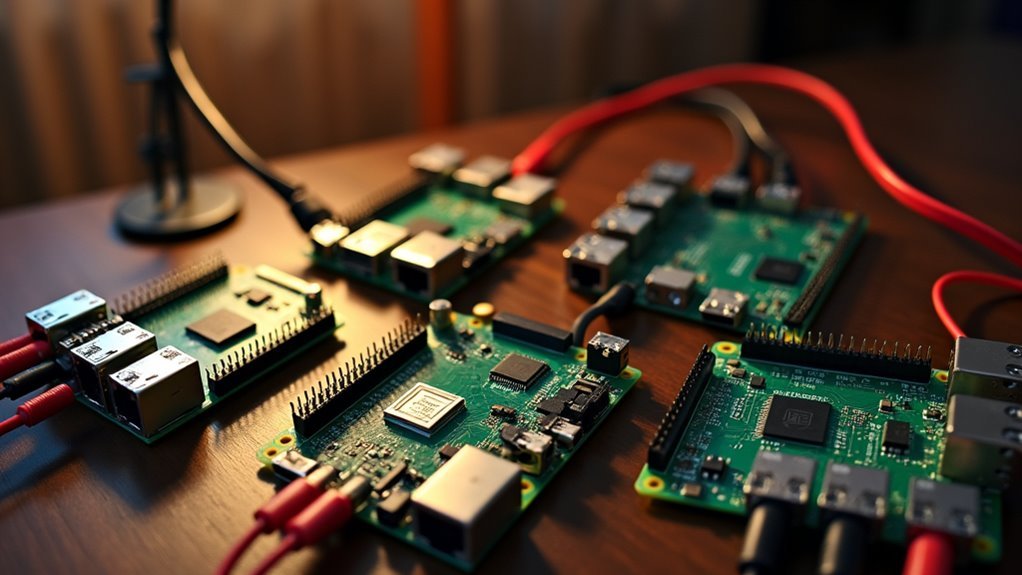
You’ve probably considered upgrading your home with smart technology, but commercial solutions can be expensive and limiting. That’s where Raspberry Pi projects shine – they’re cost-effective, customizable, and surprisingly powerful. Whether you’re looking to enhance security, automate daily tasks, or monitor energy usage, these five innovative projects will transform your living space into an intelligent ecosystem that responds to your specific needs and preferences.
Smart Security Camera System With Facial Recognition

One of the most practical Raspberry Pi projects you can build is a smart security camera system with facial recognition that’ll automatically identify family members while alerting you when strangers appear at your door.
You’ll need your Raspberry Pi, a USB-powered webcam, and machine learning tools to implement effective facial recognition algorithms. Start by creating a dataset with captured images of known individuals, which trains your model for accurate identification.
Integration with Home Assistant enables powerful automation features, like sending smartphone alerts when the system detects unknown faces or triggering alarms.
This smart security system offers extensive customization options, allowing you to add multiple cameras and integrate with other smart home devices for thorough protection.
Automated Pet Feeder With Machine Learning
Moving from securing your home to caring for your furry family members, an automated pet feeder with machine learning transforms how you manage your pet’s meal schedule while you’re away from home.
Your Raspberry Pi system uses a camera and AI-powered image processing to detect when your pet approaches the feeding area. You’ll need to configure the setup through the Viam app, collecting photos of your pet to train the machine learning model for accurate recognition.
Training your pet’s feeding system requires collecting multiple photos through the Viam app to ensure accurate AI recognition and detection.
Once configured, the motor automatically dispenses food when your pet’s detected, creating a personalized feeding schedule you can adjust remotely.
This smart device seamlessly integrates with your existing home security network, combining robotics education with practical pet care solutions.
Voice-Controlled Home Assistant Robot

While automated feeders handle your pet’s needs, a voice-controlled home assistant robot elevates your smart home by combining mobility with hands-free interaction.
You’ll build this Raspberry Pi-powered companion using a rover base, voice recognition software, and strategic sensor placement. Ultrasonic sensors prevent collisions while cameras enable navigation throughout your house.
Programming with Python gives you complete customization control over your robot’s capabilities. You can command it to deliver items, patrol rooms, or integrate with existing home automation systems through platforms like Home Assistant for seamless DIY smart device coordination.
Transform your daily routine:
- Never leave your couch – summon items from across the house with simple voice commands
- Impress guests with your futuristic robotic butler responding to every request
- Experience pride knowing you built this advanced integration yourself using online tutorials
Climate Control and Energy Monitoring Hub
A home assistant robot handles tasks across rooms, but your Raspberry Pi can tackle an even bigger challenge: enhancing your entire home’s climate control and energy consumption.
Transform your Pi into a thorough monitoring hub by integrating temperature, humidity, and air quality sensors. You’ll track real-time environmental data and automate HVAC adjustments accordingly.
Install Home Assistant software to create intelligent automations based on occupancy and schedules, maximizing energy efficiency. Connect smart thermostats for remote monitoring through mobile apps, receiving performance alerts instantly.
Smart plugs and energy monitoring sensors reveal power consumption patterns across all devices.
The real game-changer? Implement machine learning algorithms that analyze historical data to predict future energy needs, considerably reducing costs while maintaining ideal comfort levels throughout your home.
Intelligent Lighting Automation Network

Everything changes when you transform your home’s lighting into an intelligent network that responds to your daily rhythms.
Your Raspberry Pi becomes the central hub, connecting smart bulbs and switches through Zigbee or Wi-Fi protocols. Home Assistant enables sophisticated automation rules that adjust brightness at sunrise, dim lights for movie nights, or activate hallway illumination when motion sensors detect movement.
This smart system delivers remarkable energy efficiency while offering unprecedented convenience.
You’ll control everything remotely through mobile apps or voice commands with Google Assistant and Amazon Alexa integration.
Transform your lighting experience with these powerful features:
- Never stumble in darkness again – Motion-triggered lights guide you safely through hallways and bathrooms
- Come home to perfect ambiance – Automated schedules create welcoming environments before you arrive
- Slash energy bills effortlessly – Intelligent automation prevents wasteful lighting habits
Frequently Asked Questions
What Can I Do With a Raspberry Pi at Home?
You can transform your Raspberry Pi into a smart home hub, build DIY security cameras with facial recognition, create automated lighting systems, set up voice-controlled assistants, and monitor your home’s energy consumption efficiently.
Is Raspberry Pi Powerful Enough for Home Assistant?
Yes, you’ll find the Raspberry Pi 4 powerful enough for Home Assistant. It’s quad-core CPU and up to 8GB RAM handle multiple integrations and automations smoothly, making it perfect for your smart home needs.
Is Raspberry Pi Good for AI Projects?
You’ll find Raspberry Pi excellent for AI projects since it supports TensorFlow and PyTorch frameworks. You can build image recognition systems, natural language processing applications, and real-time AI solutions efficiently with its powerful hardware capabilities.
Which Raspberry Pi Is Best for Iot?
You’ll find the Raspberry Pi 4 works best for complex IoT projects needing processing power, while the Pi Zero W’s perfect for simple, space-constrained applications with its built-in connectivity.



Leave a Reply