
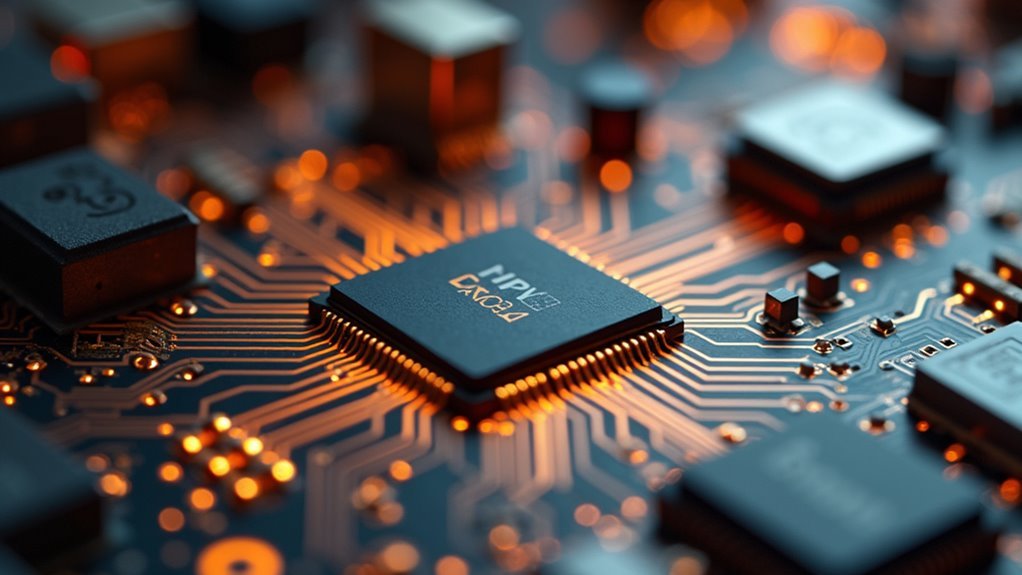
You’re probably wondering why audio enthusiasts and DIY creators consistently choose ESP32 microcontrollers for their multi-room audio projects. While there’s no shortage of options in today’s market, the ESP32 stands out for reasons that go beyond its impressive specifications sheet. It’s not just about the dual-core processing power or built-in connectivity features—there’s something more compelling that makes this tiny board the backbone of sophisticated audio systems.
Understanding ESP32 Audio Capabilities
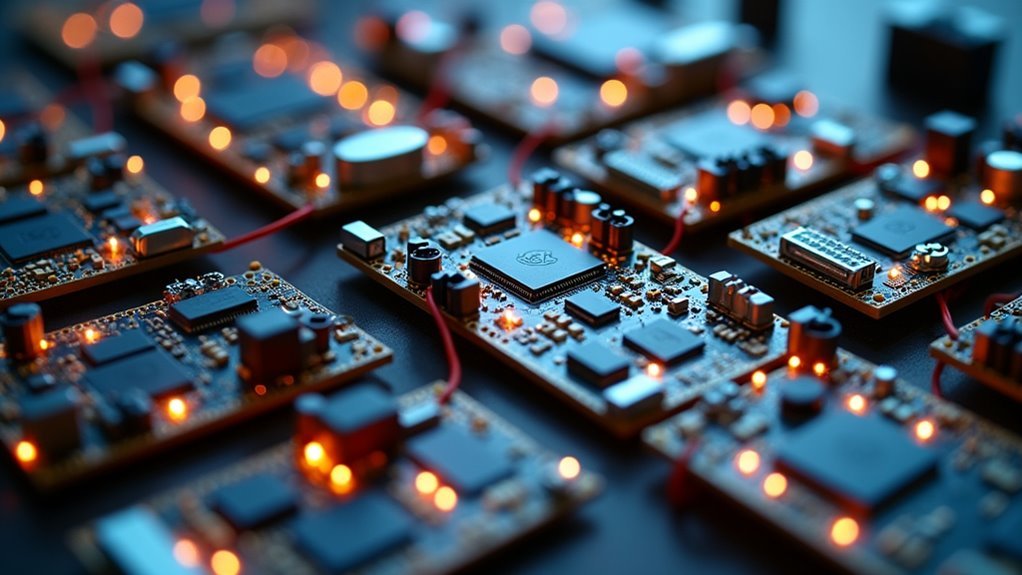
The ESP32’s dual-core architecture and generous memory allocation enable it to tackle demanding audio processing tasks that would overwhelm simpler microcontrollers.
You’ll find this audio development board excels at decoding multiple audio formats simultaneously while maintaining smooth wireless connectivity.
The ESP32-A1S variant takes things further with integrated audio codecs and built-in microphones, perfect for voice-activated controls in your multi-room setup.
The ESP32-A1S elevates your audio projects with integrated codecs and microphones, enabling sophisticated voice control across your entire multi-room system.
What sets this platform apart is its I2S interface support, delivering high-quality audio input and output essential for synchronized playback across multiple speakers.
You’re getting professional-grade audio capabilities without the premium price tag.
At around $15 per board, you can prototype and scale your multi-room audio solution affordably while leveraging built-in Wi-Fi and Bluetooth for seamless device communication.
Built-in Wi-Fi and Bluetooth Connectivity Advantages
Seamless connectivity transforms the ESP32 into a wireless audio powerhouse that eliminates the cable clutter plaguing traditional multi-room setups.
You’ll benefit from dual connectivity options that streamline your entire audio network without purchasing additional hardware.
The built-in wi-fi connects directly to your home network, giving you instant access to online music services and media servers like Logitech Media Server.
You can synchronize playback across multiple rooms effortlessly while maintaining crystal-clear audio quality.
Bluetooth connectivity adds remarkable versatility to your system.
You’ll pair headphones, speakers, and mobile devices instantly, creating flexible audio routing throughout your home.
This dual-technology approach lets you control individual room volumes while managing simultaneous multi-room playback from one centralized system, delivering cost-effective scalability for any smart home environment.
I2S Interface for High-Quality Audio Output

You’ll find the ESP32’s I2S interface delivers exceptional audio quality by transmitting digital audio data with minimal latency and distortion.
The protocol supports multiple audio formats and sample rates, letting you connect high-fidelity DACs directly for superior sound reproduction across your multi-room system.
This built-in capability guarantees you can achieve professional-grade audio output while maintaining perfect synchronization between rooms.
I2S Protocol Benefits
When building multi-room audio systems, you’ll find that ESP32’s built-in I2S (Inter-IC Sound) protocol delivers exceptional advantages for high-quality audio transmission.
This specialized digital interface transforms your audio streaming capabilities by eliminating the complexity and costs associated with additional hardware components.
The I2S protocol provides four key benefits for multi-room audio applications:
- Direct connectivity – Connect external DACs without requiring extra hardware components
- Multiple format support – Handle various audio formats and sample rates for high-fidelity playback
- Real-time transmission – Achieve low latency for synchronized playback across different rooms
- Advanced processing – Implement DSP techniques and filtering to enhance your overall audio experience
You’ll appreciate how I2S simplifies your development process while maintaining the audio quality essential for professional multi-room installations.
Audio Quality Advantages
While analog audio connections often introduce unwanted noise and signal degradation, ESP32’s I2S interface delivers pristine digital audio output that maintains your source material’s original fidelity.
You’ll experience superior audio quality through direct digital connections to external DACs, eliminating the interference common with traditional analog outputs.
The ESP32’s dual-core architecture guarantees smooth audio streaming across multiple rooms without compromising sound integrity.
You can process lossless audio formats, preserving every detail of your music throughout your multi-room setup.
When you pair ESP32 boards like the ESP32-A1S with dedicated audio codecs, you’ll access advanced signal processing capabilities that further enhance clarity.
Cost-Effective Multi-Room Audio Solutions
Although commercial multi-room audio systems can cost thousands of dollars, ESP32-based solutions offer a remarkably affordable alternative that doesn’t compromise on functionality.
You’ll find ESP32 development boards like the ESP32-A1S priced around $15 per unit, making them incredibly budget-friendly compared to expensive Sonos speakers.
Here’s how you can build cost-effective multi-room audio:
- Hardware savings: ESP32 boards eliminate costly proprietary systems while providing robust performance.
- No licensing fees: Open-source software integration with Logitech Media Server keeps costs minimal.
- Wireless flexibility: Wi-Fi and Bluetooth connectivity removes expensive wiring requirements.
- Scalable investment: Start small and expand your system gradually as your budget allows.
You’ll create synchronized playback across multiple rooms without breaking the bank, making professional-grade audio accessible to DIY enthusiasts.
ESP32-A1S Development Board Features
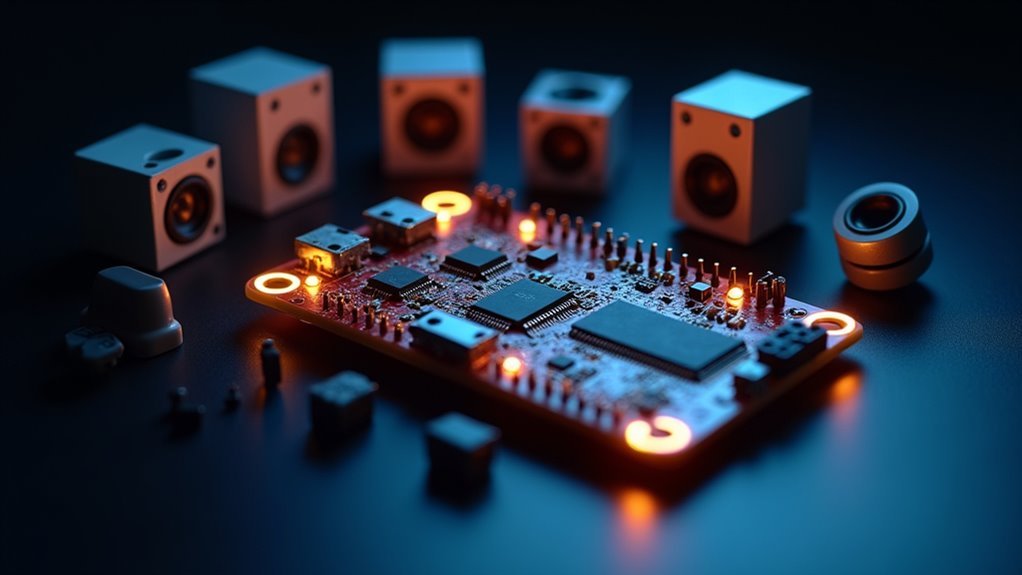
The ESP32-A1S development board stands out as a specialized audio solution that transforms your multi-room setup with its extensive feature set.
You’ll benefit from built-in Wi-Fi and Bluetooth capabilities that enable seamless connectivity across all rooms. The board supports multiple audio formats and includes integrated codecs, making your audio system versatile for various music streaming needs.
Built-in Wi-Fi and Bluetooth deliver seamless room-to-room connectivity while integrated codecs support multiple audio formats for versatile streaming.
You’ll appreciate the multiple outputs, particularly I2S, which delivers high-quality audio essential for synchronized playback throughout your home.
At approximately $15, you’re getting exceptional value without sacrificing performance. The built-in microphones add voice control functionality, enhancing your interaction with the audio system.
These features collectively make the ESP32-A1S an ideal foundation for creating sophisticated multi-room audio experiences.
Logitech Media Server Integration
You’ll find that setting up your ESP32-A1S as a client for Logitech Media Server creates a powerful foundation for your multi-room audio system.
The integration process involves configuring your board to communicate with LMS, enabling it to receive and decode audio streams from various sources like Deezer and TuneIn.
Once connected, you’ll experience the key advantage of synchronized playback, where multiple ESP32 devices can play the same audio content simultaneously across different rooms without noticeable delays.
ESP32-A1S Client Setup
When configuring your ESP32-A1S board as a Logitech Media Server client, you’re leveraging a purpose-built audio platform that streamlines multi-room integration.
The ESP32-A1S eliminates complex setup procedures through its dedicated audio architecture and built-in microphones.
Setting up your ESP32-A1S client involves these essential steps:
- Firmware Installation – Flash the LMS-compatible firmware onto your ESP32-A1S for immediate server recognition.
- Network Configuration – Connect your board to your wireless network and configure server discovery settings.
- Audio Format Setup – Configure supported codecs to guarantee peak playbook quality across all connected rooms.
- Service Integration – Link media services like Deezer and TuneIn directly through the LMS interface.
This $15 solution transforms any existing speaker into a synchronized smart audio device within minutes.
Synchronized Playback Benefits
Once you’ve configured your ESP32-A1S clients through LMS, you’ll experience true multi-room synchronization that transforms how you consume audio content throughout your home.
The real-time synchronized playback guarantees music flows seamlessly from room to room without any lag or audio delays between devices.
You’ll access diverse content through LMS plugins like Deezer, TuneIn, and BBC while maintaining perfect harmony across all connected ESP32 speakers.
Whether you’re hosting a party or simply moving throughout your house, the synchronized playback creates an immersive audio environment that follows you naturally.
At just $15 per chipset, you’ll achieve professional-grade multi-room audio without breaking the budget.
The ESP32’s flexibility allows easy customization for different room configurations while LMS handles the complex synchronization protocols behind the scenes.
Synchronized Audio Playback Across Devices
While building a multi-room audio system might seem complex, the ESP32-A1S development board’s built-in audio processing capabilities make synchronized playback across multiple devices surprisingly straightforward.
ESP32-A1S development boards transform complex multi-room audio synchronization into a straightforward DIY project with built-in processing capabilities.
You’ll achieve seamless synchronized audio playback through these key advantages:
- Real-time synchronization – The ESP32’s dual-core processing power handles multiple audio streams simultaneously, eliminating lag between rooms.
- Network coordination – Logitech Media Server orchestrates playback timing across all connected ESP32-A1S clients.
- Streaming service integration – Plugins for Deezer and TuneIn deliver consistent content to every device.
- Cost-effective scaling – At just $15 per module, you can expand your synchronized speaker network affordably.
This combination guarantees you’ll hear the same music playing at exactly the same moment throughout your home, creating a truly immersive multi-room experience.
Hardware Setup and Configuration
Before you can enjoy synchronized audio throughout your home, you’ll need to gather the essential hardware components and configure each ESP32-A1S board properly.
Start with the ESP32-A1S development board itself, priced at approximately $15 per unit, making it budget-friendly for DIY projects. You’ll connect external DACs via the I2S interface to achieve high-quality audio output essential for crisp sound reproduction.
Configure each board’s Wi-Fi settings to connect seamlessly to your home network. The dual-core architecture efficiently manages audio streams while maintaining stable connections.
Set up multiple ESP32 units as Logitech Media Server clients, enabling coordinated playback across rooms. This home automation approach transforms your living space into an integrated audio environment, leveraging the board’s built-in microphones and outputs for thorough sound control.
3D Printed Case Design for Protection
After assembling your ESP32-A1S audio setup, you’ll want to protect these valuable components from environmental hazards and physical damage. A custom 3D printed case offers the perfect solution, combining functionality with cost-effectiveness.
The case design process involves several key considerations:
- Precise measurements using Fusion 360 guarantee a tailored fit for your development board’s dimensions and ports.
- Strategic material thickness allows essential features like power lights to shine through thin plastic sections.
- Environmental suitability makes the case ideal for wet locations such as kitchens where audio systems often reside.
- Open-source availability through GitHub STL and Fusion 360 files promotes community collaboration and easy replication.
3D printing technology enables customization while maintaining durability, making it perfect for hobbyists seeking enhanced protection for their multi-room audio projects.
User Interface Customization Options
How can you transform your ESP32 multi-room audio system into an intuitive, personalized control experience? The answer lies in leveraging user interface customization options through Logitech Media Server (LMS).
You’ll find the Material Skin stands out as the most user-friendly and visually appealing option for controlling your multi-room setup.
You can enhance your experience by installing the Squeezer Android app, which provides convenient remote control without relying on web interfaces.
LMS allows you to customize the UI by defining favorites and streamlining access to preferred audio sources, making navigation more intuitive.
Experimenting with different interfaces gives you flexibility to tailor the control experience to your specific preferences.
Community documentation and feedback help maximize your system’s effectiveness and satisfaction.
Raspberry Pi Vs ESP32 Comparison
When choosing the right platform for your multi-room audio system, you’ll face a critical decision between ESP32 and Raspberry Pi boards.
While Raspberry Pi offers computing power, ESP32 delivers superior advantages for audio applications:
- Wireless Connectivity: ESP32 includes integrated Wi-Fi and Bluetooth, eliminating the need for external dongles that Raspberry Pi typically requires.
- Audio-Specific Design: ESP32 boards feature built-in audio processing capabilities, while Raspberry Pi generally needs additional DACs for quality audio output.
- Portability: ESP32’s compact size and lower power consumption make it ideal for embedded installations compared to Raspberry Pi’s larger footprint.
- Cost Efficiency: At around $15 per board versus Raspberry Pi’s $35-$55 range, ESP32 offers better value for multi-room deployments.
ESP32’s dual-core architecture efficiently handles multitasking without the resource limitations you’d encounter with Raspberry Pi.
Power Requirements and Amplification
You’ll need to contemplate the ESP32’s modest power consumption alongside your amplification requirements when designing a multi-room audio system.
The ESP32-A1S board’s built-in DAC can drive speakers directly for smaller setups, but you’ll want dedicated amplifiers like the HiFiBerry Amp4 for larger rooms requiring up to 60 watts per channel.
Your power supply options remain flexible, allowing you to use USB sources or wall adapters depending on your specific configuration needs.
ESP32 Power Consumption
While the ESP32’s impressive power efficiency makes it an ideal choice for multi-room audio systems, understanding its consumption patterns will help you optimize your setup for both performance and longevity.
The ESP32’s power consumption varies markedly based on operational mode:
- Deep sleep mode: Consumes only 160µA, perfect for standby operations between audio sessions.
- Active streaming: Draws approximately 160mA when fully operational with Wi-Fi and audio processing.
- Voltage requirements: Operates efficiently within 2.2V to 3.6V range, compatible with various power sources.
- Adaptive management: Built-in power management features automatically reduce consumption during idle periods.
You’ll find this consumption profile particularly beneficial for battery-powered installations.
The dramatic difference between active and sleep modes means you can achieve extended playback times while maintaining instant wake-up capabilities for seamless multi-room audio experiences.
Amplifier Integration Options
The ESP32-A1S board delivers efficient audio output with minimal power draw, but you’ll need dedicated amplification to achieve adequate volume levels across multiple rooms.
Pairing your ESP32 with amplifiers like the HiFiBerry Amp4 provides up to 60 watts of power, effectively driving two speakers per zone. You can enhance audio quality by incorporating a Digital-to-Analog Converter such as the HiFiBerry DAC+ for clearer sound reproduction.
Multi-channel amplifiers streamline your setup by reducing device count while maintaining excellent performance.
The ESP32’s modular design supports scalable configurations, letting you expand based on specific room requirements. Your entire audio zone—including ESP32, amplifier, and power supply—costs approximately $100, making this an affordable solution for thorough multi-room audio systems.
Community Support and Development Resources
When you’re developing ESP32-based multi-room audio systems, you’ll find an incredibly vibrant community ready to support your journey. This extensive community support makes ESP32 particularly attractive for audio projects.
You’ll benefit from:
- Active forums and online groups where developers share insights, project ideas, and troubleshooting solutions.
- GitHub repositories containing specialized ESP32 audio firmware, libraries, and multi-room system implementations.
- Open-source projects like SqueezeLite ESP32, where contributors continuously enhance streaming functionality.
- Comprehensive documentation with step-by-step tutorials that help newcomers quickly start audio development.
Regular discussions on Reddit and specialized forums provide real-time feedback on bugs, feature requests, and improvements.
This collaborative environment guarantees you’ll never face challenges alone when building your multi-room audio solution.
Real-World Implementation Examples
You’ll find compelling evidence of ESP32’s multi-room audio potential in several documented projects that showcase practical implementations.
Users have successfully integrated ESP32-A1S boards with Logitech Media Server to achieve synchronized music playback across multiple rooms, converting existing speakers into smart audio systems for around $15 per unit.
These real-world deployments demonstrate cost-effective alternatives to commercial solutions while maintaining professional-grade synchronized playback performance.
LMS Integration Success
Since ESP32-A1S boards first began connecting to Logitech Media Server instances, countless hobbyists and audio enthusiasts have transformed their homes into sophisticated multi-room audio systems.
You’ll find that LMS integration delivers exceptional results when paired with these versatile microcontrollers.
Your LMS server integration success depends on several key factors:
- Seamless synchronization – Multiple ESP32-A1S clients maintain perfect audio timing across rooms
- Platform compatibility – Direct access to Deezer, TuneIn, and other streaming services through your LMS server
- Cost-effectiveness – Transform existing speakers into smart devices for just $15 per chipset
- Community support – Active firmware development and pull requests continuously enhance functionality
You’re getting commercial-grade performance while maintaining complete control over your system’s configuration and capabilities.
Cost-Effective Speaker Conversion
Converting your existing speakers into smart multi-room devices becomes remarkably straightforward with real-world ESP32-A1S implementations. At approximately $15 per chipset, you’ll achieve significant cost savings compared to commercial alternatives like Sonos systems.
The ESP32 includes built-in microphones and audio outputs, eliminating the need for additional hardware purchases. You can stream music directly and create interactive audio experiences while maintaining flexibility for customization.
Real-world projects demonstrate successful smart speaker conversions using these development boards. Pairing your ESP32 setup with 3D printed cases enhances both functionality and aesthetics.
You’ll get proper protection for your components while creating a tailored design that fits various environments. This approach delivers professional-looking results without the premium pricing of commercial multi-room audio solutions.
Synchronized Playback Achievements
When ESP32-A1S hardware integrates with Logitech Media Server, you’ll achieve seamless synchronized music playback across multiple rooms with remarkable precision.
The system delivers professional-grade performance that rivals expensive commercial solutions while maintaining cost-effectiveness.
Your synchronized playback achievements include:
- Minimal Latency Performance – Multiple ESP32-A1S units maintain tight synchronization across all connected speakers.
- Centralized Control Integration – Wi-Fi and Bluetooth capabilities enable seamless streaming from Deezer, TuneIn, and other services.
- Cost-Effective Alternative – Considerably lower per-speaker costs compared to traditional Sonos systems.
- Streamlined Development Process – All-in-one design eliminates manual soldering requirements during prototyping.
Community feedback consistently highlights ESP32’s effectiveness in creating flexible audio systems.
You’ll find this makes it the ideal choice for DIY multi-room solutions that don’t compromise on synchronized playback quality.
Frequently Asked Questions
What Is the Advantage of ESP32?
You’ll benefit from ESP32’s built-in Wi-Fi and Bluetooth, dual cores for multitasking, integrated audio features, cost-effectiveness at $15, and versatile GPIO interfaces that simplify wireless project development considerably.
What Do I Need for Multi Room Audio?
You’ll need a central audio server like Logitech Media Server, multiple playback devices with DACs, reliable network infrastructure, compatible software like Squeezelite, and streaming service integration for seamless multi-room functionality.
What Is the Best Audio Format for ESP32?
You’ll get the best results using MP3 or AAC formats with your ESP32. They’re compressed, so you’ll save bandwidth while maintaining good sound quality, and your ESP32’s hardware handles them efficiently.
Can ESP32 Do Audio Processing?
You can definitely perform audio processing with ESP32’s dual cores and built-in I2S interfaces. It’ll handle real-time DSP tasks, audio decoding, and filtering efficiently, especially with the ESP32-S3’s enhanced processing capabilities.

Leave a Reply