

You’ve probably noticed your lights automatically turn on when you walk through the door, or your thermostat adjusting perfectly before you arrive home. Home Assistant doesn’t rely on magic—it’s tracking your location through multiple sophisticated methods that work together seamlessly. From your smartphone’s GPS to your router’s device detection, there’s an entire network monitoring your presence. But understanding exactly how this system operates will reveal why it sometimes fails.
Understanding Zone Presence Detection Methods
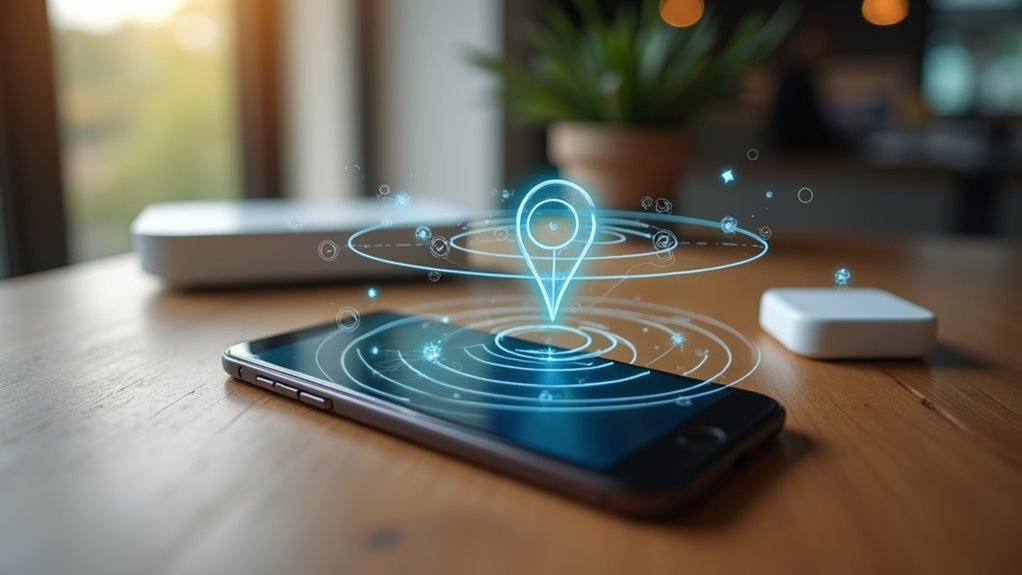
While traditional home security systems rely on manual arming and disarming, Home Assistant automatically detects your presence using sophisticated zone detection methods that work behind the scenes.
You’ll discover that GPS tracking through the Companion app provides real-time location updates directly to your Home Assistant instance. Your mobile phone constantly transmits coordinates, allowing the system to determine whether you’re inside or outside designated zones.
Additionally, Home Assistant tracks your devices through connected routers, monitoring WiFi connections to confirm your presence.
When you combine GPS data with WiFi network SSID reporting, you’ll achieve more reliable detection since your system verifies device connectivity to known networks. This dual-layer approach guarantees accurate presence detection even when GPS signals aren’t ideal indoors.
Mobile App Location Tracking Setup
You’ll need to install the Home Assistant Companion app on your Android 5+ or iPhone with iOS 15+ to get started with mobile location tracking.
During setup, you must grant location access permissions and configure them properly to guarantee continuous updates reach your Home Assistant instance.
Once you’ve activated location tracking in the app settings, your phone will automatically detect when you enter or exit defined zones with reliable accuracy.
App Installation Requirements
To track your location with Home Assistant’s mobile app, you’ll need a compatible device running Android 5.0 or newer, or iOS 15 or later. The Home Assistant Companion app serves as the bridge between your smartphone and your smart home system.
Once you’ve confirmed device compatibility, download the Home Assistant Companion app from your device’s app store. During installation, you’ll need to log into your Home Assistant instance to establish the connection.
The app will prompt you to enable location tracking during the initial setup process. You must grant proper location permissions in your mobile device settings for the tracking to function.
Without these permissions, your phone won’t transmit location data to Home Assistant, preventing accurate presence detection.
Location Permission Configuration
After installing the Home Assistant Companion app, configuring location permissions becomes your next critical step for reliable presence detection.
You’ll need to grant the app continuous GPS access to enable accurate tracking of your movements and whereabouts.
The app offers flexible privacy controls for your location sensors:
- Exact GPS coordinates – Provides precise location data for detailed tracking
- Zone names only – Shares general area information without specific coordinates
- Disabled location sharing – Completely turns off position reporting
- Background location access – Allows tracking when app isn’t actively open
- High accuracy mode – Improves positioning precision and update frequency
Remember to disable battery-saving modes that might interfere with location updates, ensuring your presence detection works consistently across all defined zones.
Zone Detection Accuracy
While Home Assistant’s zone detection relies primarily on GPS coordinates, combining multiple location technologies greatly improves accuracy and reduces false triggers. Your mobile app uses both GPS and WiFi network reporting to create a thorough picture of your presence. This dual approach guarantees your home automation systems respond reliably when you enter or exit defined zones.
| Technology | Accuracy Benefit |
|---|---|
| GPS Only | Basic location tracking |
| WiFi + GPS | Enhanced zone boundaries |
| High Accuracy Mode | Faster, precise updates |
Location updates trigger through iBeacon detection, app usage, and background fetch processes. You can configure exact GPS coordinates or zone names based on your privacy preferences. High Accuracy Mode provides faster updates but increases battery consumption, so you’ll need to balance performance with power efficiency for ideal home automation responses.
Router-Based Device Detection
Router-based device detection transforms your home network into a sophisticated presence sensor by monitoring which devices connect to your WiFi.
Your router tracks MAC addresses of connected devices, allowing Home Assistant’s device tracker to determine who’s home based on active connections. This method proves more reliable than GPS tracking since it’s unaffected by signal strength or location accuracy issues.
When your smartphone, tablet, or laptop connects to your network, Home Assistant recognizes your presence and can trigger automated actions:
- Turn on lights automatically when you arrive
- Adjust thermostat settings for comfort
- Activate security system when everyone leaves
- Send notifications about family member arrivals
- Control smart home devices based on occupancy
Configuration remains straightforward—simply enable device tracking and verify your router supports the necessary integration.
WiFi Network Name (SSID) Tracking

Beyond simple device presence detection, Home Assistant can track the specific WiFi network name (SSID) your mobile devices connect to, providing another layer of accuracy for determining your location.
When you install the Home Assistant mobile app with location tracking enabled, it automatically reports your connected SSID, creating a new entity in your system for monitoring.
This WiFi network name (SSID) tracking works exceptionally well when combined with GPS data, as GPS alone can be unreliable due to signal strength variations.
You’ll need to configure your network reporting properly, allowing Home Assistant to create device trackers that show ‘home’ or ‘not_home’ states based on connectivity.
You can even monitor multiple SSIDs using template logic for robust presence detection across different environments.
GPS and Location Services Integration
You’ll need to balance location accuracy with battery consumption when configuring GPS services in Home Assistant’s companion app.
High Accuracy Mode delivers precise positioning by combining GPS, WiFi, and cellular data, but it’ll drain your phone’s battery faster than standard location services.
Consider your specific automation needs and adjust the accuracy settings accordingly—you don’t always need pinpoint precision for effective presence detection.
Location Accuracy Settings
While Home Assistant’s presence detection relies heavily on accurate location data, you’ll need to fine-tune your GPS and location services settings to achieve peak performance.
The default accuracy setting of 200 meters strikes a balance between reliable performance and battery preservation, but you can adjust this based on your specific needs.
Key location accuracy considerations:
- Default 200-meter radius balances battery life with detection reliability
- High Accuracy Mode enables faster location updates but drains battery considerably
- 5-second update intervals provide real-time tracking in high accuracy mode
- Zone-based triggers automatically send location updates when entering/exiting areas
- Bluetooth integration can trigger location data transmission from connected devices
Proper configuration guarantees you’ll receive timely location updates without sacrificing your device’s battery performance unnecessarily.
Battery Impact Management
These accuracy settings directly impact your device’s battery consumption, making smart battery management a top priority for sustained presence detection.
High Accuracy Mode’s 5-second GPS updates drain battery considerably, requiring careful balance between location precision and device longevity. You can optimize battery impact management by adjusting the default 200-meter accuracy requirement based on your specific needs.
When enabling High Accuracy Mode, Background Location, and Location Zone settings, grant necessary Android permissions thoughtfully. The permanent notification that appears provides real-time address or coordinate updates but can be minimized to reduce battery drain.
You’ll need to weigh the benefits of faster, more accurate location reporting against extended battery life for effective battery impact management.
Multiple Person Household Configuration
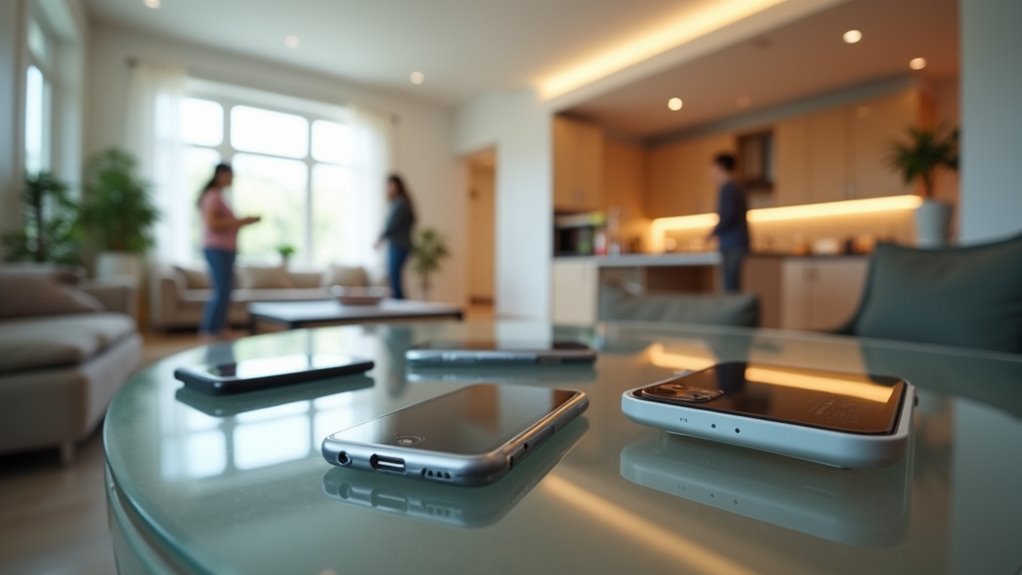
When multiple people live in your home, each person needs their own device tracker configured in Home Assistant for accurate presence detection.
You’ll need to install the Home Assistant Companion app on each family member’s smartphone or smartwatch, guaranteeing location access is granted during setup.
Configure individual tracking through Settings > People, where you can assign specific devices to each household member.
This creates personalized presence detection within your home zone, enabling targeted automations based on who’s actually present.
- Install companion app on every family member’s device
- Grant location permissions during initial setup process
- Assign devices to individuals in Settings > People
- Combine GPS tracking with WiFi network reporting
- Create groups for simplified automation triggers
This multi-device approach guarantees Home Assistant accurately knows which family members are home.
Smartwatch and Wearable Device Tracking
Beyond smartphones, smartwatches and wearable devices offer another layer of presence detection that can greatly improve Home Assistant’s accuracy in tracking household members. You’ll need the Home Assistant Companion app installed with location tracking enabled on your smartwatch. For ideal performance, your wearable requires a mobile plan to send location updates when you’re away from home WiFi.
| Scenario | Without Smartwatch | With Smartwatch |
|---|---|---|
| Phone dies during emergency | No presence detection | Continuous tracking |
| Forgot phone at home | False presence reading | Accurate location data |
| Multiple family members | Single point of failure | Redundant safety net |
| Automation reliability | Basic functionality | Enhanced precision |
| Peace of mind | Moderate confidence | Complete assurance |
Your smartwatch appears as a device tracker entity, seamlessly integrating into automation routines for thorough presence detection coverage.
Device Tracker Entity Management
Once you’ve set up device tracking, you’ll want to rename your device tracker entities from their default technical names to something more meaningful like “John’s Phone” or “Sarah’s Laptop.”
You can customize these names and configure attribute privacy controls through Home Assistant’s Integrations Dashboard to limit what information gets stored or displayed.
These management steps guarantee your device trackers are both user-friendly and respect your household’s privacy preferences.
Entity Naming Configuration
After Home Assistant detects your devices and creates their corresponding `device_tracker` entities, you’ll likely want to rename them for better organization and identification.
The default entity naming configuration uses device IDs that aren’t always user-friendly, making it difficult to distinguish between family members’ phones or different household devices.
You can easily modify entity names through Home Assistant’s Integrations Dashboard. This entity naming configuration process helps you create meaningful identifiers like `device_tracker.john_phone` instead of cryptic device IDs.
Consider these naming best practices:
- Use descriptive names that identify both the person and device type
- Maintain consistent naming conventions across all household devices
- Avoid spaces and special characters in entity names
- Include location indicators for stationary devices
- Keep names concise but informative
Attribute Privacy Controls
While Home Assistant’s device tracker entities excel at detecting your presence, you maintain complete control over how much location data they share. You can configure privacy settings to share exact GPS coordinates, only zone names, or disable location sharing entirely.
Each device tracker’s attributes vary based on your operating system and the permissions you’ve granted.
Make sure you configure these privacy settings per server to control when location data transmits to Home Assistant. The `sensor.last_update_trigger` helps you monitor what triggered recent location updates, ensuring your presence detection works as expected.
Remember that disabling location permissions completely stops data transmission, which affects automation triggers and reduces device tracking accuracy throughout your smart home system.
Combining GPS With Wifi for Enhanced Accuracy
Although GPS tracking provides a solid foundation for presence detection, Home Assistant’s accuracy improves dramatically when you combine it with WiFi network reporting.
Your mobile app reports the connected WiFi SSID, creating cross-referenced location data that’s best viewed with JavaScript enabled dashboards.
This dual-tracking approach creates a thorough detection system that reduces false positives and negatives. When enabled, a new entity appears in Home Assistant, monitoring your device’s connectivity status alongside GPS coordinates.
Key benefits of combining GPS and WiFi tracking:
- Enhanced reliability through cross-referencing physical location with network connection
- Reduced chances of incorrect occupancy detection
- More accurate automations based on household member presence
- Real-time connectivity status monitoring
- Detailed presence information for better decision-making
This integration facilitates precise automations you can trust.
High Accuracy Mode and Battery Optimization
You’ll face a trade-off when enabling High Accuracy Mode since GPS updates every 5 seconds provide precise location data but drain your battery considerably.
The feature requires specific Bluetooth connections or zone entry to activate, which helps balance accuracy with power consumption.
You can minimize the permanent notification that displays your current location and adjust accuracy requirements from the default 200-meter threshold to optimize your setup.
GPS Speed Vs Battery
When Home Assistant’s High Accuracy Mode kicks in, you’re trading battery life for precision. The GPS speed increases dramatically, updating your location every 5 seconds instead of using standard intervals. This constant GPS polling delivers faster presence detection but comes at a significant cost to your device’s battery performance.
The balance between GPS speed and battery consumption requires strategic configuration:
- Configure High Accuracy Mode to activate only in specific zones
- Connect activation to Bluetooth devices near your home
- Adjust the default 200-meter accuracy setting based on your needs
- Monitor battery optimization settings that limit background activity
- Consider using zone-based triggers instead of constant high-precision tracking
Smart configuration lets you maintain reliable presence detection while preserving battery life for daily use.
Bluetooth Zone Constraints
Since Bluetooth zone constraints offer the most practical approach to High Accuracy Mode management, you can configure specific Bluetooth devices to trigger enhanced location tracking automatically.
When you’re connected to designated Bluetooth devices like your car’s system or home speakers, Home Assistant activates High Accuracy Mode for precise positioning data. This eliminates constant GPS polling while ensuring accuracy when needed most.
You’ll notice bluetooth zone constraints work by monitoring your device’s Bluetooth connections rather than relying solely on location sensors. This approach dramatically reduces battery drain since High Accuracy Mode only activates during specific scenarios.
You can also create buffers around original zones for early activation, allowing seamless shifts when entering defined areas while maintaining peak battery performance through intelligent constraint management.
Notification Management Settings
Managing High Accuracy Mode notifications becomes important once you’ve configured your Bluetooth constraints, as the system displays a permanent notification whenever this enhanced tracking activates.
This notification shows your current address or coordinates along with location accuracy data, keeping you informed about the app’s tracking status.
Your notification management settings offer control over how prominently these alerts appear:
- Minimize the persistent notification through your device’s system notification settings
- Monitor real-time location accuracy displayed in the notification
- View current address or coordinate information directly from the notification bar
- Access quick toggles for High Accuracy Mode from the notification panel
- Customize notification priority levels to reduce visual interruption
The notification guarantees you’re aware when enhanced location tracking connects to your local network and external GPS services.
Troubleshooting Common Location Issues
Although Home Assistant’s location tracking works reliably most of the time, you’ll occasionally encounter issues that prevent accurate presence detection.
When your automation to turn on lights doesn’t trigger upon arrival, start by checking your phone’s battery optimization settings. If battery-saving mode is enabled, it restricts location updates and prevents Home Assistant from detecting zone changes.
Verify that location permissions are properly configured for the Home Assistant Companion app. Without these permissions, your device can’t transmit location data.
You’ll also need remote access configured if you want location tracking to work outside your home WiFi network.
Check your device tracker configurations, ensuring correct device IDs and entity IDs are specified.
Finally, confirm location tracking is enabled in your app settings.
Alternative Tracking Solutions and Workarounds
When traditional GPS-based tracking fails or proves unreliable, you can implement several alternative solutions that don’t depend on your phone’s location services.
These alternative tracking solutions offer robust workarounds for consistent presence detection.
Alternative tracking methods include:
- Ping device tracker – Monitors device availability on your network to determine presence status
- Router integration – Leverages connected devices on supported routers for automated detection
- Nabu Casa subscription – Provides seamless external access for reliable location updates
- iBeacon Tracker integration – Uses Bluetooth beacons to trigger location updates within range
- Combined tracker groups – Merges GPS and WiFi trackers for enhanced reliability and accuracy
You can mix these methods to create a thorough presence detection system that works even when individual tracking components fail.
Privacy Settings and Location Data Control
While implementing multiple tracking methods enhances reliability, you’ll want to carefully control what location data gets shared with your Home Assistant server.
Home Assistant’s privacy settings offer flexible control over your location sharing. You can choose to send exact GPS coordinates, zone names only, or disable location sharing entirely. These settings are managed per-server, letting you customize privacy controls for different installations.
Your device_tracker entity attributes reflect these privacy choices and show how location updates occur. The system tracks update causes through sensor.last_update_trigger, helping you understand when and why your location was shared.
Remember that location permissions must be granted for the app to function—disabling them completely stops all location data transmission to your server.
Advanced Features With Ibeacons and Automation
Beyond basic GPS tracking, iBeacons offer precise proximity detection that transforms how Home Assistant responds to your presence.
You’ll configure these small Bluetooth devices by adding their UUID, major, and minor values to your zone settings. When iBeacon detection occurs, your smart home automatically springs into action.
Key benefits of iBeacon integration include:
iBeacon integration delivers room-level precision that transforms basic home automation into intelligent, location-aware smart home experiences.
- Real-time presence updates for accurate automation triggers
- Room-level precision beyond standard GPS capabilities
- Seamless integration with the Home Assistant mobile app
- Automatic lighting and climate control adjustments
- Enhanced automation scenarios based on specific proximity zones
You’ll create sophisticated automation flows that respond instantly as you move through different areas.
This technology bridges the gap between knowing you’re home and understanding exactly where you’re within your living space.
Frequently Asked Questions
How Does the Home Assistant Know I’m Home?
Home Assistant tracks your phone’s GPS location and WiFi connection to determine when you’re home. It uses device trackers that monitor when you enter or leave predefined zones, providing reliable presence detection through multiple sources.
How Do I Access Home Assistant When Not at Home?
You can access Home Assistant remotely through Home Assistant Cloud for secure connection, use the Companion app, or set up Cloudflared or dynamic DNS service for external access.
Does a Home Assistant Need to Be on 24/7?
Yes, you’ll need Home Assistant running 24/7 for ideal performance. It continuously monitors sensors, processes location updates, and maintains device connections. Turning it off breaks presence detection and prevents real-time automation responses.
What’s Better, Homebridge or Home Assistant?
You’ll find Home Assistant offers superior presence detection through GPS tracking, WiFi monitoring, and group device management. Homebridge focuses on Apple HomeKit integration but lacks Home Assistant’s extensive automation and customization capabilities for determining occupancy.


Leave a Reply