

You’ll face dozens of dashboard platforms when setting up your smart home sensors, but most won’t deliver the flexibility you actually need. While basic solutions like simple web interfaces might seem appealing, they’ll quickly become limiting as your sensor network grows. The real challenge isn’t just displaying data—it’s creating a system that adapts to your specific monitoring requirements and scales with your expanding setup. Your choice of platform will determine everything that follows.
Understanding Dashboard Components and Architecture
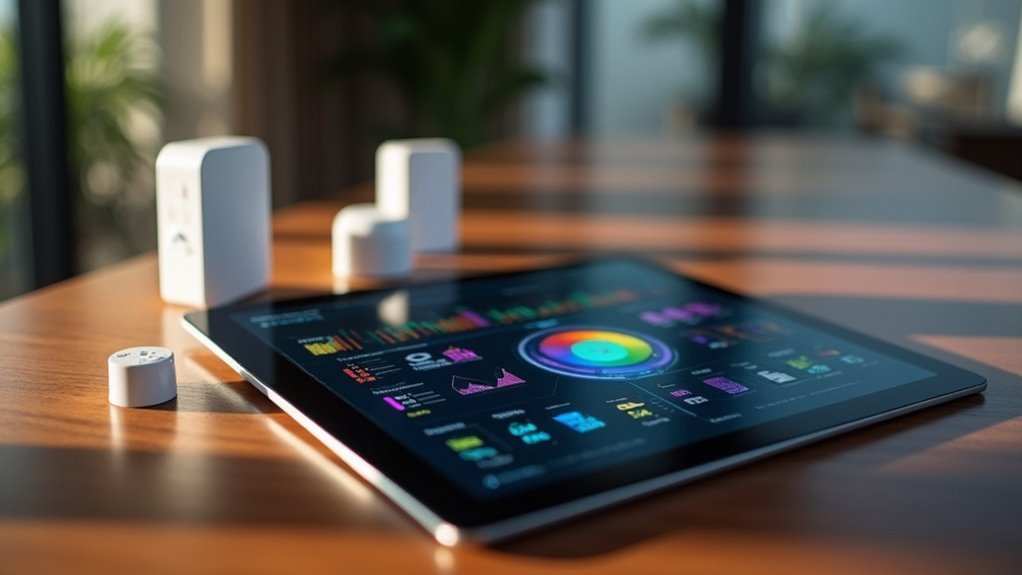
When you’re setting up your home sensor dashboard, you’ll need to understand the fundamental building blocks that make everything work together.
Understanding the core components of your home sensor dashboard is essential before diving into customization and advanced features.
Your dashboard consists of two main components: views and cards. Views act as containers that organize your display, while cards are the workhorses that actually display information from your home sensors.
You can customize each dashboard with unique titles, icons, and URLs for better navigation.
Cards come in different types, including sensor cards, gauge cards, and alarm panel cards, each designed for specific entities. The edit mode lets you rearrange layouts intuitively.
For advanced users, YAML programming enables custom cards creation, and you can add third-party options from the Home Assistant Community Store.
Selecting the Right Platform for Your Smart Home Setup
You’ll need to compare different smart home platforms to find the one that best fits your dashboard requirements and technical expertise.
Home Assistant stands out among platforms like SmartThings and Hubitat due to its extensive device compatibility and superior customization capabilities.
The platform’s ability to support thousands of integrations while offering complete control over your dashboard design makes it an attractive choice for most users.
Platform Comparison Overview
The foundation of any effective home sensor dashboard lies in choosing the right platform for your specific needs and technical comfort level.
When comparing smart home platforms, Home Assistant stands out for its exceptional dashboard customization capabilities. Unlike SmartThings and Hubitat, you’ll find superior flexibility in creating tailored views that showcase your sensor data exactly how you want.
If you’re comfortable with coding, Home Assistant’s YAML programming opens advanced configuration possibilities. You can organize sensor data into multiple views within a single view structure, categorizing temperature, humidity, and motion sensors for better accessibility.
The Home Assistant Community Store expands functionality with custom cards beyond default offerings. Active community forums provide collaboration opportunities, helping you optimize your dashboard setup through shared insights and troubleshooting support.
Home Assistant Advantages
Because Home Assistant prioritizes user control over pre-configured limitations, you gain unprecedented freedom in designing dashboards that reflect your unique smart home vision.
You’ll discover an extensive library of cards for displaying sensor data, from temperature readings to motion detection alerts, all easily configurable through the interface.
The platform’s community-driven development means you’re constantly gaining access to new features and custom modifications through the Home Assistant Community Store.
You can create multiple organized views within single dashboards, perfect for managing different home areas efficiently.
Most importantly, Home Assistant’s broad integration capabilities let you centralize control of your entire automation ecosystem, regardless of device manufacturers, creating a unified monitoring experience that grows with your smart home needs.
Home Assistant Dashboard Creation Walkthrough
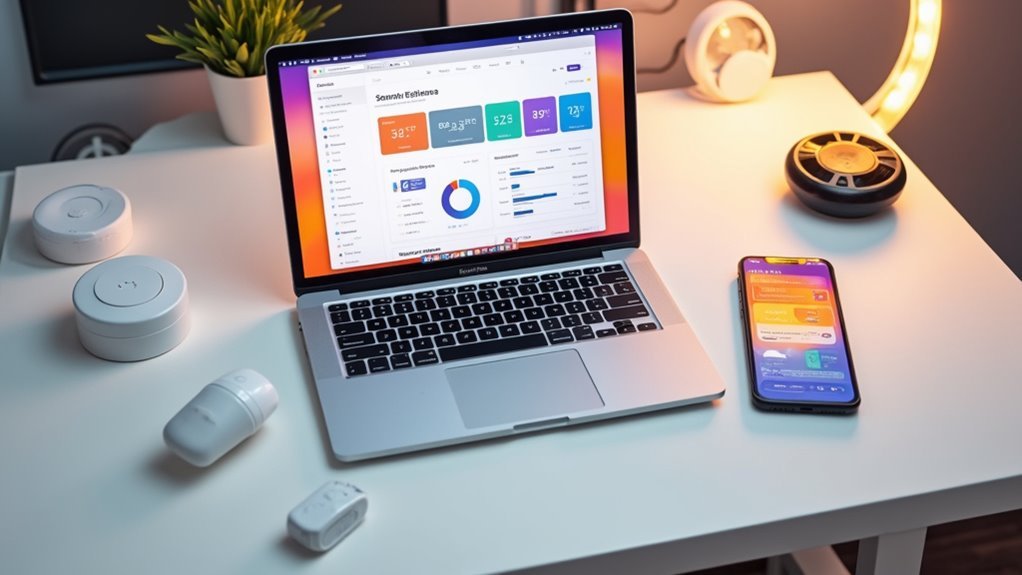
Once you’ve chosen Home Assistant as your platform, you’ll need to create a custom dashboard that displays your sensor data effectively.
The dashboard setup process starts with defining a title, icon, and URL for navigation, then progresses to configuring individual cards that present your information.
You’ll find various card configuration options available, from basic sensor displays to interactive controls, all of which can be arranged and customized to match your specific monitoring needs.
Dashboard Setup Process
When setting up your first Home Assistant dashboard, you’ll want to create a fresh dashboard rather than modifying the default one to preserve your personalized layout.
You’ll need to provide essential details including a title, icon, and navigation URL for your new dashboard.
During the setup process, consider these key configuration options:
- Access control – Choose between admin-only restrictions or open access for all users
- View customization – Configure each view’s title, icon, URL, and theme settings
- Layout selection – Use masonry as your default view type for the best visual appearance
- Card management – Add and arrange cards in edit mode by selecting entities and customizing layouts
For advanced features, you’ll need to install the Home Assistant Community Store to access custom cards and modifications.
Card Configuration Options
After creating your dashboard structure, you’ll configure individual cards to display your home sensor data and controls. Home Assistant offers various card types including alarm panels, buttons, and sensors that you can select based on your specific needs.
Each card’s configuration involves specifying entities through YAML programming, allowing complete customization of appearance and functionality. You’ll tailor data presentations to match your preferences and requirements.
In edit mode, you can rearrange cards to optimize layout and guarantee critical information remains easily accessible. Adding badges provides quick status indicators, though their appearance mightn’t suit everyone’s taste.
For advanced customizations beyond standard options, explore the Home Assistant Community Store where you’ll find additional custom cards and modifications that greatly enhance your dashboard’s functionality and visual appeal.
Essential Card Types for Sensor Data Visualization
While setting up your Home Assistant dashboard, you’ll discover that choosing the right card types transforms raw sensor data into meaningful, actionable insights.
You’ve got several essential options that’ll make your dashboard both functional and visually appealing.
Here are the key card types you should consider:
- Sensor cards – Display real-time readings from your devices, giving you instant access to current values
- Gauge cards – Present numerical data graphically, making it easy to understand levels at a glance
- Mini Graph Cards – Track trends over time in compact charts, perfect for monitoring temperature or humidity fluctuations
- Button cards – Trigger sensor-based actions like activating fans when temperatures rise, adding smart automation to your dashboard
These cards work together to create thorough visualization solutions.
Configuring Views and Navigation Elements

You’ll need to organize your sensor dashboard through strategic view configuration that includes setting up navigation pathways between different sections.
Your layout choices, particularly the masonry view type, will determine how effectively your sensor cards display across various screen sizes.
Theme selection and customization options let you create a cohesive visual experience that matches your home’s aesthetic while maintaining functional access controls.
Dashboard Navigation Setup
Creating an organized navigation structure forms the foundation of any effective Home Assistant dashboard, as it determines how easily you’ll access your smart home controls.
When setting up your dashboard navigation, you’ll need to configure each view with essential elements that enhance both functionality and user experience.
Here’s what you’ll configure for each view:
- Basic settings – Define titles, icons, URLs, and select the masonry layout for ideal visual appeal
- Custom themes – Apply personalized styling if you’ve installed custom themes for your dashboard
- Access restrictions – Limit sensitive views to admin users only for enhanced security
- Layout organization – Arrange views efficiently using configuration options for better usability
Regularly review and adjust your navigation structure as your smart home needs evolve.
View Layout Options
Once you’ve established your navigation structure, configuring individual view layouts becomes your next priority for enhancing dashboard functionality. You’ll find the masonry layout works best for most scenarios, creating visually appealing card arrangements that adapt to different screen sizes.
| Layout Type | Best Use Case |
|---|---|
| Masonry | Mixed card sizes, general dashboards |
| Panel | Single-focus displays, kiosks |
You can customize each view with titles, icons, and navigation URLs to improve user experience. Don’t forget to leverage user role restrictions for security-sensitive areas. If you’ve installed custom themes, apply them to match your aesthetic preferences. Use edit mode to rearrange views and cards until you achieve the ideal layout for your specific needs.
Theme Configuration Methods
Custom themes transform your dashboard’s appearance beyond the standard layout configurations, giving you control over colors, fonts, and visual elements across your entire interface.
You’ll need to install custom themes before you can apply them to your views, but once available, they provide consistent branding and personalization options.
Theme configuration offers several practical benefits:
- View-specific styling – Apply different themes to individual views for organized visual separation
- Consistent branding – Maintain uniform colors and fonts across your entire dashboard system
- Enhanced readability – Choose themes that improve text contrast and sensor data visibility
- Personal customization – Match your dashboard aesthetics to your home’s design preferences
You can select themes during view creation or modify existing views to incorporate your preferred visual styling.
Installing and Using the Home Assistant Community Store
While Home Assistant provides excellent built-in dashboard capabilities, you’ll access considerably more customization options by installing the Home Assistant Community Store (HACS).
You can install HACS by following the official installation instructions, which typically involve adding a custom repository to Home Assistant.
Once installed, you’ll find HACS in your Home Assistant sidebar, where you can browse and install custom integrations and frontend cards developed by the community.
These custom cards greatly enhance your dashboard functionality beyond standard options.
Most custom cards require YAML configuration for setup, but HACS provides extensive documentation and examples to guide you through customization.
Remember to regularly update HACS and its installed components to guarantee peak performance and access to the latest community improvements and features.
Popular Custom Cards for Enhanced Functionality
After setting up HACS, you’ll discover a rich ecosystem of community-developed cards that transform your dashboard’s capabilities.
These custom cards extend Home Assistant’s functionality far beyond default options, giving you powerful tools to create professional-looking sensor dashboards.
Custom cards unlock professional dashboard capabilities that go far beyond Home Assistant’s standard interface limitations.
Essential cards you’ll want to explore include:
- Card Mod – Apply custom CSS styles to personalize your dashboard’s visual appeal and match your aesthetic preferences.
- Custom Button Card – Create versatile, interactive buttons that control smart home entities with enhanced design flexibility.
- Mini Graph Card – Display compact data trend visualizations perfect for monitoring sensor readings and historical statistics.
- Stack-in Card – Organize multiple cards within single containers to improve layout management and maximize screen space efficiently.
These cards form the foundation for sophisticated dashboard designs.
YAML Programming for Advanced Customizations
You’ll need YAML programming skills to gain access to advanced customizations that transform your Home Assistant dashboard beyond basic functionality.
You can access and edit YAML code directly within each card’s configuration window, where helpful suggestions appear as you type.
Custom card configurations require this structured markup language to define everything from entity behaviors to complex styling rules that make your dashboard truly unique.
YAML Code Access
When you’re ready to access the full potential of your Home Assistant dashboards, accessing YAML code through the card configuration window becomes your gateway to advanced customization.
You’ll find this powerful feature opens doors to precise control over your dashboard elements.
Here’s what you can accomplish with YAML code access:
- Real-time suggestions – You’ll receive helpful suggestions while typing, making configuration easier without extensive YAML knowledge
- Custom card integration – You can implement third-party cards from the Home Assistant Community Store for enhanced functionality
- Style modifications – You’ll customize card appearances, colors, and layouts beyond standard options
- Complex behaviors – You can create sophisticated automations and conditional displays for dynamic dashboards
This level of customization transforms basic sensor displays into professional-grade monitoring systems.
Custom Card Configuration
Three fundamental components form the backbone of custom card configuration in Home Assistant: card type definition, entity specification, and styling parameters.
You’ll find YAML suggestions appearing as you type in the card configuration window, streamlining your customization process. Popular options like Custom Button Card and Mini Graph Card require YAML modifications to reveal their full potential and enhance visual appeal.
The Home Assistant Community Store expands your possibilities with additional custom cards, though these often need YAML coding for proper integration.
You can access thorough tutorials and resources to master implementation and troubleshoot configurations effectively. Start with basic card modifications, then gradually incorporate advanced styling parameters to create dashboards that perfectly match your monitoring needs and aesthetic preferences.
Sensor Integration and Entity Management
Since Home Assistant treats every connected device as an entity, you’ll find that integrating sensors into your dashboard becomes surprisingly straightforward. You can connect temperature, humidity, motion, and light sensors to create a thorough overview of your home’s conditions.
Entity management gives you powerful organizational tools:
Transform your smart home chaos into organized efficiency with Home Assistant’s robust entity management system.
- Rename sensors with descriptive names like “Living Room Temperature” instead of cryptic device IDs
- Group related sensors by room or function for easier navigation
- Categorize devices using areas and labels to streamline dashboard creation
- Configure display settings to show only relevant data points
This organized approach makes finding specific sensors effortless when building dashboards. You’ll also reveal automation potential, creating rules that respond to sensor state changes for enhanced home management efficiency.
Theme Selection and Visual Styling Options
After you’ve organized your sensors and entities, transforming your dashboard’s visual appearance becomes the next exciting step in creating a personalized control center.
Home Assistant’s default masonry view arranges cards beautifully, but you can explore various layout styles to match your design goals.
You’ll find extensive theming options through the Home Assistant Community Store, which offers professionally designed themes beyond the basic defaults.
These custom themes instantly enhance your dashboard’s visual appeal while maintaining consistency across all interface elements.
For detailed customization, you can modify individual cards using YAML code in the configuration window.
The Card Mod custom card proves especially valuable here, as it enables CSS styling for extensive visual modifications.
This combination lets you create truly unique dashboard experiences tailored to your preferences.
Mobile Optimization and Responsive Design
When you access your Home Assistant dashboard from smartphones and tablets, mobile optimization becomes vital for maintaining functionality and visual appeal.
You’ll want to guarantee your dashboards automatically adapt to different screen sizes through responsive design techniques.
Consider these key strategies for mobile optimization:
- Use masonry layouts that dynamically rearrange elements based on screen dimensions
- Implement touch-friendly controls with larger interactive elements for easier navigation
- Test across multiple devices during creation to identify potential layout issues
- Prioritize essential information that remains visible on smaller screens
You should focus on creating layouts that maintain usability while preserving access to significant home sensor data.
Testing your dashboards on various devices helps you catch issues early and guarantees consistent performance across all platforms.
Troubleshooting Common Dashboard Issues
Even perfectly configured dashboards can encounter issues that disrupt your home sensor monitoring experience. When you notice misconfigured cards or views, double-check your entity selections and card settings in the configuration window.
When dashboard cards display incorrectly, verify your entity selections and configuration settings to restore proper functionality.
If your dashboard fails to load or displays errors, clear your browser cache or refresh the page to resolve transient issues.
You’ll find Home Assistant logs invaluable for identifying specific dashboard configuration errors and understanding what’s gone wrong. When layout problems occur, switch the view type or rearrange cards in edit mode to correct visual discrepancies.
Don’t hesitate to seek assistance through community forums and the #frontend chat channel, where experienced users share valuable troubleshooting tips and proven solutions.
Community Resources and Support Channels
Where can you turn when dashboard challenges exceed basic troubleshooting steps? The Home Assistant community offers extensive support channels that’ll help you overcome complex obstacles and enhance your dashboard development skills.
You can access these valuable resources to accelerate your learning and connect with experienced users:
- #frontend chat channel – Engage in real-time discussions about dashboard development and share improvement suggestions with active community members.
- Community forums – Access additional help and discuss dashboard-related queries with fellow users who’ve faced similar challenges.
- Frontend repository – Contribute suggestions and feedback that directly influence future dashboard features and functionalities.
- Custom card development resources – Learn to create unique dashboard functionalities tailored to your specific preferences and requirements.
These channels provide ongoing support throughout your dashboard journey.
Performance Optimization and Best Practices
Building strong community connections sets you up for success, but optimizing your dashboard’s performance guarantees that success translates into a smooth, responsive user experience.
You’ll want to limit the number of entities displayed since excessive entities slow down loading times and reduce responsiveness. Choose the masonry view type for aesthetic arrangement while keeping layouts user-friendly and avoiding information overload.
Use custom themes sparingly to enhance visual appeal without compromising performance—excessive styling leads to slower rendering.
Regularly review and remove unused or redundant cards and views to streamline your dashboard and reduce clutter.
Consider using the Home Assistant Community Store to find custom cards that’re optimized for performance, enhancing functionality without sacrificing speed.
Frequently Asked Questions
How Much Does It Cost to Set up a Complete Home Sensor Dashboard System?
You’ll spend $200-800 for a complete system. Basic setups with Raspberry Pi and sensors cost $200-400, while premium systems with professional hubs and multiple wireless sensors range $500-800 depending on your home’s size.
Can I Access My Dashboard Remotely When Away From Home?
You can definitely access your dashboard remotely through internet connectivity. Most modern systems offer mobile apps, web interfaces, or cloud platforms that let you monitor sensors from anywhere with internet access.
What Happens to My Dashboard Data if the Internet Goes Down?
When your internet goes down, you’ll lose remote access to cloud-based dashboards, but local sensors continue collecting data. Systems with local storage preserve information until connectivity returns and syncs.
How Long Does It Take to Learn Dashboard Creation for Beginners?
You’ll typically need 2-4 weeks to learn basic dashboard creation. If you’re tech-savvy, you might grasp fundamentals in days. Complex customizations and integrations usually require several months of practice and experimentation.
Which Sensors Work Best for Elderly or Disabled Family Members?
You’ll want motion sensors for fall detection, smart medication dispensers with alerts, door/window sensors for wandering prevention, temperature monitors for comfort, and emergency buttons they can easily reach and press when needed.

Leave a Reply