
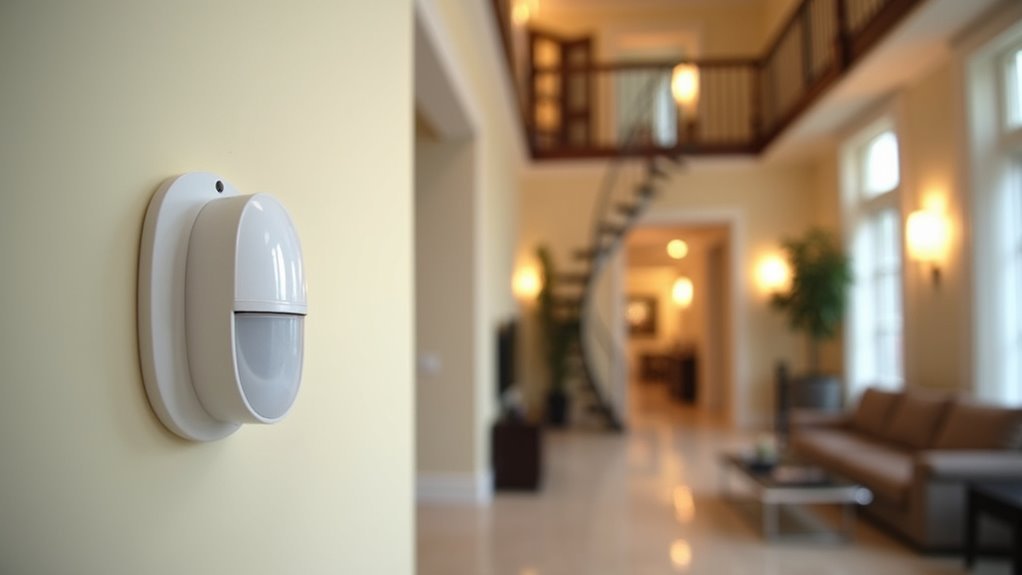
You’re investing in motion sensors to protect your home, but their effectiveness depends entirely on where you place them. Most homeowners make critical positioning errors that leave vulnerable blind spots throughout their property. The difference between catching an intruder and missing them completely often comes down to understanding the subtle science behind sensor placement. Your security system’s success hinges on strategic decisions you’ll make in the next few minutes.
Understanding How Motion Sensors Detect Movement

When you’re planning the placement of indoor motion sensors, understanding their detection mechanisms becomes essential for ideal security coverage. Your sensors detect movement primarily through passive infrared sensors that monitor heat signatures from living beings.
These passive infrared sensors emit rays that fan out across your space, creating a detection zone spanning 20 to 40 feet depending on your specific model. The motion detection technology works by sensing temperature changes when warm bodies move through the infrared field.
You’ll achieve peak performance by mounting your sensors 6 to 8 feet high, which maximizes their field of view while minimizing false triggers from pets. For enhanced accuracy, dual technology sensors combine infrared detection with microwave sensing, requiring both heat and movement before triggering alerts.
Essential Factors for Optimal Sensor Placement
Since proper sensor placement determines the effectiveness of your entire security system, you’ll need to evaluate several critical factors before installing your devices. Motion sensors require strategic positioning to maximize detection while minimizing false triggers.
| Factor | Recommendation |
|---|---|
| Height | 6-8 feet off ground |
| Heat Sources | Keep away from vents/radiators |
| Room Coverage | Guarantee clear line of sight |
| Strategic Placement | Near entry points for intruders |
| Corner Installation | Maximize detection area |
You’ll want to avoid obstructions from furniture that block sensor coverage. Installing near doors and windows provides early intrusion detection. Corner placement eliminates blind spots and expands monitoring range. Distance from heat sources and air vents will reduce false alarms caused by temperature changes. These considerations guarantee peak performance.
High-Traffic Areas and Main Hallways

You’ll achieve maximum coverage by positioning sensors in central hallways where foot traffic naturally converges from multiple rooms.
These strategic placements let you monitor movement patterns efficiently while creating a security checkpoint that detects anyone accessing different areas of your home.
Optimizing traffic flow detection means selecting hallway locations that capture the most activity with the fewest sensors needed.
Central Hallway Placement
Central hallways represent one of the most strategic locations for motion sensor placement in any home security system. These natural funnels connect various rooms, making them perfect chokepoints where you’ll catch any unauthorized movement throughout your home.
When you install motion sensors in central hallways, you’re creating an immediate alert system that’ll notify you of activity during both busy and quiet periods.
For ideal performance, consider these key placement strategies:
- Mount sensors 6 to 8 feet high to avoid pet-triggered false alarms
- Use multiple sensors in longer hallways for thorough coverage
- Position devices to trigger automatic lighting for improved visibility
This strategic approach eliminates blind spots that intruders might exploit while enhancing safety as you navigate dark spaces.
Traffic Flow Optimization
Understanding your home’s traffic patterns transforms motion sensor effectiveness from basic detection to intelligent monitoring. Placing motion sensors in high-traffic areas like main hallways creates extensive coverage that monitors multiple access points simultaneously. You’ll eliminate blind spots by positioning sensors to cover natural foot traffic flow, ensuring every movement gets detected efficiently.
Mount your sensors 6 to 8 feet high to maximize range without furniture interference. Multiple sensors with overlapping coverage increase detection accuracy during peak activity times, delivering maximum security.
| Location | Height | Coverage Benefit | Detection Result |
|---|---|---|---|
| Main hallway | 6-8 feet | Multiple access points | Extensive monitoring |
| Intersections | 7-8 feet | Traffic convergence | Enhanced accuracy |
| Stairway landings | 6-7 feet | Vertical movement | Multi-level protection |
| Entrance corridors | 7-8 feet | Primary pathways | Immediate alerts |
Entry Points and Doorway Monitoring
Strategic placement of motion sensors at entry points forms the foundation of effective home security monitoring.
You’ll want to focus on doorway monitoring to detect unauthorized access before intruders can fully penetrate your home’s defenses.
Position sensors strategically to enhance security through extensive coverage:
- Front and back doors – Install sensors near main entry points to catch movement immediately upon breach
- Room doorways – Target areas containing valuables with dedicated monitoring for specific spaces
- Above doorframes – Mount discreetly at 6-8 feet height for ideal detection range while avoiding pet false alarms
You’ll achieve maximum protection by creating overlapping sensor coverage at multiple entry points.
This layered approach guarantees prompt detection of any unauthorized movement while maintaining an unobtrusive aesthetic that won’t disrupt your home’s decor or daily traffic flow.
Corner Installations for Maximum Room Coverage
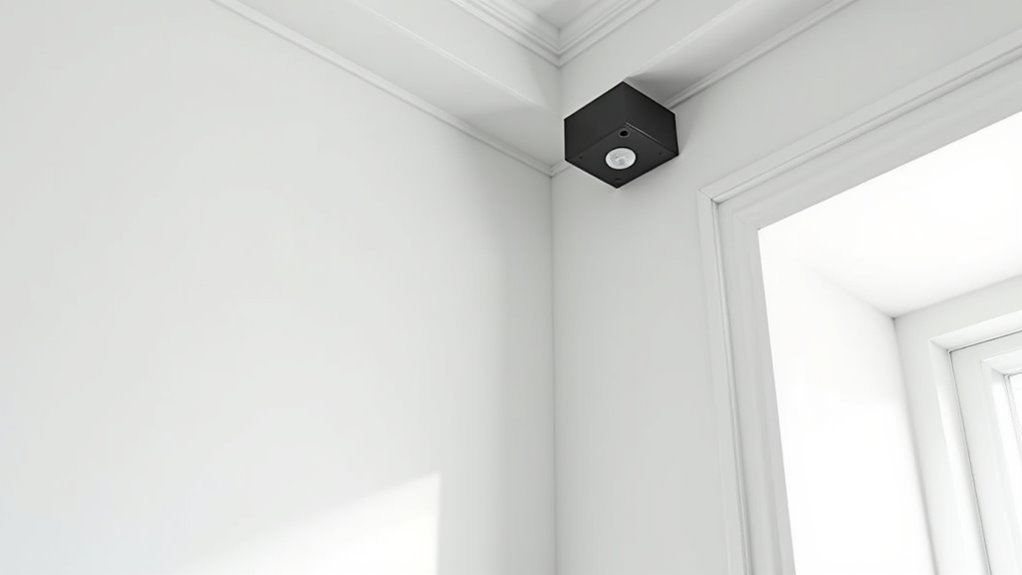
When you position motion sensors in room corners, you’ll maximize detection coverage while eliminating blind spots that could compromise your security system.
Corner installations leverage your room’s natural layout, enabling sensors to monitor movement across two walls simultaneously and dramatically expanding the coverage area compared to wall-mounted alternatives.
Corner positioning maximizes sensor efficiency by monitoring two walls at once, creating superior coverage compared to single-wall installations.
You’ll achieve ideal results by mounting sensors 6 to 8 feet high in corners, where they can effectively detect movement from multiple angles.
This strategic positioning allows your sensors to monitor both entryways and opposite sides of rooms efficiently.
Corner placements also help you detect movement from various directions while maintaining the recommended height for distinguishing human-sized heat signatures from pets.
Behind Valuable Items and Electronics
Since intruders typically target your most valuable possessions first, positioning motion sensors behind electronics and prized items creates a critical detection perimeter around these high-risk zones.
You’ll want to focus on protecting televisions, computers, and jewelry by installing sensors that monitor movement around these prime targets.
These advanced security solutions offer several key advantages:
- Instant alerts – You’ll receive immediate notifications when detecting movement near valuable items
- Remote monitoring – Smart integration lets you track activity from anywhere
- Quick response capability – Fast detection enables rapid security responses
When placing sensors behind valuable items, make sure furniture or other obstructions don’t block their field of view.
This strategic positioning transforms your motion detection system into a targeted defense network that guards your most important possessions.
Staircase and Multi-Level Detection
You’ll want to monitor movement between floors by installing motion sensors on your staircases, as they provide early warning when intruders attempt to access different levels of your home.
Position sensors at both the top and bottom of stairways to eliminate blind spots and guarantee complete coverage of vertical movement.
Mount these devices at 6-8 feet high in corner locations to maximize detection range while avoiding false alarms from pets.
Multi-Floor Movement Monitoring
Multi-level homes require strategic motion sensor placement to effectively monitor movement between floors, making staircases critical points for thorough security coverage.
You’ll need to position sensors at both the top and bottom of your staircases to guarantee extensive coverage that detects unauthorized movement in either direction.
For ideal multi-floor movement monitoring, consider these placement strategies:
- Mount sensors 6-8 feet high on staircases to maximize detection while reducing false alerts from pets
- Install multiple sensors throughout your home to create overlapping coverage zones
- Position sensors to monitor both upward and downward movement on staircases
This strategic approach eliminates blind spots and provides continuous monitoring as individuals move between levels.
Your well-positioned staircase sensors become the backbone of your multi-level security system, alerting you to any suspicious activity.
Optimal Stairway Sensor Placement
Proper sensor height becomes even more important when you’re working with the unique challenges that staircases present. Install motion sensors at both the top and bottom of your stairway to detect motion before intruders access different levels.
Position sensors between 6 to 8 feet high to avoid false alarms from pets while maintaining thorough coverage of the entire stairwell area.
Corner placement maximizes detection range and eliminates blind spots throughout your staircase.
Don’t position sensors directly opposite doorways at stair endpoints, as this creates limited detection scope in confined spaces.
Strategic stairway sensor placement requires testing after installation to verify proper coverage patterns and adjust based on typical foot traffic flow. This guarantees your motion sensors effectively monitor all movement between floors.
Basement and Lower Level Protection
While upper floors receive most security attention, basements and lower levels create significant vulnerabilities that intruders often exploit to gain undetected access to your home.
Motion sensors provide essential protection by monitoring these overlooked areas where traditional security measures often fall short.
Strategic basement security requires careful sensor placement:
- Entry point monitoring – Install sensors near basement doors, windows, and bulkhead entrances to detect unauthorized access immediately.
- Concealment area coverage – Position sensors under staircases, behind storage units, and in dark corners where intruders might hide.
- Access route surveillance – Monitor pathways leading to upper levels, preventing undetected movement throughout your home.
You’ll want sensors that trigger both alarms and automatic lighting, creating dual deterrent effects while alerting you to potential threats in real-time.
Under-Stair Spaces and Hidden Areas
Most intruders exploit under-stair spaces and hidden areas because homeowners consistently overlook these prime concealment zones when designing their security systems.
You’ll want to install motion sensors under your stairs to monitor access to lower levels effectively. These overlooked spaces provide perfect hiding spots where potential intruders can remain undetected while planning their next move.
Placing sensors behind furniture and inside closets creates additional protection for your valuables.
These concealed locations catch movements you’d otherwise miss, alerting you to unauthorized access in less visible areas.
By strategically positioning sensors in under-stair spaces and other hidden areas, you’ll eliminate blind spots that potential intruders commonly exploit.
This approach strengthens your overall security measures and guarantees thorough coverage throughout your home.
Interior Closets and Storage Areas
You shouldn’t overlook interior closets and storage areas when positioning motion sensors throughout your home.
These spaces often hide valuable items that intruders target, making sensor placement here a smart security investment that’ll alert you before thieves can access your belongings.
Installing motion sensors in these areas also triggers automatic lighting, giving you convenient illumination while adding an extra detection layer that catches intruders who might use closets as hiding spots.
Hidden Intruder Detection
Interior closets and storage areas represent some of the most vulnerable yet neglected zones in home security systems.
You’ll find these spaces are prime targets for hidden intruder detection because they’re frequently overlooked during security planning. Intruders often use these areas to conceal themselves or search for valuable items without triggering your primary alarm systems.
Installing motion sensors in these locations provides critical advantages:
- Enhanced coverage – Monitors blind spots where intruders might hide
- Valuable item protection – Secures areas where you store important belongings
- Automated lighting – Improves visibility and safety when accessing storage
Valuables Protection Strategy
When protecting high-value items, strategic sensor placement in closets and storage areas creates a defensive perimeter around your most precious belongings. Motion sensors in these overlooked spaces detect unauthorized access to jewelry, important documents, and electronics that intruders typically target.
You’ll receive immediate alerts when someone enters these areas, allowing for quick response to potential threats.
These sensors serve dual purposes by automating lighting for convenient access while maintaining security surveillance. When integrated with your security system, they guarantee thorough coverage throughout your home’s hidden spaces.
Positioning sensors in closets and storage rooms eliminates blind spots that standard security measures often miss, protecting your valuable items from theft. This strategic approach creates multiple detection layers, greatly reducing the risk of undetected intrusions.
Automated Lighting Benefits
Beyond security advantages, motion sensors in closets and storage areas transform these spaces through intelligent lighting automation that responds instantly to your presence.
You’ll experience immediate visibility when accessing dark storage spaces, eliminating fumbling for switches while carrying items.
The automated lighting system delivers multiple practical benefits:
- Safety enhancement – Illuminated spaces prevent accidents from stored items and reduce trip hazards in cramped areas
- Energy savings – Lights automatically shut off when you leave, eliminating wasted electricity from forgotten switches
- Security improvement – Unexpected activation alerts you to unauthorized access in overlooked storage locations
Motion sensors streamline your daily routines by providing hands-free illumination exactly when needed.
This intelligent automation enhances security while creating more functional, user-friendly storage spaces throughout your home.
Height Considerations for Sensor Mounting
Most indoor motion sensors perform best when mounted between 6 to 8 feet above the ground, guaranteeing they’ll detect human movement while avoiding false alarms from pets or small animals.
Following proper height considerations for sensor mounting maximizes your system’s effectiveness by capturing infrared radiation from human bodies across wider detection ranges.
Proper sensor height placement ensures optimal infrared detection coverage while maximizing your security system’s overall effectiveness and performance.
When mounting indoor motion sensors at the ideal height, you’ll achieve better sensitivity and coverage.
Positioning sensors too low causes missed detections in high-traffic areas, while placing them too high reduces their responsiveness.
You must verify nothing obstructs your sensors—furniture or decorative objects can block their detection capabilities.
Consider your room’s layout and typical movement patterns when determining placement.
Strategic positioning at the recommended height, combined with clear sightlines, creates extensive coverage throughout your space.
Common Placement Mistakes to Avoid
Proper height placement alone won’t guarantee ideal sensor performance if you make critical positioning errors that compromise your security system’s effectiveness.
Avoid placing sensors in locations that create vulnerabilities or trigger false alarms.
Key mistakes when placing sensors include:
- Behind large furniture – This creates blind spots where intruders can move undetected, defeating the purpose of your motion sensors.
- Near heat sources – Stoves, radiators, and heating vents cause temperature fluctuations that trigger false alarms.
- Directly across from doors – This positioning limits detection scope and reduces effectiveness in confined areas.
Instead, position motion sensors to monitor common entry points while maintaining clear sightlines throughout the room.
After installation, conduct thorough testing to identify any detection gaps or false alarm triggers, then adjust placements accordingly for maximum security coverage.
Heat Sources and False Alarm Prevention
While passive infrared (PIR) sensors excel at detecting body heat, they can’t distinguish between an intruder’s warmth and heat from household appliances.
Heat sources like stoves, heaters, and air vents can trigger false alarms by emitting infrared radiation that confuses your motion sensors. To prevent these issues, you’ll need to position sensors at least six feet away from any heating equipment or air vents that create temperature changes.
Windows pose another threat, as direct sunlight causes rapid thermal fluctuations that fool PIR technology.
You should avoid placing sensors near windows or areas where sunlight creates warming patterns.
After installation, conduct thorough testing to identify potential false alarm triggers.
Walk through different scenarios and monitor how your sensors respond to various heat sources throughout your home.
Integrating Multiple Sensors for Complete Coverage
You’ll achieve maximum security effectiveness by creating overlapping coverage zones that eliminate blind spots and guarantee no movement goes undetected.
Your sensors should communicate with each other through a centralized network, allowing them to coordinate detection patterns and reduce false alarms.
This integrated approach transforms individual sensors into a cohesive security system that provides seamless monitoring throughout your entire home.
Overlapping Coverage Zones
Creating a thorough security network requires strategic placement of multiple motion sensors with overlapping coverage zones.
You’ll want to position sensors with 20% overlap in their detection areas, ensuring consistent monitoring without blind spots. This strategic placing guarantees that if one sensor fails or becomes obstructed, another can still detect movement effectively.
Your security setup benefits from these key strategies:
- Target high-traffic areas and entry points to create extensive monitoring coverage
- Use dual-technology sensors combining passive infrared and microwave detection for reduced false alarms
- Test and adjust placements regularly to optimize effectiveness across various scenarios
Sensor Communication Networks
Beyond positioning individual sensors with proper overlap, connecting these devices through a unified communication network transforms your security system into an intelligent monitoring solution.
When you install motion sensors throughout your home, establishing robust sensor communication networks guarantees seamless data sharing between all devices. You’ll want to connect sensors through a central security hub that processes real-time information and triggers automated responses like activating lights or alarms.
Smart home compatibility enhances your control over the entire system while placing sensors in areas with existing wireless infrastructure strengthens signal reliability.
Regular testing helps you optimize performance by identifying weak communication points and adjusting sensor configurations. This interconnected approach eliminates detection gaps and reduces false alarms, creating an all-encompassing security network that monitors your entire property effectively.
Frequently Asked Questions
Where Should Motion Sensors Be Placed?
You should place motion sensors near main entryways, hallways, and staircases at 6-8 feet high. Install them in room corners, under stairs, and inside closets while avoiding furniture and heat sources.
Where Is the Best Place to Put Sensors?
You should place sensors in room corners, near main entryways, and along hallways at 6-8 feet height. Don’t install them behind furniture or near heat sources that’ll cause false alarms.
What Is the Best Sensor Positioning?
You’ll achieve ideal sensor positioning by mounting them 6-8 feet high in room corners, targeting main entryways and hallways first. Don’t place them behind furniture or near heat sources that’ll cause false alarms.
Where Is the Best Place to Put a Ring Motion Sensor?
You’ll get the best results placing your Ring motion sensor near entryways like front or back doors, mounted 6-8 feet high in corners for maximum coverage while avoiding furniture obstructions.



Leave a Reply