
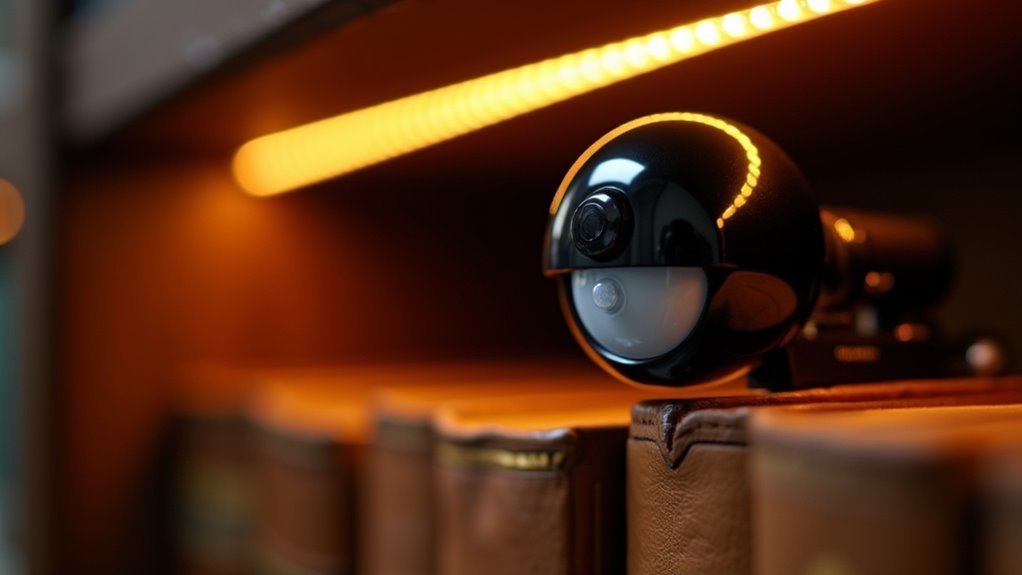
You’ve probably wondered how those convenient bookshelf lights know exactly when you’re approaching your favorite novel. Motion-activated lighting isn’t magic—it’s sophisticated sensor technology working behind the scenes to detect your presence and illuminate your books instantly. The science involves multiple components working together, from infrared detection systems to smart power management circuits. Understanding these mechanisms will transform how you think about lighting your personal library.
Understanding Motion Sensor Technology for Bookshelf Applications
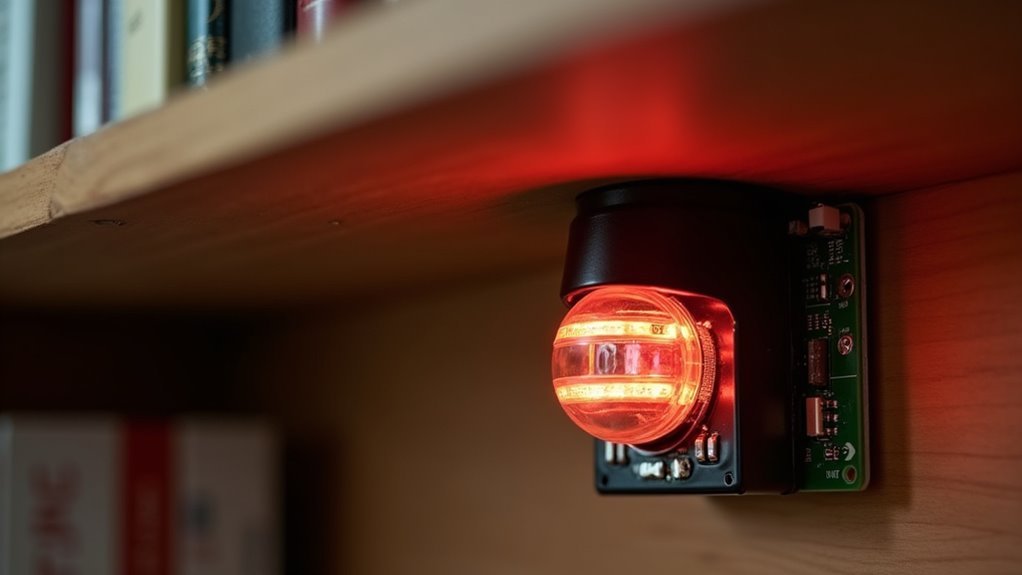
When you’re looking to upgrade your bookshelf lighting, understanding how motion sensor technology works can help you make the best choice for your space.
Most motion-activated bookshelf lights use passive infrared (PIR) technology, which detects your body heat as you approach. The motion sensor typically covers about 10 feet with a wide field of view, ensuring it’ll catch your movement from various angles.
Once the sensor detects movement, your motion activated LED light switches on instantly, illuminating your books and shelves.
After you leave the area, the light automatically turns off after roughly 20 seconds of inactivity. This smart functionality conserves battery life while providing convenient hands-free illumination whenever you need it, eliminating the frustration of searching through dark shelves.
Types of Motion Detection Systems Used in Bookshelf Lighting
You’ll find two main types of motion detection systems powering your bookshelf lights: passive infrared sensors and dual technology sensors.
Passive infrared detection works by monitoring heat signatures from your body movement, while dual technology sensors combine both infrared and microwave detection methods for enhanced accuracy.
Understanding these systems helps you choose the right motion-activated lighting solution that’ll reliably respond to your presence near your books.
Passive Infrared Detection
Since most motion-activated bookshelf lights rely on passive infrared (PIR) detection, understanding how these systems work will help you choose the right lighting solution for your needs.
PIR sensors detect infrared radiation naturally emitted by your body heat. When you approach your bookshelf, the motion sensor recognizes this thermal signature and triggers the lights within less than a second.
These systems typically work effectively within 10-15 feet, perfect for most home libraries. However, you’ll need to guarantee clear line of sight between the sensor and your movement area, as obstructions can interfere with detection accuracy.
What makes PIR technology particularly appealing is its energy-efficient design. The lights automatically shut off after predetermined inactivity periods, conserving battery life and reducing energy consumption considerably.
Dual Technology Sensors
Dual technology sensors represent the next evolution in motion-activated bookshelf lighting, combining both passive infrared and microwave detection methods to deliver superior accuracy and reliability.
These advanced motion sensors detect both body heat and movement reflections, covering larger areas while considerably reducing false alarms that plague single-technology systems.
You’ll benefit from their ability to adapt to different lighting conditions, ensuring your LED light activates consistently whether it’s day or night.
Installing these sensors at 66-78 inches maintains ideal detection coverage for anyone accessing your shelves.
- Enhanced accuracy – Dual detection methods minimize false triggers from environmental changes
- Larger coverage area – Body heat and microwave detection work together for thorough monitoring
- Smart calibration – Ignores small movements like pets while responding to human presence
Essential Components and Hardware for Motion-Activated Book Lights
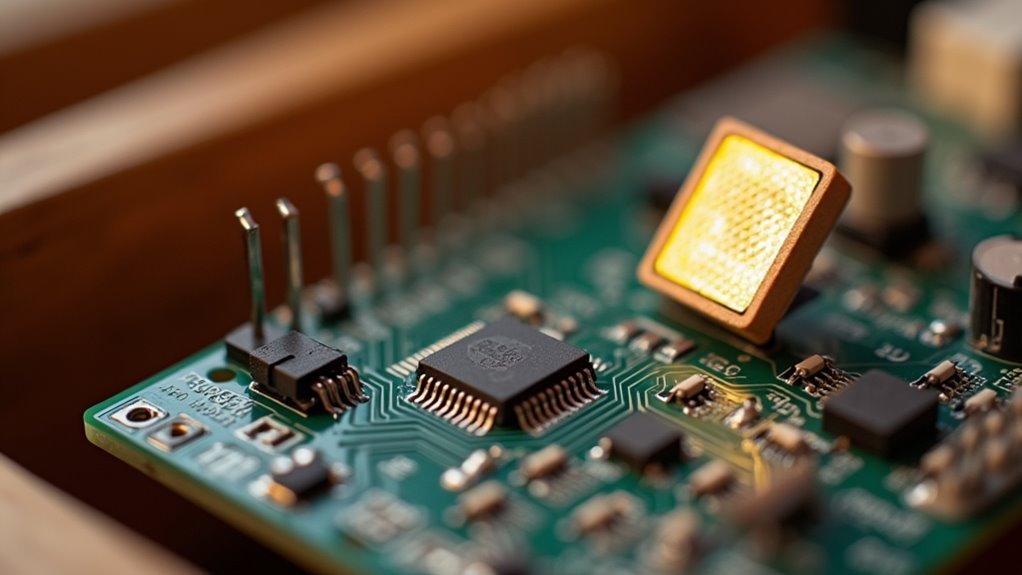
When you’re selecting motion-activated bookshelf lights, the passive infrared (PIR) sensor serves as the core component that detects your body heat and triggers the illumination system.
These motion sensor units work seamlessly with energy-efficient LED lights to provide bright illumination while minimizing power consumption. You’ll find that most models include rechargeable batteries with convenient USB power charging capabilities, allowing weeks of operation in sensor mode.
The hardware typically features adjustable brightness controls, letting you customize light intensity for reading or display purposes.
Installation components often include adhesive strips or magnetic fixtures for flexible positioning. These mounting options guarantee you can secure the lights on or within your bookshelves without complex wiring or permanent modifications to your furniture.
Optimal Placement Strategies for Maximum Sensor Effectiveness
Although proper sensor placement may seem straightforward, you’ll achieve maximum performance by positioning your motion-activated bookshelf lights between 66-78 inches from the floor. This ideal placement guarantees your motion sensor maintains a clear line of sight for detecting movement effectively.
You’ll want to avoid common placement mistakes that reduce sensor accuracy:
- Keep lights away from heat sources like radiators or heating vents to prevent false activations from temperature fluctuations.
- Position sensors away from direct sunlight and reflective surfaces such as windows that interfere with detection.
- Guarantee an unobstructed view of the monitoring area by removing obstacles that block the sensor’s range.
For thorough coverage, install multiple lights across different bookshelf sections, creating well-lit environments throughout your entire reading space.
Step-by-Step Installation Process for DIY Bookshelf Motion Lights
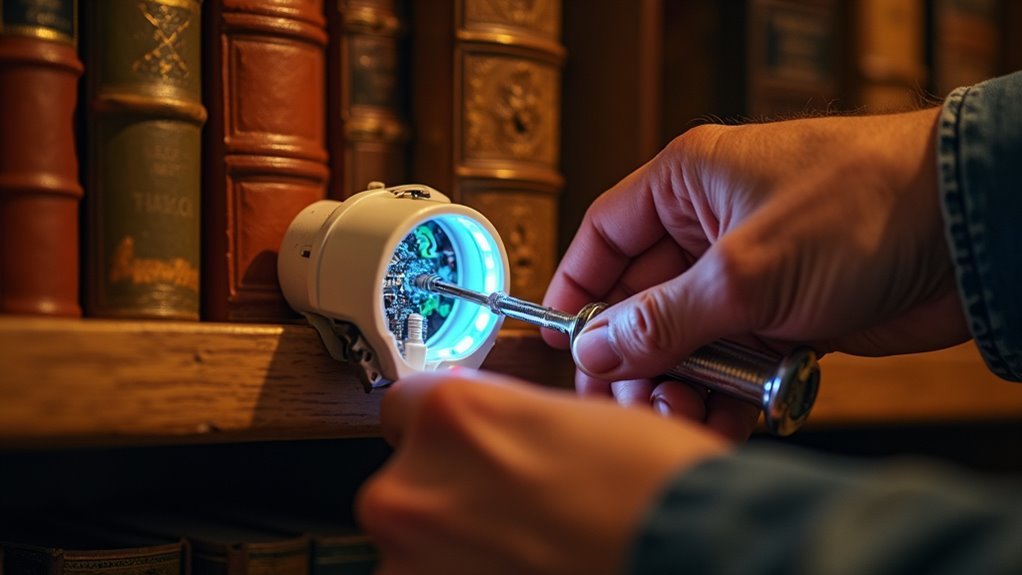
Before starting your installation, you’ll need to gather essential tools including a Phillips screwdriver, drill with a 7/32 bit, tape measure, and mounting screws.
Motion-activated cabinet lighting is simple to install when you follow these steps systematically.
Measure and mark your desired height between 66-78 inches from the floor, ensuring the motion sensor has an unobstructed view. Drill holes for your screws, then secure the light fixture to your bookshelf or wall, keeping it level and stable.
For adhesive installations, clean and dry the surface thoroughly before applying tape.
Once mounted, test your motion sensor by walking in front of it to confirm proper activation. Adjust the angle as needed to optimize the detection range for your specific space.
Power Management and Battery Considerations for Long-Term Use
You’ll want to maximize your motion-activated bookshelf lights’ battery performance through strategic power management techniques.
USB charging capabilities offer convenient recharging options that’ll keep your lights operational without constantly replacing disposable batteries.
Monitoring your lights’ power consumption patterns helps you identify ideal settings that balance illumination needs with extended battery life.
Battery Life Optimization
When you’re looking to maximize the performance of your motion-activated bookshelf lights, understanding battery management becomes essential for long-term satisfaction.
Most models use rechargeable batteries with 2500mAh capacity, providing 2-4 weeks of operation in motion sensor mode. You’ll get approximately three hours of continuous use in “ON” mode before recharging becomes necessary.
Strategic placement greatly impacts battery life optimization. Position your lights in areas with moderate foot traffic to reduce unnecessary activations while maintaining functionality.
- Choose models with energy-efficient LED technology to minimize power consumption and extend operating time
- Monitor usage patterns and adjust placement to balance convenience with battery conservation
- Regularly check battery levels and establish a consistent charging schedule to prevent unexpected outages
USB Charging Benefits
USB charging transforms how you manage power consumption for your motion-activated bookshelf lights by eliminating the expense and environmental impact of disposable batteries.
The USB charging benefits extend beyond convenience, offering remarkable versatility for powering your lights. You’ll appreciate connecting to power banks, laptop ports, or wall adapters without specialized chargers.
Your rechargeable battery, typically a robust 2500mAh capacity, delivers exceptional longevity between charges. In motion sensor mode, you’ll enjoy 2-4 weeks of reliable operation with regular activation.
The system’s automatic shutoff after 20 seconds of inactivity maximizes energy efficiency while maintaining functionality.
You can easily monitor power levels and recharge proactively, ensuring consistent performance. With proper care, your rechargeable battery will maintain peak capacity for over two years, making these lights a smart long-term investment.
Power Consumption Monitoring
Monitoring your motion-activated bookshelf lights’ power consumption becomes straightforward with modern energy-efficient LED technology that dramatically reduces electricity costs compared to traditional lighting.
The motion sensor activates only when detecting movement, automatically shutting off after approximately 20 seconds of inactivity to maximize energy conservation.
You can enhance your power consumption tracking by integrating these lights with smart home systems that provide detailed usage data and optimization insights:
- Track real-time energy usage patterns through connected apps
- Monitor battery performance and receive low-power alerts
- Schedule automatic dimming or activation periods for maximum efficiency
With USB rechargeable batteries offering up to four weeks of operation and replaceable components lasting over two years, you’ll maintain consistent performance while minimizing maintenance requirements and long-term costs.
Frequently Asked Questions
What Triggers Motion Sensor Lights?
Your body heat triggers motion sensor lights through infrared detection. When you move within their range, sensors detect temperature changes from your warm body, automatically activating the lights for convenient illumination.
What Activates a Motion Sensor Light?
Your body heat and movement activate motion sensor lights through passive infrared technology. When you walk within the sensor’s detection range, it detects temperature changes and triggers the light to turn on automatically.
Why Is My LED Motion Light Not Working?
Your LED motion light isn’t working because you’ve got a dead battery, blocked sensor, or interference from heat sources. Check if it’s positioned correctly at 66-78 inches and try resetting it.
How Are Motion Sensor Lights Powered?
You’ll find motion sensor lights powered by rechargeable batteries, typically 2500mAh capacity, or through USB charging connections. They’re designed to conserve energy by activating only when detecting movement, extending battery life considerably.


Leave a Reply