
Your smart home’s success hinges on choosing the right protocol hub—the central brain that orchestrates every connected device in your house. You’ll find dozens of options promising seamless automation, but most homeowners make critical mistakes when selecting their hub, leaving them with frustrated connectivity issues and incompatible devices. The key isn’t just picking any hub; it’s understanding which communication standards will actually work together in your specific setup.
Understanding Smart Home Protocol Hubs and Their Role
How do dozens of smart devices from different manufacturers communicate seamlessly in your home? The answer lies in smart home hubs that serve as central command centers for your entire ecosystem.
Smart home hubs act as universal translators, enabling seamless communication between devices from different manufacturers in your connected home.
These hubs translate between various communication protocols like Zigbee, Z-Wave, Wi-Fi, and Thread, ensuring your devices can work together regardless of their manufacturer.
Multi-protocol hubs excel at breaking down compatibility barriers, allowing you to mix and match devices without worrying about brand restrictions. They enhance interoperability by creating a unified network where your smart thermostat, lighting, and security systems can collaborate effectively.
Beyond simple connectivity, these hubs enable sophisticated automation scenarios. You’ll control everything through a single interface, streamlining your smart home experience while maximizing the potential of devices from different manufacturers working in perfect harmony.
Essential Communication Protocols for Home Automation
When you’re selecting a smart home hub, you’ll need to understand how different communication protocols stack up against each other regarding performance and practicality.
Wi-Fi offers high bandwidth for data-heavy devices but consumes more power and can face interference issues, while Zigbee and Z-Wave excel with low-power mesh networking that extends your system’s range and battery life.
Your choice between these protocols will directly impact both how far your smart devices can reach throughout your home and how often you’ll need to replace batteries or recharge devices.
Protocol Comparison Analysis
While choosing the right communication protocol can make or break your smart home setup, understanding how each option performs across key factors like power consumption, range, and device compatibility will guide you toward the best solution.
Smart home hubs rely on these communication protocols to orchestrate your connected devices effectively.
Key Performance Factors:
- Power Efficiency – Zigbee and Thread excel for battery-operated devices, while Wi-Fi drains power faster.
- Range Coverage – Z-Wave’s sub-GHz frequency provides superior range compared to Wi-Fi’s potential interference issues.
- Device Compatibility – Wi-Fi offers broadest support, but Matter guarantees universal interoperability across platforms.
- Network Architecture – Mesh protocols like Zigbee create self-healing networks, while Thread eliminates central hub dependency.
Matter’s open-source standard revolutionizes interoperability by bridging different protocols seamlessly.
Power and Range
Understanding power consumption and transmission range becomes critical as you design your smart home network, since these factors directly impact both your energy bills and device reliability.
Z-Wave operates in sub-GHz frequencies, delivering exceptional range and reliability for larger homes with obstacles.
Zigbee’s 2.4 GHz mesh topology extends range by relaying signals through connected devices, creating robust coverage.
Wi-Fi provides high-speed transmission for bandwidth-intensive smart home devices like cameras, though interference can limit range without strategic router placement.
Thread’s IPv6-based mesh protocol enables direct device communication without central hubs, optimizing both power efficiency and range.
Bluetooth Low Energy excels in power conservation for battery-operated devices but restricts coverage to short-range, localized applications.
Z-Wave Technology: Mesh Networking for Reliable Control
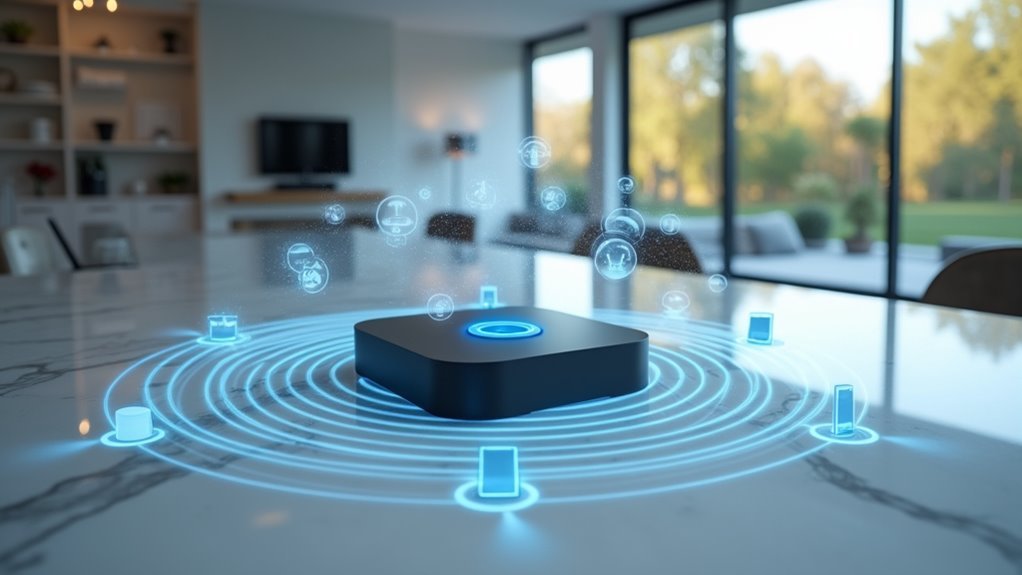
Since Z-Wave operates in the sub-GHz frequency band, it creates a robust mesh network where each device strengthens your entire smart home system. Each Z-Wave device acts as a node, allowing signals to hop between devices for reliable communication throughout larger homes.
This mesh networking approach guarantees your commands reach their destination even when direct paths aren’t available.
Your smart home setup benefits from Z-Wave’s thorough capabilities:
- Network capacity: Supports up to 232 devices for extensive automation
- Low power consumption: Battery-operated devices last considerably longer than Wi-Fi alternatives
- Secure data transmission: AES 128 encryption protects against unauthorized access
- Extended coverage: Signal hopping between devices eliminates dead zones
Z-Wave’s mesh architecture transforms individual devices into collaborative network partners, delivering consistent performance across your entire home.
Zigbee Protocol: Low-Power Wireless Communication
Zigbee’s foundation rests on efficient 2.4 GHz wireless communication that prioritizes minimal power consumption for your smart home devices. This low-power protocol creates a mesh network where each device can relay signals to others, dramatically extending your system’s range and reliability throughout your home.
You’ll appreciate Zigbee’s impressive scalability, supporting up to 65,000 devices on a single network. This makes it perfect for extensive smart home installations where you’re planning significant expansion.
The protocol’s energy efficiency means your battery-operated sensors and smart locks will run for years without replacement.
Your wireless communication remains secure through AES 128 encryption, protecting your smart home data from potential threats.
Zigbee’s mesh network topology guarantees consistent connectivity even when individual devices encounter interference.
Wi-Fi Integration: High-Bandwidth Device Connectivity
Wi-Fi delivers the high-bandwidth backbone your smart home needs for data-intensive devices like security cameras, streaming speakers, and video doorbells. Unlike low-power protocols, Wi-Fi handles substantial data flows that enable 4K video streaming and real-time audio transmission.
Your modern smart home hub’s Wi-Fi capabilities provide centralized control over these demanding devices while maintaining seamless performance.
Modern smart home hubs leverage Wi-Fi’s high-bandwidth capabilities to deliver centralized control and seamless performance across data-intensive connected devices.
You’ll benefit from Wi-Fi’s extensive compatibility across manufacturers, though you might encounter interference issues in larger homes. The protocol’s WPA2 and WPA encryption protect your data during transmission, while integrated automation features let you coordinate multiple high-bandwidth smart home devices simultaneously.
- Supports 4K security cameras and video doorbells without lag
- Enables seamless music streaming through multiple smart speakers
- Provides robust encryption for secure data transmission
- Integrates with hubs for thorough home automation
Thread Protocol: IPv6-Based Mesh Networks
Thread protocol builds upon IPv6 technology to create self-healing mesh networks that connect your smart home devices without requiring a central hub.
You’ll benefit from devices that relay data between each other, extending your network’s range throughout your home. This mesh topology means if one device fails, others automatically reroute communications to maintain connectivity.
Your battery-powered devices will last longer since Thread’s designed for energy efficiency, minimizing power consumption while ensuring reliable communication.
You can integrate devices from various manufacturers thanks to Matter compatibility, creating a truly interoperable ecosystem.
Security remains paramount with AES 128 encryption protecting all data transmission across your network.
Thread’s IPv6 foundation enables direct device-to-device communication, eliminating single points of failure while providing robust, scalable connectivity for your expanding smart home infrastructure.
Matter Standard: Universal Device Compatibility
You’ll find that Matter’s open standard breaks down the walls between different smart home brands, letting your Apple, Google, and Amazon devices work together seamlessly.
This cross-brand integration means you’re no longer locked into a single ecosystem when building your smart home.
Cross-Brand Device Integration
Since smart home devices from different manufacturers traditionally operate in isolated ecosystems, the Matter standard represents a breakthrough in achieving true cross-brand compatibility.
You’ll no longer need multiple smart home hubs or separate apps to control devices from different brands. Matter’s use of IPv6 enables seamless communication protocols across Thread, Wi-Fi, and Ethernet connections, creating unified interoperability within your smart home ecosystem.
The rigorous certification process guarantees devices work together effortlessly, eliminating compatibility headaches you’ve experienced before. With major players like Apple, Amazon, and Google backing this cross-brand integration, you’re assured widespread support.
- Universal device control through a single interface
- Simplified setup process with certified interoperability
- Future-proof investment with ongoing open-source development
- Reduced dependency on manufacturer-specific ecosystems
Future-Proof Smart Homes
While smart home technology evolves at breakneck speed, Matter’s open-source architecture guarantees your investment won’t become obsolete within a few years.
You’ll benefit from universal compatibility that connects devices from different manufacturers seamlessly, eliminating the frustration of incompatible ecosystems. Matter’s IPv6 support guarantees your home scales effortlessly as you add new technology, while existing protocols use Thread, Wi-Fi, and Ethernet networks you already have.
Your smart home Matter deployment protects against future obsolescence since major companies like Apple, Amazon, and Google have committed to this standard.
Communication between devices remains consistent regardless of brand, creating truly future-proof smart homes. You won’t need expensive upgrades or replacements when switching between compatible devices, making Matter the smart choice for long-term home automation success.
Bluetooth Low Energy for Short-Range Smart Devices
Although many smart home protocols compete for dominance in wireless communication, Bluetooth Low Energy (BLE) has carved out a specific niche for short-range, battery-powered devices. Operating in the 2.4 GHz band, BLE excels at short-range communication up to 100 meters while consuming minimal power. This makes it perfect for smart devices like fitness trackers and smart locks that need extended battery life.
BLE’s exceptional power efficiency and 100-meter range make it the go-to protocol for battery-powered smart home devices.
Key advantages of BLE for smart homes include:
- Considerably lower power consumption compared to traditional Bluetooth
- Seamless integration with smart home hubs from manufacturers like Flic and Qolsys
- Ideal for localized device interactions within single rooms
- Perfect for controlling smart lighting and audio devices
BLE’s limited range makes it unsuitable for whole-home automation but excellent for targeted applications.
Ethernet Connections: Wired Stability for Critical Devices
When you’re setting up critical smart home devices like security cameras or entertainment systems, Ethernet connections deliver the high-speed data transmission your most demanding equipment needs.
You’ll experience reliable network performance that wireless protocols simply can’t match, especially in environments where Wi-Fi signals struggle to reach.
However, you’ll need to plan for cable infrastructure requirements that involve running wires throughout your home, which takes more effort upfront but pays off with rock-solid connectivity.
High-Speed Data Transmission
Most smart home enthusiasts discover that Ethernet connections deliver unmatched performance for their most critical devices. This wired technology provides high-speed data transmission at speeds reaching 10 Gbps, ensuring your bandwidth-intensive equipment operates flawlessly.
You’ll experience reliable performance that wireless protocols simply can’t match, especially for security cameras and streaming systems.
- Interference-free connectivity – Wired connections eliminate wireless signal disruptions
- Long-distance capability – Twisted pair and fiber-optic cables maintain signal quality throughout larger homes
- Universal compatibility – Seamless integration with various smart home systems requiring consistent network connectivity
- Superior protection – Enhanced security features protect against unauthorized access
Your smart home systems benefit from Ethernet’s inherent stability, making it the preferred choice for critical devices that demand unwavering network connectivity and enhanced security.
Reliable Network Performance
Beyond achieving impressive speeds, Ethernet’s greatest strength lies in its unwavering reliability when your smart home depends on consistent network performance. You’ll experience minimal interference and reduced latency that wireless connections can’t match, ensuring communication between different smart devices remains seamless.
| Device Type | Performance Benefit | Distance Coverage |
|---|---|---|
| Smart home hubs | Zero connection drops | Up to 328 feet |
| Security cameras | Stable video streaming | Consistent quality |
| Gaming consoles | Low latency gaming | Uninterrupted sessions |
| Automation systems | Real-time responses | Reliable commands |
Ethernet connections handle multiple devices connected simultaneously without performance degradation. Your protocols for smart home networks gain enhanced security since physical access is required for breaches. This reliable performance makes Ethernet essential for critical smart home infrastructure requiring constant connectivity.
Cable Infrastructure Requirements
Although establishing Ethernet infrastructure requires upfront planning and installation effort, you’ll need to take into account several key factors that determine your smart home’s wired network success.
Your cable infrastructure forms the backbone of reliable wired communication, connecting smart home hubs and critical devices that demand consistent performance.
- Cable routing through walls and ceilings requires careful planning to minimize installation complexity while maintaining clean aesthetics.
- Strategic placement of Ethernet ports guarantees ideal connectivity for security cameras, gaming systems, and streaming devices.
- Cat6 or Cat6a cables provide the high-speed data transmission capabilities needed for bandwidth-intensive smart home applications.
- Professional installation services can handle complex runs and guarantee proper termination for maximum low latency performance.
This Ethernet foundation supports your most demanding devices when wireless simply isn’t enough.
Multi-Protocol Hub Advantages Over Single-Protocol Systems
When you’re building a smart home, single-protocol systems force you into rigid ecosystems that limit your device choices and create compatibility headaches.
Multi-protocol hubs eliminate these restrictions by seamlessly integrating Zigbee, Z-Wave, Wi-Fi, and Bluetooth devices from different manufacturers through a single interface. You’ll gain the flexibility to choose the best devices for your specific needs rather than settling for what’s available within one ecosystem.
These hubs support multiple communication standards, enabling devices that normally can’t talk to each other to work together in advanced automation scenarios.
You’ll also benefit from local control, which improves response times and enhances security by reducing cloud dependency.
Additionally, multi-protocol hubs future-proof your investment by ensuring compatibility with emerging technologies like Matter.
Hub Selection Criteria: Range, Power, and Compatibility
How do you choose the right hub when countless options flood the smart home market? You’ll need to evaluate several critical factors that directly impact your smart home’s performance and functionality.
Consider these essential selection criteria:
- Range of communication protocols – Z-Wave excels for larger homes, while Bluetooth works best for short-range applications.
- Power efficiency – Zigbee and Z-Wave extend battery life for wireless devices, unlike power-hungry Wi-Fi connections.
- Compatibility with various devices – Matter hubs support multiple protocols for enhanced interoperability across smart home devices.
- Local operation capabilities – Minimize cloud dependence while maintaining functionality during internet outages.
Factor in your initial purchase price alongside potential licensing fees for proprietary protocols. The right hub balances range, efficiency, and compatibility within your budget.
Top Multi-Protocol Smart Home Hubs Comparison
Five standout multi-protocol hubs dominate today’s smart home landscape, each offering distinct advantages for different user needs and budgets.
The Aeotec Smart Home Hub delivers excellent value at $129.99, supporting Zigbee, Z-Wave, Wi-Fi, and Matter for seamless smart devices integration.
Amazon Echo Hub’s 2024 edition features a 10-inch HD touchscreen and Matter support for $179.99, enhancing user interaction.
Homey Pro offers the most thorough multi-protocol support with intuitive automation capabilities, though it’s pricier at $400.
FIBARO’s Yubii Home Hub accommodates 40 devices across Z-Wave, Wi-Fi, and 433 MHz protocols for $141.95.
HomeSeer’s HomeTroller Pi G3 provides extensive programming flexibility through its web interface, supporting Z-Wave Plus and Zigbee for $149.
Each smart home hub option addresses different automation requirements and technical expertise levels.
Setting Up Your Protocol Hub for Maximum Performance
After selecting your ideal multi-protocol hub from the available options, proper setup becomes the foundation for achieving peak smart home performance.
Your hub’s ability to support multiple protocols guarantees seamless integration across your smart home ecosystem, but strategic placement and configuration maximize its potential.
Strategic hub placement and proper configuration unlock your multi-protocol device’s full potential for seamless smart home integration.
Position your central device in your home’s center to optimize wireless signal strength and minimize interference. This placement strategy enhances connectivity across all connected devices.
- Enable local control features to maintain functionality during internet outages and reduce response times
- Schedule regular firmware updates to access security enhancements and new protocol compatibility
- Organize devices into scenes and automations based on daily usage patterns
- Implement systematic device management by grouping similar devices for streamlined control
These optimization steps transform your hub into a reliable command center.
Future-Proofing Your Smart Home With Scalable Hub Solutions
You’ll want to choose hub solutions that support emerging scalable protocol standards like Matter, which guarantees your devices from different manufacturers can communicate seamlessly as technology evolves.
Smart hubs such as Homey Pro and Samsung SmartThings offer clear upgrade pathways that let you add new protocols and device compatibility through software updates rather than hardware replacement.
This approach protects your investment while keeping your smart home system adaptable to future technological advances.
Scalable Protocol Standards
While smart home technology continues evolving at breakneck speed, scalable protocol standards like Matter have emerged as the cornerstone for building future-proof ecosystems that won’t leave you scrambling to replace devices every few years.
These standards guarantee interoperability across manufacturers, letting you mix and match devices without compatibility headaches.
Matter’s multi-protocol support means your devices can communicate through Thread, Wi-Fi, or Ethernet, adapting as technology advances.
Meanwhile, Zigbee and Z-Wave leverage mesh networking to expand coverage and support numerous devices simultaneously.
Key benefits of scalable protocol standards include:
- Cross-manufacturer device compatibility reduces vendor lock-in
- Mesh networking capabilities extend range and device capacity
- Robust security measures like AES 128 encryption protect growing networks
- Future technology compatibility minimizes upgrade costs
Hub Upgrade Pathways
Since smart home ecosystems continue expanding rapidly, choosing a hub with robust upgrade pathways becomes critical for protecting your long-term investment.
Multi-protocol hubs supporting Zigbee, Z-Wave, Wi-Fi, and Matter compatibility guarantee you won’t need expensive hardware replacements as technologies evolve. The Aeotec Smart Home Hub and Homey Pro exemplify future-proofing by adapting to new protocols seamlessly.
Prioritize hubs offering local control capabilities, which maintain functionality during internet outages while enhancing security.
This approach strengthens your smart home ecosystem’s reliability regardless of external disruptions.
Regular software updates from manufacturers keep your hub current with emerging devices and security patches.
When selecting upgrade pathways, consider hubs that balance protocol flexibility with consistent manufacturer support, assuring your investment remains viable as smart home standards continue advancing.
Frequently Asked Questions
What Is the Best Protocol for Home Automation?
You’ll find Matter’s the best choice for most homes since it’s open-source and guarantees compatibility across different manufacturers. For specific needs, consider Wi-Fi for high-bandwidth devices or Zigbee/Z-Wave for low-power applications.
What Is the Best Home Automation Hub?
You’ll want the Aeotec Smart Home Hub for $129.99, supporting Matter, Zigbee 3.0, and Z-Wave Plus. It offers excellent compatibility, local processing, voice control integration, and user-friendly SmartThings app management.
What Protocols Are Used in Smart Hub?
Your smart hub uses multiple protocols including Wi-Fi for high-speed devices, Zigbee and Z-Wave for low-power mesh networks, and Matter for universal compatibility across different manufacturers’ devices.
What Protocol Do Hubs Use?
You’ll find hubs use multiple protocols like Wi-Fi, Zigbee, Z-Wave, and Thread to connect different devices. They’re switching to Matter protocol for better interoperability, letting you control everything seamlessly.

Leave a Reply