
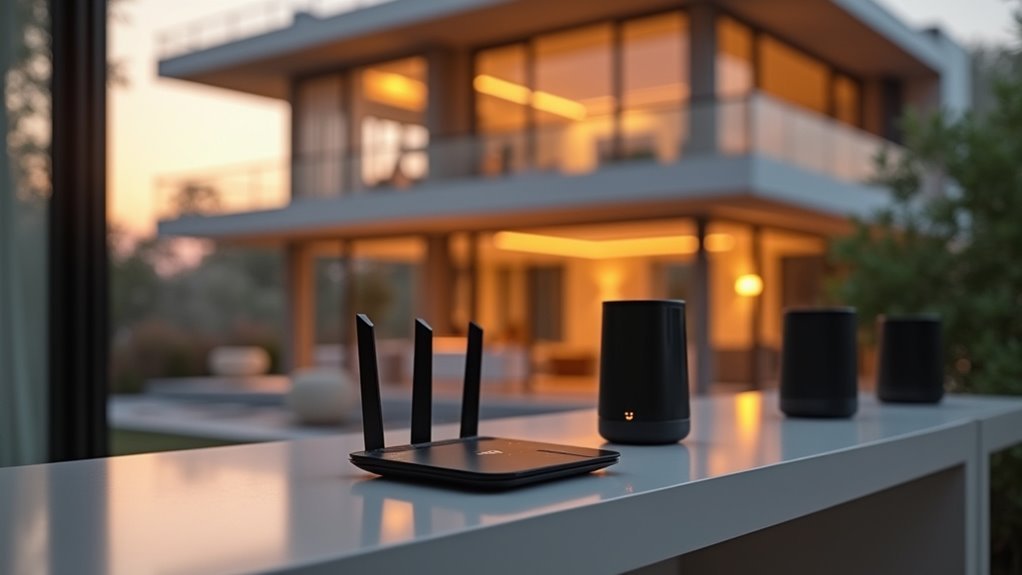
You’ve probably experienced the frustration of dead zones and weak signals in your multi-story home, where your Wi-Fi barely reaches the basement or struggles to penetrate thick walls between floors. Standard routers simply can’t handle the vertical challenges that come with multiple levels, leaving you with inconsistent coverage and dropped connections. The solution lies in mesh networking technology, but choosing the right system requires understanding which models actually deliver on their promises of whole-home coverage.
Eero Pro 6E – Superior Coverage for Three-Story Homes

When you’re dealing with a sprawling three-story home, the Eero Pro 6E mesh system delivers the robust coverage you need to eliminate frustrating dead zones.
This powerhouse uses tri-band technology to strengthen your Wi-Fi coverage across 6,000 square feet, ensuring every floor receives a strong signal.
You’ll appreciate the Wi-Fi 6E technology that provides faster speeds when multiple smart devices connect simultaneously.
Each unit includes Ethernet ports for wired connections to gaming consoles and smart TVs that demand stable connectivity.
The system excels in multi-story homes where traditional routers fail.
Network management becomes effortless through the Eero app’s user-friendly interface, letting you monitor connections and optimize performance throughout your entire home with just a few taps.
TP-Link Deco BE63 – High-Performance Wi-Fi 7 for Gigabit Connections
For homes equipped with gigabit internet service, the TP-Link Deco BE63 mesh system releases the full potential of Wi-Fi 7 technology to deliver blazing-fast speeds across multiple floors.
This high-performance mesh network handles bandwidth-intensive activities like 4K streaming and online gaming simultaneously without compromising speed.
The BE63’s five 2.5 GbE Ethernet ports provide exceptional connectivity options for wired devices, boosting overall network performance.
With five 2.5 GbE ports, the BE63 delivers exceptional wired connectivity that supercharges your entire network’s performance.
You’ll eliminate Wi-Fi dead zones throughout your multi-story homes while maintaining backward compatibility with older Wi-Fi standards.
- Experience lightning-fast gigabit connections that keep your entire family connected
- Stream multiple 4K videos without frustrating buffering or lag
- Game competitively with ultra-low latency across every floor
- Connect all your smart devices with rock-solid reliability
Asus ZenWiFi XT8 – Professional-Grade Multi-Floor Performance

While many mesh systems struggle to maintain consistent performance across multiple floors, the Asus ZenWiFi XT8 delivers professional-grade coverage that spans over 5,000 square feet without compromising speed or reliability. This system’s tri-band Wi-Fi 6 technology guarantees robust coverage throughout multi-story homes, while its dedicated backhaul enhances node communication for superior network performance.
| Floor Level | Coverage Area | Performance |
|---|---|---|
| Basement | 1,200 sq ft | Full signal strength |
| Main Floor | 1,800 sq ft | Peak speeds |
| Second Floor | 1,500 sq ft | Consistent connectivity |
| Third Floor | 500 sq ft | Zero dead zones |
You’ll appreciate the easy setup through the Asus Router app, which streamlines network management. The ZenWiFi XT8’s AiMesh compatibility lets you expand coverage by integrating additional Asus routers, effectively helping eliminate dead zones across any home layout.
Netgear Orbi 970 Series – Premium Speed Across Multiple Levels
The Netgear Orbi 970 Series stands as the ultimate solution for demanding multi-story households that require blazing-fast speeds up to 10.8 Gbps without compromise.
This tri-band mesh system leverages cutting-edge Wi-Fi 6E technology to eliminate dead zones throughout multi-story homes while delivering premium speeds that handle high bandwidth demands effortlessly.
You’ll experience unparalleled performance with the dedicated 6GHz backhaul band ensuring maximum throughput between nodes. The system supports up to 200 smart devices simultaneously, while multiple Ethernet ports enable wired connections for enhanced network performance.
- Freedom from buffering – Stream 8K content on every floor without interruption
- Gaming dominance – Zero lag across all levels for competitive advantage
- Smart home paradise – Connect hundreds of devices with rock-solid reliability
- Future-proof investment – Wi-Fi 6E technology protects your upgrade for years
TP-Link Deco S4 – Budget-Friendly Option for Smaller Multi-Story Houses

When budget constraints meet multi-story connectivity needs, the TP-Link Deco S4 delivers impressive performance at just $100 without sacrificing reliable coverage throughout your home.
This budget-friendly mesh system blankets up to 3,000 square feet with steady wireless coverage, effectively eliminating dead zones across multiple levels in smaller multi-story homes.
You’ll appreciate the easy setup process with pre-paired units that get you connected immediately.
The dual-band Wi-Fi handles internet speeds up to 500 Mbps while supporting up to 50 smart devices simultaneously.
Whether you’re streaming on the top floor or browsing downstairs, you’ll maintain steady connections for everyday tasks.
For families seeking dependable mesh networking without premium pricing, the Deco S4 proves that reliable coverage doesn’t require breaking your budget.
Frequently Asked Questions
Is Mesh Wifi Good for Multiple Floors?
Yes, you’ll find mesh Wi-Fi excellent for multiple floors. It eliminates dead zones, maintains consistent speeds throughout your home, and handles numerous devices simultaneously. Strategic node placement guarantees strong coverage across all levels.
What Is the Best Mesh Wifi System for Large Homes?
You’ll want the Asus ZenWiFi XT8 for excellent coverage and performance elimination of dead zones. It’s highly recommended for large homes, providing reliable connectivity across multiple floors effectively.
What Is a Major Disadvantage of a Mesh Network?
You’ll face higher costs as a major disadvantage, with quality mesh systems reaching $400 or more. You’re also likely to experience latency issues when multiple devices connect to the same node.
How Many Mesh Nodes for a 3 Story House?
You’ll need 3-4 mesh nodes for a three-story house. Place one node on each floor, positioning them centrally for ideal coverage. Test different locations and add extra nodes if you encounter dead zones or weak signals.

Leave a Reply