

You’ve probably walked into your home countless times only to manually flip light switches and adjust thermostats, wondering why your smart home isn’t actually that smart. Setting up automated presence detection with Node-RED transforms this frustrating routine into seamless convenience. Your devices will know exactly when you’re coming and going, but there’s a specific sequence of steps you’ll need to master before your home starts anticipating your every move.
Understanding Node-RED and Home Assistant Integration
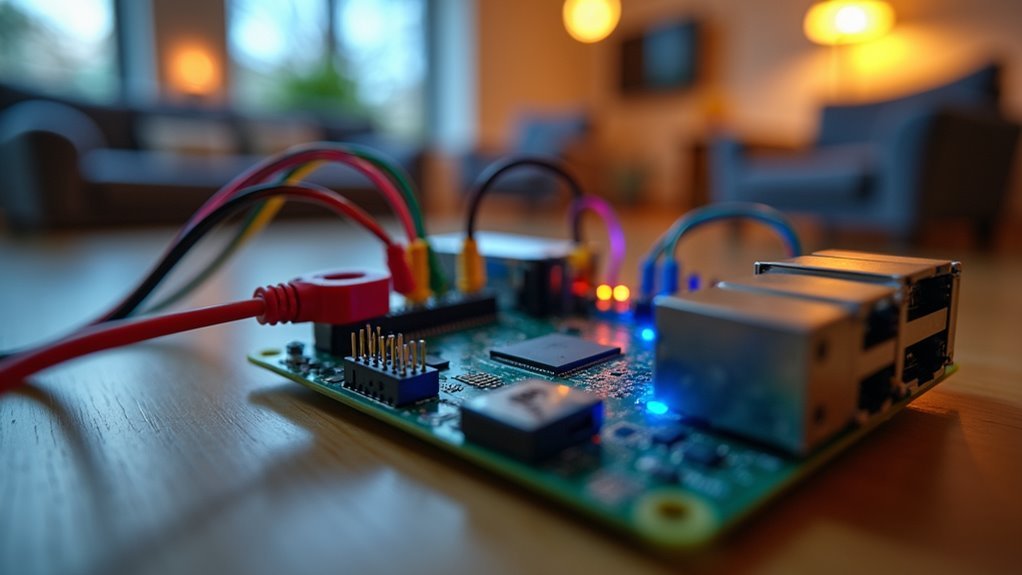
When you’re looking to create sophisticated home presence automations, Node-RED stands out as a powerful visual programming tool that transforms complex automation logic into intuitive, drag-and-drop workflows.
You’ll find that connecting nodes in the Node-RED interface makes integrating presence detection within your Home Assistant setup remarkably straightforward.
The seamless communication between Node-RED and Home Assistant enables you to build automations that respond instantly to presence status changes.
You can configure Home Assistant’s device_tracker component to work directly with Node-RED, providing real-time updates on family members’ locations.
This integration allows you to monitor device presence changes and trigger responsive automation actions, whether someone’s arriving home or leaving for work.
Installing Node-RED for Home Automation
You’ll need to install the Node-RED add-on through Home Assistant’s Supervisor to begin creating your presence automation flows.
Navigate to the Add-on Store, search for Node-RED, and click install to add this powerful visual programming tool to your system.
Once installed, you’ll configure the initial settings and enable sidebar access to streamline your automation development process.
Home Assistant Integration
Before you can harness Node-RED’s powerful automation capabilities, you’ll need to install it as an add-on through Home Assistant’s Add-on Store.
Once installed, configure the `credential_secret` setting to prevent startup issues. Access the Node-RED interface by clicking “OPEN WEB UI” to begin creating your automation flows.
Verify your connection by checking for a green Home Assistant icon in Node-RED’s sidebar. If it’s red, review the add-on log in Home Assistant to troubleshoot connection problems.
You’ll use the events: state node to monitor entity changes, triggering responsive actions based on their states.
Node-RED’s visual flow editor simplifies automation logic through drag-and-drop functionality, making home automation accessible and intuitive for managing presence detection workflows.
Node-RED Add-on Installation
Three simple steps will get Node-RED running on your Home Assistant system.
First, navigate to the Home Assistant Add-on Store and search for “Node-RED,” then click the install button to begin the installation process. Once installed, toggle the “show in sidebar” option for quick access to your smart home automation interface.
Next, configure your node-red settings by setting the `credential_secret` in the configuration options to prevent startup issues. This vital step guarantees your smart home automation platform runs smoothly.
Finally, launch the Node-RED interface by clicking “OPEN WEB UI.” You’ll discover a user-friendly workspace where the left sidebar contains nodes you can drag and drop into the flow area, creating powerful automation sequences for your connected devices.
Initial Configuration Setup
Once Node-RED is installed through the Home Assistant Add-on Store, you’ll need to complete several configuration steps to guarantee peak performance and security.
First, set the `credential_secret` in the configuration panel to prevent startup issues and enhance security during the Node-RED installation process. This step is essential for protecting your home automation credentials.
Next, enable Node-RED to start automatically at boot using `sudo systemctl enable nodered.service` if you’re running it on a Raspberry Pi separately.
After configuration, start Node-RED with the `node-red-start` command and access the interface by directing to `http://ip-address:1880` in your browser.
Verify the Home Assistant connection by confirming the Home Assistant icon in the sidebar appears green, indicating successful integration.
Configuring Device Trackers for Presence Detection
You’ll need to implement the Pingtrack platform in your Home Assistant configuration.yaml file to track devices on your network effectively.
Configure each device tracker by specifying IP addresses or hostnames of family members’ smartphones and other devices you want to monitor.
Test your setup thoroughly since modern devices often disable Wi-Fi to save battery, which can create false away states that’ll disrupt your automations.
Pingtrack Platform Implementation
Several device tracking platforms exist within Home Assistant, but Pingtrack stands out as one of the most reliable options for presence detection since it monitors devices through their IP addresses on your local network.
You’ll need to modify your configuration.yaml file to implement this platform effectively.
Add the device_tracker component and specify each device you want to monitor. The configuration supports multiple trackers, allowing you to simultaneously monitor phones, tablets, and other connected devices.
After setting up individual trackers, create a group that consolidates all tracked devices’ presence status. This simplifies your automation workflow considerably.
Remember that your devices must remain connected to the network for Pingtrack to provide accurate real-time presence updates and maintain reliable monitoring performance.
Device Tracker Configuration
Device tracker configuration forms the foundation of reliable presence detection in your Home Assistant setup.
You’ll need to define each device in your configuration.yaml file using unique MAC addresses or IP addresses for accurate home/away status detection. This guarantees your system can distinguish between different family members and their devices.
Create device tracker groups to monitor multiple people collectively, which provides more thorough presence data for your Node-RED automations.
However, you’ll face challenges with modern smartphones that automatically disable Wi-Fi to conserve battery, potentially causing false absence readings.
Regular testing and debugging of your device trackers is essential.
Monitor the tracking accuracy and adjust configurations as needed to guarantee your Node-RED presence automations trigger reliably when family members arrive or leave.
Reliability Testing Methods
Although device trackers can experience connectivity hiccups and false readings, implementing systematic testing methods guarantees your presence detection system performs reliably. You’ll need to simulate presence changes using inject nodes in Node-Red to verify automations respond correctly to both home and away states. The current state node monitors your group entity’s status, ensuring triggers activate only when intended.
| Test Scenario | Expected Result |
|---|---|
| Single member leaves | Group remains “home” |
| All members leave | Group changes to “away” |
| First member returns | Group changes to “home” |
| Network disconnection | No false “away” trigger |
| Phone Wi-Fi toggle | Maintains accurate status |
Regularly check Home Assistant logs to identify tracker issues like false triggers from phone disconnections, ensuring your automation system maintains accuracy.
Setting Up Ping-Based Presence Monitoring
When you’re ready to implement ping-based presence monitoring, you’ll start by modifying your configuration.yaml file to include device_tracker settings for each device you want to monitor.
This setup uses the Pingtrack platform, which periodically pings your specified devices to determine their online status.
Here’s how to configure effective ping-based presence monitoring with Node-RED:
Follow these steps to set up reliable ping-based presence detection that integrates seamlessly with your Node-RED automation workflows.
- Configure device tracking – Add device_tracker entries in configuration.yaml for smartphones and other devices you want to monitor.
- Ensure device connectivity – Keep your smartphones connected to Wi-Fi since modern phones disable Wi-Fi when idle, affecting tracking accuracy.
- Create presence groups – Aggregate multiple device statuses into a single group for simplified monitoring and automation triggers.
Use Node-RED’s current state node to check your group’s presence status and establish reliable automation triggers.
Creating Family Group Entities for Multi-User Tracking
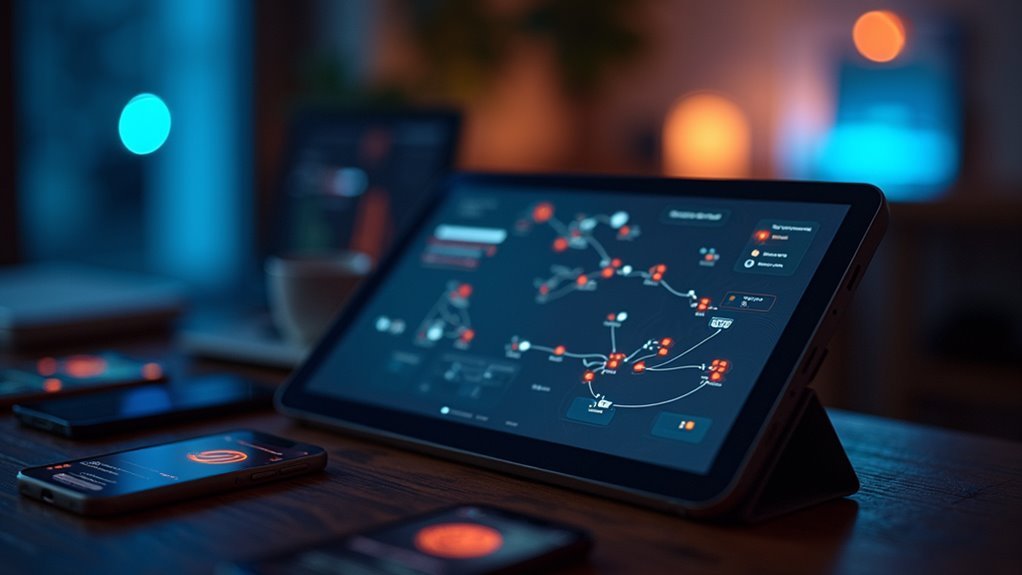
You’ll want to create a family group entity that combines all your individual device trackers into a single, manageable unit for streamlined automation.
This approach lets you monitor whether anyone’s home without checking each family member’s status separately.
Setting up the group configuration requires adding your device tracker entities to the `configuration.yaml` file, then implementing logic that determines the overall household presence state.
Group Configuration Setup
Managing multiple family members’ presence requires creating a unified group entity that consolidates individual device trackers into a single, manageable unit.
This group configuration streamlines automating your home by providing one entity to monitor instead of checking each person individually.
To configure your family presence group, you’ll need to:
- Edit configuration.yaml – Add a group entity with an intuitive name like “Family” that includes all family members’ device trackers.
- Verify device trackers – Ascertain each person’s tracker accurately reports home/away status for reliable detection.
- Test group behavior – Confirm the group shows “home” when anyone’s present and “not_home” when everyone’s away.
Once established, you can monitor this group in Node-RED using current state nodes to trigger presence-based automations efficiently.
Multi-Device Tracking Logic
Since family presence detection relies on multiple devices working together, implementing robust multi-device tracking logic becomes essential for accurate automation triggers.
You’ll need to create a family group in your Home Assistant configuration.yaml file that includes individual device trackers for each family member’s phone. This family group automatically aggregates the presence status of all members, simplifying your Node-Red automation logic.
Structure your group entity with clear naming conventions for easy reference in Node-Red flows.
When you monitor the family group using Node-Red’s current state node, you can determine whether any family member is home or everyone’s away. The group state updates automatically based on individual device trackers, eliminating the need to check each person’s status separately in your automation workflows.
Building Your First Presence Detection Flow
When you’re ready to create your first presence detection flow, start by opening Node-RED and establishing a new flow that’ll monitor your family’s comings and goings.
Setting up your initial presence detection flow begins with launching Node-RED and creating a dedicated monitoring system for household movement patterns.
Begin with an “events: state” node to track your device presence status, ensuring you’ve configured the correct entity IDs. Next, add a “current state” node to monitor your family group entity, which determines overall home occupancy.
Here’s your basic flow structure:
- Monitor individual devices – Use “events: state” nodes for each tracked device to capture real-time presence changes
- Evaluate group status – Connect a “switch” node to assess whether the group state shows “home” or “not_home”
- Trigger smart actions – Link an “API call” node to execute automated responses like controlling lights during nighttime departures
Test everything using “inject” nodes to simulate presence changes before deploying your smart automation.
Implementing Conditional Logic With Switch Nodes

Once your basic presence detection flow captures device states, you’ll need switch nodes to make intelligent decisions based on those conditions. Switch nodes enable sophisticated conditional logic by evaluating incoming payloads against specific criteria you define.
Configure multiple rules within each switch node to handle complex scenarios. You can check string values, numeric ranges, or Boolean states depending on your automation needs. For instance, trigger lights only when everyone’s away or adjust heating based on occupancy patterns.
| Condition Type | Example Use Case |
|---|---|
| String Match | Device name equals “John’s Phone” |
| Numeric Range | Temperature between 68-72°F |
| Boolean State | Motion sensor true/false |
| Presence Count | Number of devices > 0 |
| Time-based | Hour between 6-22 |
Each output path leads to different actions, creating tailored responses. Use debug nodes to monitor switch node outputs and verify your conditional logic works correctly.
Automating Lights Based on Home and Away Status
After establishing your conditional logic framework, you’ll want to connect presence detection directly to your lighting system for seamless automation. This integration transforms your home’s response to occupancy changes, creating intelligent lighting behaviors that enhance security and convenience.
To implement effective presence-based lighting automation:
- Configure group monitoring – Set up a Home Assistant group containing all family members’ device trackers to detect when everyone’s away.
- Implement time restrictions – Use Big Timer nodes to limit automation to nighttime hours, guaranteeing lights activate only when darkness provides security benefits.
- Create responsive actions – Deploy call service nodes that trigger on state change events, automatically controlling outside lights based on your family’s presence status.
This approach guarantees your home appears occupied while providing welcoming illumination upon return.
Testing and Debugging Your Presence Flows
Building reliable presence-based lighting automation requires thorough testing to verify your flows work correctly before you depend on them.
Start your testing process by adding Debug nodes to visualize flow outputs and identify logic issues. Use Inject nodes to simulate home and away states without physically moving devices. Monitor your group entity’s status with Current State nodes to guarantee accurate family presence detection.
| Testing Method | Purpose |
|---|---|
| Debug nodes | Visualize output and identify logic issues |
| Inject nodes | Simulate presence states for testing |
| Current State nodes | Monitor group entity status |
For debugging, regularly check Node-RED logs to troubleshoot errors or unexpected behavior. Review your flow configuration systematically and test each node individually to confirm they trigger as expected, maintaining reliable presence detection automation.
Advanced Presence Detection Methods and Alternatives
While basic device tracking through Wi-Fi connections provides a foundation for presence detection, you’ll often encounter reliability issues when smartphones disable Wi-Fi to conserve battery power.
Advanced presence detection methods offer more robust solutions for your Node-Red automations.
Consider implementing these enhanced approaches:
- Bluetooth Low Energy (BLE) tracking – Monitor devices that consistently broadcast signals without draining battery life.
- GPS-based geofencing – Create precise location boundaries using dedicated apps that communicate with your Node-Red flows.
- Smart gadgets integration – Combine motion sensors, smart door locks, and security cameras as presence indicators.
You’ll achieve better accuracy by layering multiple detection techniques together. This redundancy prevents false triggers and maintains reliable automation performance.
Regularly monitor and adjust your settings to accommodate mobile operating system updates that might affect detection reliability.
Frequently Asked Questions
How Do I Set up Node-Red With Home Assistant?
Install Node-RED add-on through Home Assistant’s Add-on Store, configure your credential_secret properly, start the service, then access the web interface at http://ip-address:1880 to verify the connection’s working correctly.
What Are the Disadvantages of Node-Red?
You’ll face a steep learning curve with Node-RED’s visual interface. Debugging flows becomes challenging, performance degrades with complex automations, community nodes aren’t always reliable, and security vulnerabilities emerge without proper configuration.
How Do I Connect Node-Red to Influxdb?
You’ll install the InfluxDB node package through Node-RED’s “Manage Palette” section, configure connection details like server URL and credentials, format data using Function nodes, then deploy your flow to start sending data.
How Do I Turn off Flow in Home Assistant Node-Red?
You’ll disable flows by clicking the toggle switch next to the flow’s name, then hitting “Deploy.” Alternatively, right-click the flow and select “Pause” to temporarily stop it without losing configurations.



Leave a Reply