
You’re spending a third of your life in your bedroom, yet you’ve likely never considered how its environment affects your sleep quality. Most people accept restless nights and groggy mornings as normal, but they’re actually symptoms of an unoptimized sleep space. Your bedroom’s temperature, lighting, and air quality constantly work against your natural sleep cycles. Smart programming technology can transform this passive space into an active partner in your rest, but the key lies in understanding which environmental factors matter most.
Essential Environmental Controls for Optimal Sleep Quality
While you might focus on expensive sleep gadgets or supplements, your bedroom’s basic environment controls the quality of your rest more than any other factor.
Start with ideal temperature settings between 60-72°F, as your body needs to cool down for better sleep.
Your body’s natural temperature drop signals sleep onset, making a cool bedroom between 60-72°F essential for quality rest.
Install blackout curtains to eliminate disruptive light sources that mess with your circadian rhythms. A white noise machine masks jarring sounds that fragment your rest cycles.
Decluttering creates a peaceful atmosphere that reduces stress and anxiety. Your bedroom design should prioritize these fundamentals over flashy accessories.
Quality bedding tailored to your comfort preferences provides proper support throughout the night.
These simple environmental adjustments transform your sleep environment into a restorative sanctuary.
Temperature Automation and Climate Programming Features
Smart thermostats represent the next evolution in bedroom climate control, automatically adjusting temperatures throughout the night to match your body’s natural cooling needs.
These temperature automation systems maintain ideal sleep conditions by keeping your bedroom between 60-70°F, facilitating proper body temperature regulation for restful sleep.
Advanced climate control features enhance your sleep hygiene through:
- Cycle-based programming – Automatically adjusts temperatures according to your sleep stages
- Personal preference learning – Adapts to your individual comfort requirements over time
- External condition compensation – Maintains consistent indoor temperatures regardless of weather changes
- Integration compatibility – Works seamlessly with cooling mattress pads and breathable bedding
This automation guarantees consistently high sleep quality by eliminating temperature fluctuations that disrupt your rest, creating an environment tailored for deep, restorative sleep.
Smart Lighting Systems for Circadian Rhythm Support
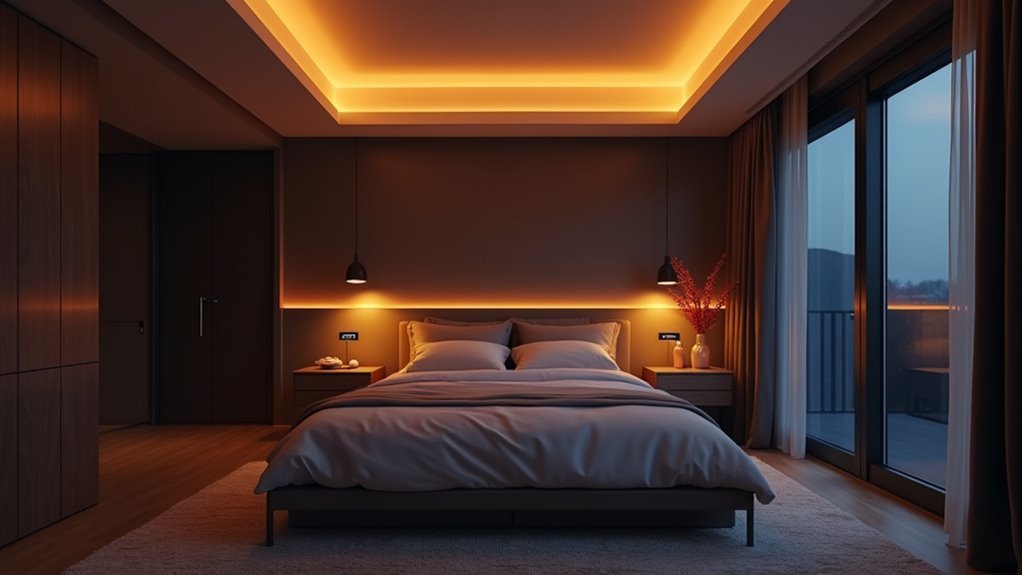
Beyond temperature control, your bedroom’s lighting environment plays an essential role in regulating your body’s internal clock and optimizing sleep quality.
Smart lighting systems automatically adjust brightness and color temperature throughout the day, mimicking natural sunlight to support your circadian rhythms. During evening hours, these systems create dim lighting with warm tones that promote melatonin production, signaling your body to prepare for rest.
Smart lighting systems mimic natural sunlight patterns, automatically shifting to warm, dim tones that boost melatonin production for better sleep.
You’ll benefit from programmable features that gradually reduce brightness over time, creating a gentle shift that reduces stress. Since blue light exposure disrupts sleep patterns, smart systems filter harmful wavelengths during nighttime hours.
You can customize schedules and remotely control your sleep environment, tailoring the lighting to match your personal sleep routines for consistently better rest.
Noise Management and Sound Control Technologies
You can’t achieve perfect sleep if unwanted sounds constantly interrupt your rest throughout the night.
White noise machines offer an effective solution by creating consistent audio that masks disruptive environmental sounds and helps maintain deeper sleep cycles.
Additionally, implementing strategic soundproofing techniques in your bedroom will greatly reduce noise pollution and create the quiet sanctuary you need for ideal rest.
White Noise Solutions
Countless sleepers struggle with disruptive noises that fragment their rest throughout the night, from traffic sounds to neighbor activity.
White noise machines offer an effective solution by producing consistent sounds that mask these disturbances, creating a peaceful sleep environment. Research shows ambient noise above 30 decibels interferes with sleep quality, making white noise essential for maintaining a quiet atmosphere.
Here’s how white noise solutions enhance your bedroom:
- Customizable sound options including nature sounds and fan noises to match your preferences
- Faster sleep onset with studies showing up to 38% reduction in time needed to fall asleep faster
- Supplemental noise control that works alongside acoustic panels and rugs for enhanced soundproofing
- Consistent masking that prevents sleep fragmentation from unexpected sounds throughout the night
Soundproofing Your Space
While white noise machines provide excellent sound masking, creating extensive noise control requires addressing the source of sound intrusion itself through strategic soundproofing techniques.
You’ll want to install soundproof curtains and acoustic panels to block external noise from penetrating your bedroom walls and windows. Weatherstripping around doors and windows creates airtight seals that prevent sound leaks.
Adding rugs to hardwood floors dampens internal noise transmission, while positioning heavy furniture like bookshelves against walls facing noise sources creates additional barriers.
These modifications work alongside white noise to establish a thorough quiet environment where you can truly relax.
When combined with earplugs or noise-canceling headphones, you’ll have multiple layers of protection ensuring ideal sleep quality.
Air Quality Monitoring and Purification Integration
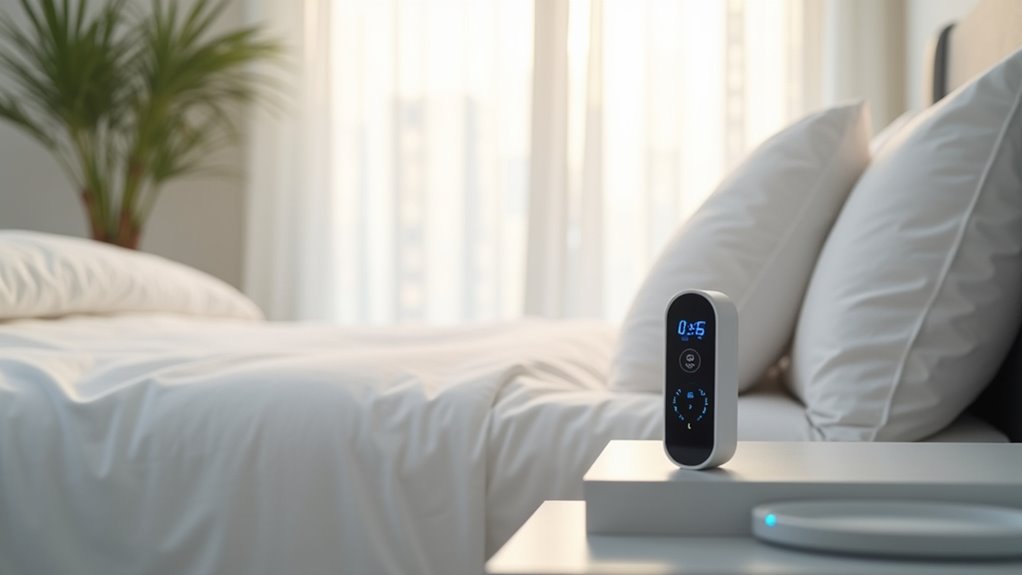
Although many people focus solely on temperature and lighting when optimizing their sleep environment, the air you breathe throughout the night plays an equally essential role in determining sleep quality and morning alertness.
Poor air quality disrupts your sleep cycles and reduces cognitive function, while clean air promotes uninterrupted sleep and better respiratory health.
Here’s how to optimize your bedroom’s air quality:
- Install air purifiers to eliminate allergens, dust, and pollutants that compromise your breathing during sleep.
- Monitor humidity levels and VOC concentrations to identify potential irritants affecting your comfort.
- Add air-purifying plants like snake plants or peace lilies to create a calming atmosphere while naturally filtering toxins.
- Prioritize ventilating your space regularly through windows or exhaust fans to maintain fresh air circulation and improve sleep quality.
Bedroom Layout Design for Automated Comfort Systems
When you’re designing your bedroom layout with automated comfort systems in mind, strategic placement becomes the foundation for creating an environment that responds seamlessly to your sleep needs. Position your bed away from windows to minimize light disruption while maximizing blackout curtains’ effectiveness. Smart lighting systems work best when centrally located, ensuring even dim lighting distribution for ideal melatonin production.
| System Type | Ideal Placement |
|---|---|
| Smart Thermostat | Central wall for perfect sleep temperature control |
| Automated Shades | All windows for complete light blocking |
| White Noise Machine | Bedside table to mask disruptive noises |
| Smart Lighting | Ceiling-mounted for ambient coverage |
This bedroom layout creates a serene sleeping space where automated comfort systems function efficiently, promoting a quieter environment essential for restorative sleep.
Frequently Asked Questions
How to Set up a Bedroom for Better Sleep?
Keep your bedroom between 60-72°F and use blackout curtains for darkness. Choose a comfortable mattress supporting spine alignment, declutter regularly, and paint walls in soothing colors like light blue or lavender.
What Is the 10 3 2 1 0 Sleep Rule?
You’ll follow the 10 3 2 1 0 sleep rule by stopping caffeine 10 hours before bed, alcohol 3 hours prior, food 2 hours earlier, screens 1 hour before, and creating 0 bedroom distractions.
What Should the Bedroom Environment Be Like for Good Sleep?
You’ll need a cool room between 60-70°F, complete darkness with blackout curtains, minimal noise using white noise machines, clutter-free space, and breathable bedding materials like cotton for ideal temperature regulation.
Why Is Bedroom Design Important?
Bedroom design directly impacts your sleep quality by controlling light, temperature, and noise levels. You’ll reduce stress through decluttering, while soothing colors and comfortable bedding support better rest and spine alignment.



Leave a Reply