
You’ve probably fumbled for light switches in the dark more times than you’d like to admit. Remote home lighting systems eliminate that frustration while transforming how you interact with your living space. These smart solutions offer everything from voice commands that instantly brighten your kitchen to automated sensors that guide your midnight bathroom trips. But choosing the right system for your home requires understanding which features actually matter.
Smart Bulb Systems for Wireless Control
When you’re looking to modernize your home’s lighting, smart bulb systems offer an exceptional blend of convenience and efficiency through wireless control technology.
You’ll experience significant energy savings since these LED technology bulbs consume 75% less power than traditional incandescent options. Remote control capabilities let you adjust your smart lighting from anywhere using smartphone apps or voice assistants like Alexa and Google Assistant.
Smart LED bulbs slash energy costs by 75% while offering convenient voice and app control from anywhere.
You can easily customize your lighting with features including scheduling, color changing, and dimming to match different activities and moods.
Installation couldn’t be simpler – you’ll screw them into existing sockets and connect to your home network immediately.
With lifespans reaching 20,000 hours, these home automation solutions reduce replacement frequency while delivering long-term cost efficiency and enhanced convenience for your daily routine.
Hub-Based Lighting Networks
While smart bulbs provide excellent standalone functionality, hub-based lighting networks take your home automation to the next level by connecting multiple devices through a centralized control system.
These networks enable seamless communication between smart devices using protocols like Zigbee and Z-Wave, ensuring interoperability across different brands.
Your hub manages numerous smart bulbs, switches, and sensors while offering sophisticated automation capabilities.
You’ll create personalized lighting schedules and scenes that adapt to your lifestyle. Advanced features like geofencing automatically adjust lights based on your location.
- Control hundreds of smart devices from one centralized hub
- Create complex lighting schedules for different rooms and times
- Achieve significant energy savings through optimized usage patterns
- Enable cross-brand compatibility with multiple communication protocols
- Automate lighting based on occupancy, time, and location data
Voice-Activated Light Management
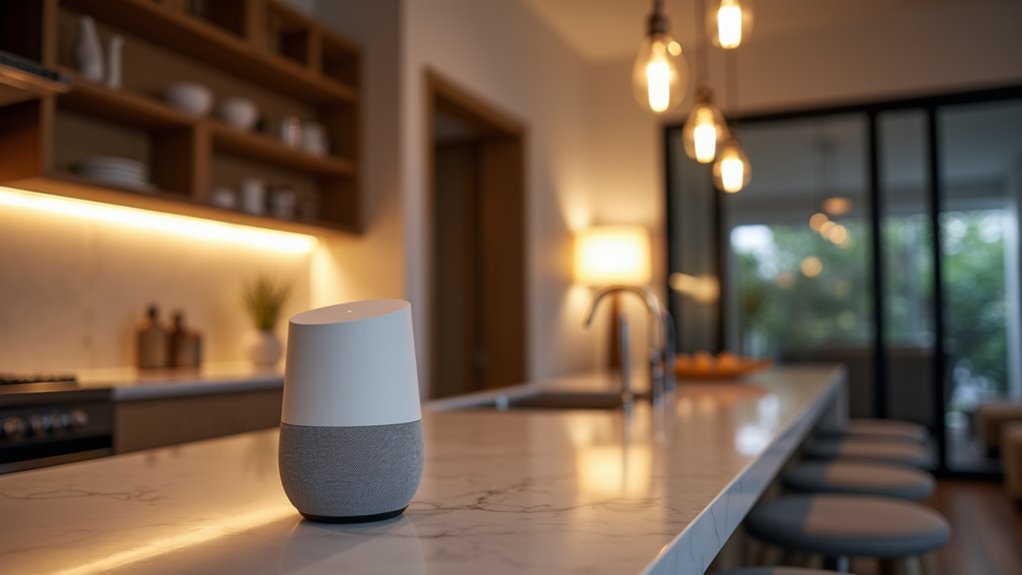
Building upon your centralized hub network, voice-activated light management transforms how you interact with your smart lighting system by eliminating the need for physical controls entirely.
You can control your lighting through Amazon Alexa, Google Assistant, or Apple Siri using simple voice commands to adjust brightness levels, change colors, or toggle lights on and off.
This smart home technology proves especially valuable when you’re mobility-challenged or carrying items. You’ll create personalized lighting atmospheres with custom commands like “movie time” or “welcome home” for different scenarios.
When integrated with your home’s security and HVAC systems, voice-activated light management delivers thorough automation. Studies demonstrate this smart lighting approach enhances energy efficiency by making it effortless to turn off lights when leaving rooms.
Motion Sensor Automation Setups
Motion sensor automation setups take your smart lighting system to the next level by creating hands-free environments that respond intelligently to your presence.
These lighting systems automatically detect movement and control your lights without requiring manual intervention, dramatically improving energy efficiency throughout your home.
- Customizable sensitivity settings let you adjust motion detection based on your specific environment and preferences
- Smart home hubs integration enables seamless remote control through smartphone apps and voice assistants
- Energy-efficient LED bulbs can slash energy consumption by up to 75% compared to traditional incandescent lighting
- Enhanced home safety through automatic illumination that deters potential intruders when movement is detected
- Automation convenience guarantees lights aren’t left on in unoccupied spaces, reducing utility bills
Smartphone App-Controlled Fixtures
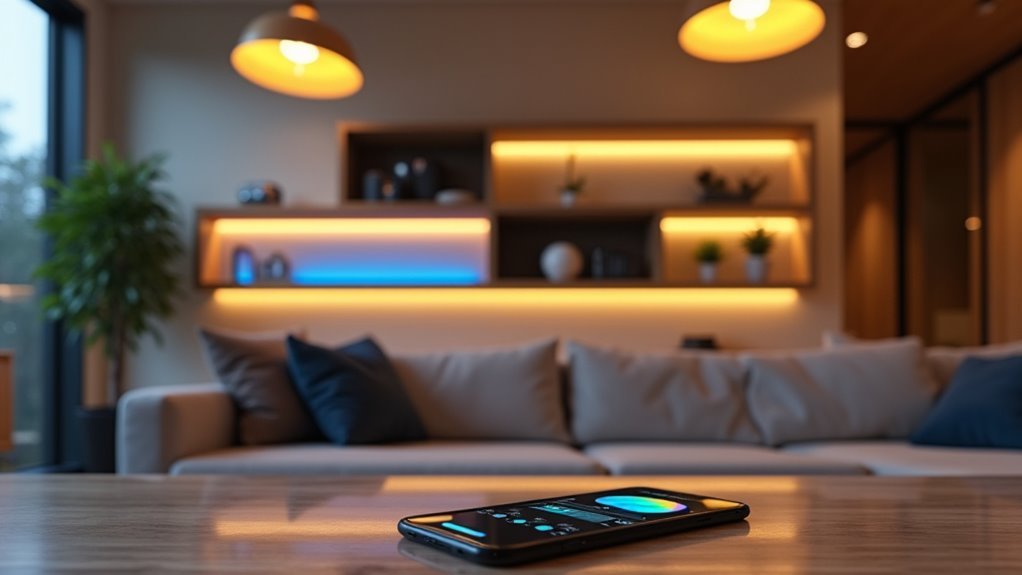
You’ll find that smartphone app-controlled fixtures offer intuitive interfaces that make managing your home’s lighting effortless from anywhere.
These apps typically feature clean, user-friendly designs with simple toggles, sliders, and scheduling options that let you control individual lights or entire rooms.
Whether you’re adjusting brightness while lying in bed or turning on your porch light before arriving home, the remote control capabilities give you complete command over your lighting system through Wi-Fi or Bluetooth connectivity.
App Interface Features
How intuitive can controlling your home’s lighting become with today’s smartphone technology?
Smart lighting systems offer sophisticated smartphone apps that transform how you control your lights through user-friendly interfaces designed for seamless operation.
These apps deliver extensive features that enhance both convenience and energy efficiency:
- Remote access – Control your lights from anywhere within Wi-Fi range or via mobile data
- Customizable scheduling – Set automatic on/off times to optimize your daily routines
- Personalized ambiance – Adjust brightness levels and select from full color spectrums
- Voice integration – Connect with voice assistants like Alexa and Google Assistant for hands-free operation
- Energy monitoring – Track energy consumption and receive connectivity alerts in real-time
You’ll find these interfaces intuitive and responsive, making lighting management effortless.
Remote Control Capabilities
Where once you’d to be physically present to flip a switch, smartphone app-controlled fixtures now let you manage your entire home’s lighting from virtually anywhere on the planet.
Smart lighting systems give you complete remote control over smart LED bulbs through dedicated mobile apps. You can adjust brightness, change colors, and create custom lighting schedules that enhance energy efficiency by automatically cycling lights on and off according to your daily routines.
These smart systems integrate seamlessly with voice assistants, enabling hands-free voice commands for instant control.
Advanced features like geofencing automatically adjust lighting based on your location, while real-time notifications alert you to unexpected changes, providing enhanced security monitoring for your home.
Dimmer Switch Integration Options
You’ll find smart dimmer switches offer significant advantages beyond basic on-off control, including customizable brightness levels, energy savings, and seamless integration with voice assistants or smartphone apps.
These devices typically work with your existing light fixtures, so you won’t need to replace all your bulbs to create a smart lighting system.
However, you’ll want to evaluate compatibility factors like your home’s wiring, bulb types, and whether your current fixtures can handle dimming functionality before making the upgrade.
Smart Dimmer Benefits
Smart dimmer switches transform your home’s lighting control by offering adjustable brightness levels that let you create the perfect ambiance for any activity.
These devices deliver significant energy savings while providing unmatched convenience through remote control capabilities via smartphone apps or voice commands.
Smart dimmers offer multiple advantages for modern homeowners:
- Energy efficiency – Reduced light intensity conserves electricity and extends bulb lifespan
- Universal compatibility – Works with existing non-smart bulbs, eliminating costly replacements
- Automation features – Schedule lights to turn on/off at specific times
- Enhanced security – Automated lighting creates the appearance of occupancy when away
- Customizable ambiance – Adjust lighting intensity for dining, reading, or entertaining
Advanced automation capabilities enable you to program lighting schedules that enhance both security and energy efficiency throughout your home.
Installation Compatibility Considerations
While smart dimmers offer tremendous benefits, successful installation depends on several critical compatibility factors that you’ll need to evaluate before making your purchase.
First, verify compatibility between your existing light fixtures and smart dimmer switches, as not all dimmable LEDs work with every dimmer technology. Check the load rating matches your bulbs’ total wattage to prevent overheating.
If you’re planning smart home hub integration, select switches supporting protocols like Zigbee or Z-Wave for centralized control.
Most importantly, determine if your home has a neutral wire, which many smart dimmer switches require for proper functionality. Older homes often lack this wiring.
Given the complexity of installation and electrical code compliance requirements, consult a professional electrician for safe, proper setup.
Color-Changing LED Installations
When you’re ready to transform your home’s atmosphere at the touch of a button, color-changing LED installations deliver unprecedented control over your lighting environment.
These energy-efficient smart home solutions let you customize lighting through smartphone apps or voice commands, creating perfect ambiance for any occasion.
- Extended lifespan: Up to 20,000 hours reduces replacement frequency and long-term costs
- Energy savings: Uses 75% less electricity than traditional incandescent bulbs
- Smart integration: Connects with home hubs for seamless automation features
- Adjustable brightness: Fine-tune intensity levels for relaxation or focused work
- Advanced scheduling: Set timers and automated routines for enhanced convenience
You’ll appreciate how these systems synchronize with music and events while supporting sustainable living practices through reduced energy consumption.
Scheduled Timer Programming Systems
You’ll find that scheduled timer programming systems transform how you manage your home’s lighting through automated daily schedules that turn lights on and off at predetermined times.
These systems offer significant energy-saving features by ensuring your lights operate only when needed, reducing unnecessary power consumption throughout your home.
You can also program security simulation options that create realistic occupancy patterns while you’re away, deterring potential intruders with varied lighting sequences.
Automated Daily Light Schedules
Since most homeowners follow predictable daily routines, automated light schedules provide an intelligent way to align your lighting with your lifestyle while maximizing energy savings.
These smart systems let you create customized schedules that automatically turn lights on and off at predetermined times, eliminating unnecessary usage when spaces are unoccupied.
Modern automated lighting systems offer advanced features that enhance both energy efficiency and convenience:
- Integration with motion sensors to activate lights only when movement is detected
- Smartphone apps that let you control remotely and adjust schedules from anywhere
- Programming options that simulate occupancy for improved security when you’re away
- Customizable routines for waking up, working, and winding down
- Energy monitoring features that help reduce electricity bills through optimized usage patterns
Energy Saving Timer Features
Beyond basic scheduling, energy-saving timer features offer sophisticated programming capabilities that can greatly reduce your home’s electricity consumption.
These smart lighting systems enable customizable schedules that sync with your daily routines, ensuring lights operate only when necessary. You’ll appreciate how timer features automatically brighten lights during morning hours for enhanced alertness, then dim them for evening relaxation.
Motion sensors integrated with these systems provide additional efficiency by activating lights only in occupied rooms. This prevents unnecessary illumination in empty spaces, maximizing your energy savings potential.
The combination of efficient LED technology and automated timer programming can reduce energy consumption by up to 75% compared to traditional incandescent bulbs, considerably lowering your electricity bills while maintaining ideal lighting comfort.
Security Simulation Programming Options
While energy efficiency remains a primary benefit of smart lighting timers, these systems also excel at enhancing your home’s security through sophisticated programming options.
You can use customizable scheduling to simulate occupancy when you’re away, making potential intruders believe someone’s home. Smart lighting systems integrate seamlessly with existing security systems, creating realistic presence effects through lighting automation.
- Randomized scheduling patterns make your lighting unpredictable, preventing burglars from identifying routine behavior
- Remote smartphone control lets you adjust scheduling lights from anywhere in real-time
- Motion sensor lighting integration provides immediate response to movement during nighttime hours
- Natural pattern mimicking replicates your actual daily routines for authentic home security
- Multi-room coordination guarantees your entire house maintains realistic occupancy simulation
Multi-Room Lighting Coordination
As you expand your smart lighting setup beyond individual fixtures, multi-room lighting coordination transforms how you control lighting throughout your entire home. Smart lighting systems synchronize across rooms, creating cohesive scenes for activities like dinner parties or movie nights. Advanced technology incorporates motion sensors that activate lights as you move through spaces, delivering seamless experiences while maximizing energy efficiency.
| Feature | Benefit |
|---|---|
| Voice Assistants Integration | Hands-free control across multiple rooms |
| Customizable Schedules | Automated lighting aligned with daily routines |
| Motion Sensor Coordination | Energy conservation with seamless activation |
You’ll enjoy programming different brightness levels and color temperatures that automatically adjust based on your activities. Multi-room lighting coordination eliminates the need to manually adjust individual switches, while customizable schedules guarantee your home’s illumination matches your lifestyle patterns perfectly.
Energy-Efficient Smart Controls
Smart lighting controls deliver substantial energy savings that complement your coordinated lighting setup.
These energy-efficient systems utilize LED technology that consumes 75% less power than traditional bulbs while offering advanced features to reduce energy consumption further.
You’ll control brightness remotely and implement customizable scheduling to optimize usage patterns throughout your day. Motion sensors automatically shut off lights in unoccupied rooms, preventing unnecessary waste.
Key energy-saving benefits include:
- Average energy bill reduction of 15-30% through smart lighting optimization
- LED technology lasting considerably longer than incandescent alternatives
- Automated scheduling eliminating manual switching routines
- Motion detection preventing lights from staying on unnecessarily
- Integrated home automation coordinating with other energy-efficient devices
These intelligent controls transform your lighting into a cost-effective system that pays for itself through reduced electricity bills.
Frequently Asked Questions
What Are the Disadvantages of Lighting Control System?
You’ll face high upfront costs, power outage disruptions, physical switch overrides, steep learning curves if you’re not tech-savvy, and connectivity issues that’ll affect your system’s reliability and functionality.
What Are the Disadvantages of Smart Lighting Systems?
You’ll face high upfront costs, potential connectivity issues, and technology learning curves. Power outages can trigger all lights simultaneously, while physical switches override smart controls, causing frustration when managing remotely.
Is Smart Home Lighting Worth It?
Yes, you’ll find smart home lighting worth it. You’ll save 75% on energy costs, enjoy convenient remote control, enhance security through automated schedules, and benefit from long-term durability that offsets initial investment costs.
What Are the Disadvantages of Smart Light Switches?
Smart light switches cost more upfront and often require professional installation. You’ll face compatibility issues with existing wiring, power outages reset settings, and manual switch use disrupts automated functions.


Leave a Reply