
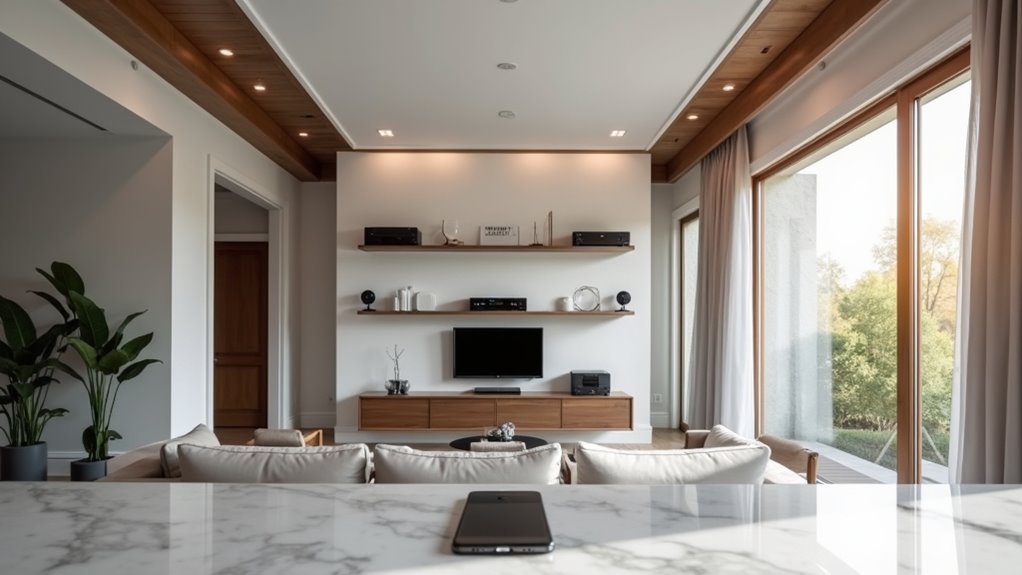
You’ve probably experienced the frustration of walking from room to room, losing your favorite song as Bluetooth disconnects or speakers fall out of sync. A properly configured multi-room audio system eliminates these interruptions, letting you control music throughout your entire home from a single device. However, choosing between wireless protocols, deciding on open versus closed ecosystems, and ensuring seamless integration with your existing smart home devices requires careful consideration of factors most homeowners overlook.
Understanding Multi-Room Audio Technology

Multi-room audio systems let you stream music throughout your entire home with perfect synchronization, creating a seamless listening experience as you move from room to room.
These systems rely on wireless networks, typically Wi-Fi or proprietary protocols, to connect speakers without extensive wiring. You’ll control everything through user-friendly apps on your smartphone or tablet, managing individual speakers or creating grouped playback zones.
Performance depends heavily on speaker placement, room acoustics, and Wi-Fi strength, all affecting sound quality and connectivity.
Modern multiroom audio systems integrate seamlessly with smart home ecosystems and support various streaming services. You can even use voice commands for hands-free control, making the technology incredibly convenient for daily use while enhancing your home’s entertainment capabilities.
Benefits of Seamless Home Audio Distribution
Understanding how multi-room technology works sets the foundation for appreciating what it can do for your daily life. Multi-room audio systems transform your home into a cohesive listening environment where you’ll experience uninterrupted audio playback as you move between spaces. Through seamless integration with streaming services, you’ll access your favorite music directly without constant phone connectivity.
| Feature | Benefit | Result |
|---|---|---|
| Individual Control | Customize each room’s audio | Personalized listening experience |
| Synchronized Playback | Unified sound throughout home | Continuous entertainment flow |
| Streaming Integration | Direct service access | Simplified music selection |
| Optimized Placement | Strategic speaker positioning | High-quality sound delivery |
| Single App Control | Centralized management | Enhanced user accessibility |
You’ll enjoy superior audio distribution through carefully positioned speakers that optimize acoustics in every room, creating an elevated listening experience.
Planning Your Multi-Room Audio Layout

Where should you begin when designing your multi-room audio layout? Start by evaluating your home’s key areas where you’ll want audio in multiple rooms, including living rooms, kitchens, patios, and bedrooms. This determines the zones needed for your multiroom audio setup.
Choose appropriate wireless speakers for each space—in-ceiling or in-wall options provide discrete aesthetics, while portable speakers offer outdoor flexibility.
Check your Wi-Fi strength throughout each zone, as robust network coverage guarantees seamless audio streaming without interruptions.
Planning your multi-room audio layout should include integration with smart home devices for voice control compatibility.
Select systems supporting future expansion, allowing you to add speakers or zones as your needs evolve.
Wireless Vs Wired System Comparison
You’ll face a fundamental choice between wireless and wired systems when setting up your multi-room audio.
Each connection method brings distinct installation requirements, from simple plug-and-play wireless setups to more complex wired configurations requiring professional installation.
Your decision will impact everything from initial costs to long-term performance and reliability throughout your home.
Connection Method Differences
When choosing between wireless and wired multi-room audio systems, you’re fundamentally deciding between convenience and performance.
Wireless systems excel in speaker placement flexibility, letting you position speakers anywhere without running cables through walls. You’ll appreciate their expandability – adding new rooms requires simply connecting another speaker to your network. However, audio streaming quality depends on your Wi-Fi strength and network stability.
Wired systems deliver superior sound quality and reliability since they’re immune to wireless interference. Installation complexity increases considerably though, often requiring professional installation to route cables discreetly.
While initial setup demands more planning and potentially higher costs, you’ll enjoy consistent performance regardless of network conditions. Future expansions mean additional wiring work, making wireless the clear winner for flexibility.
Installation Complexity Comparison
Installation complexity varies dramatically between wireless and wired multi-room audio systems, with wireless options offering a clear advantage for most homeowners.
You’ll find wireless systems require minimal setup—simply connect speakers to your Wi-Fi network without running cables through walls. However, you’re dependent on strong connectivity throughout your home for peak audio performance.
Wired systems demand professional installation due to complex cable routing and precise speaker placement requirements. You’ll need certified electricians to guarantee safety compliance and proper setup.
While this increases initial costs and complexity, you’ll gain superior reliability and seamless expansion capabilities.
Your choice depends on balancing convenience against performance. Wireless systems excel in simplicity, while wired systems offer long-term stability and easier future expansion without network reconfigurations.
Performance and Reliability
Beyond setup considerations, the actual performance and reliability of your multi-room audio system will considerably impact your daily listening experience.
Wired systems deliver superior sound quality since they’re not affected by compression artifacts or latency issues that can compromise your audio experience. You’ll get consistent, high-fidelity sound regardless of network conditions or interference from other devices.
Wireless systems offer impressive convenience but their performance depends heavily on your Wi-Fi signal strength and network stability.
While modern wireless technology has improved dramatically, you might still encounter occasional dropouts or audio delays, especially with ideal speaker placement in areas with weak signals.
However, wireless systems provide unmatched flexibility for adjusting your setup as your needs change.
Closed System Solutions and Their Advantages
While open systems offer flexibility, closed multiroom systems provide a different approach that prioritizes simplicity and seamless integration.
These solutions create a cohesive audio experience through manufacturers like Sonos, who’ve perfected the art of unified control.
Closed systems deliver several key advantages:
- Streamlined Setup – You’ll manage everything through a single proprietary app, eliminating compatibility guesswork between different brands and ensuring seamless flow throughout your home.
- Enhanced User Convenience – Built-in lifestyle features like sleep timers and multiple streaming integrations simplify daily operation.
- Optimized Compatibility – Your turntables and CD players integrate effortlessly with the ecosystem.
- Premium Audio Quality – Brands like BluOS deliver exceptional sound, though you’ll pay more than open alternatives.
However, you’re betting on one manufacturer’s long-term commitment to maintaining functionality.
Open System Flexibility and Component Mixing

Open multiroom audio systems flip the script by letting you build your ideal setup from components across multiple brands.
Break free from single-brand limitations and create your perfect multiroom audio experience with cross-manufacturer compatibility.
You’ll enjoy open system flexibility that eliminates vendor lock-in, allowing you to mix and match speakers based on your preferences and budget rather than manufacturer limitations.
These systems leverage existing wireless protocols like AirPlay and Google Cast, so you won’t need proprietary technology to connect different devices.
You can control everything through your favorite music apps, streamlining audio management without juggling multiple brand-specific applications.
AirPlay compatibility and Google Cast support are widely available across numerous manufacturers, giving you extensive product choices.
When you’re ready to expand or upgrade components, you won’t lose existing functionality—simply add new speakers that support these universal protocols to enhance your multiroom audio system.
Essential Equipment for Multi-Room Setup
Three core components form the foundation of any successful multi-room audio system: speakers, a central hub or receiver, and streaming sources.
You’ll need to strategically position wireless or wired speakers like Sonos or Polk Audio throughout your home for ideal coverage.
Your multiroom setup requires these essential components:
- AV receiver or hub – Denon HEOS or Yamaha MusicCast manages audio sources and facilitates zone connectivity
- Streaming devices – Smartphones and smart speakers like Amazon Echo control playbook across rooms
- Quality wiring and mounting gear – Essential for reliable wired connections and proper speaker placement
- User-friendly control app – Manages audio playback while integrating seamlessly with your existing smart home devices
This equipment guarantees smooth operation and professional-grade performance throughout your entire system.
Speaker Selection and Room Placement Strategy
Once you’ve gathered your equipment, the success of your multi-room system hinges on smart speaker selection and strategic placement decisions.
Your speaker selection should match each room’s size and acoustics—choose smaller speakers for intimate spaces and larger ones for open areas to optimize your audio experience. Position speakers at ear level when seated, using wall mounts or stands for proper height and angle.
Consider in-ceiling or in-wall speaker options for rooms where aesthetics matter, ensuring clean installation without compromising sound quality. Maintain at least one foot distance from corners to prevent sound reflections that muddle audio.
For outdoor areas, select weather-resistant speakers positioned strategically to cover your listening zone. Proper room placement transforms good equipment into an exceptional multi-room audio experience.
Network Requirements and Connectivity Options
While speaker placement sets the foundation, your network infrastructure determines whether your multi-room audio system delivers seamless performance or frustrating dropouts.
You’ll need specific connectivity requirements to maintain synchronized audio streaming across all zones.
Here are four essential network requirements:
- Establish robust Wi-Fi coverage – Your Wi-Fi network needs minimum 5 Mbps per speaker to prevent audio interruptions during streaming.
- Upgrade to dual-band Wi-Fi – Use both 2.4 GHz and 5 GHz frequencies to reduce interference and accommodate multiple devices simultaneously.
- Consider wired connections – Ethernet cables provide superior stability and reduced latency, especially for larger installations with numerous speakers.
- Deploy mesh Wi-Fi system – Multi-floor homes benefit from mesh networks that eliminate dead zones and strengthen connectivity throughout your speaker placement areas.
Installation Process and Best Practices
After establishing your network foundation, you’ll need to map your home’s layout and identify specific zones for speaker placement before beginning installation.
The installation process starts with determining whether wired or wireless connections best suit your needs. Wired systems deliver superior audio experience through high-quality speaker wires (CL2 or CL3 rated, 16 AWG or 14 AWG gauge), while wireless options offer greater flexibility.
Focus on ideal placement in each zone to guarantee sound distribution throughout your home speaker network. Maintain consistent polarity and secure all connections to prevent distortion.
Consider professional installation for complex setups to ensure safety compliance and enhanced performance. After completing installation, test your entire system and adjust audio levels to achieve balanced sound across all zones.
Audio Source Integration and Streaming Services
You’ll want to connect your multi-room system to popular streaming platforms like Spotify, Apple Music, and Amazon Music for direct access to millions of songs without requiring your phone as a middleman.
Most modern systems support common protocols such as AirPlay 2 and Google Cast, making it easy to integrate various digital sources across different device brands.
You can also incorporate high-quality network streamers or AV receivers to guarantee peak audio performance throughout your setup.
Streaming Service Compatibility
Since streaming services form the backbone of most modern music consumption, ensuring your multi-room audio system supports your preferred platforms is essential for a seamless listening experience.
Most systems offer extensive compatibility with major music streaming platforms, but verification remains vital.
Here’s what you’ll find with modern multi-room audio systems:
- Major Platform Support – Access Spotify, Apple Music, Amazon Music, and Tidal across all connected rooms without switching apps or devices.
- Voice Assistants Integration – Control playback through Amazon Alexa or Google Assistant using simple voice commands for hands-free operation.
- Direct Streaming Protocols – Apple AirPlay and Google Cast enable effortless streaming from your devices without additional hardware requirements.
- Extensive Service Libraries – Sonos compatibility includes over 100 music services, providing diverse listening options for every preference.
Digital Source Integration
Beyond streaming service compatibility, modern multi-room audio systems excel at integrating multiple digital sources to create a complete entertainment hub throughout your home.
Digital source integration connects you directly to Spotify, Apple Music, and Amazon Music without requiring your smartphone as an intermediary. You’ll enjoy seamless streaming through AirPlay 2 and Google Cast protocols while maintaining exceptional audio quality.
Voice control integration with Amazon Alexa or Google Assistant lets you manage your entire system hands-free.
These systems support high-resolution audio formats, ensuring audiophile-quality sound reproduction. You can link diverse sources including smart TVs, turntables, and CD players, expanding your audio playback options across every room.
This versatility transforms your home into a sophisticated entertainment environment where any source reaches any location effortlessly.
Control Apps and User Interface Management
How effectively you control your multi-room audio system depends largely on the quality of its management app and user interface.
Well-designed control apps transform your audio playback experience by providing intuitive navigation and responsive performance across all connected speakers.
Intuitive control apps elevate your multi-room audio system from basic sound distribution to a sophisticated, seamlessly integrated home entertainment experience.
Key features that define exceptional user interface management include:
- Volume and grouping controls – Adjust individual room levels or create speaker groups for synchronized playback throughout your home
- Streaming services integration – Access Spotify, Apple Music, and Amazon Music directly through the app without switching platforms
- Voice control compatibility – Connect with smart assistants like Alexa or Google Assistant for hands-free operation
- Real-time responsiveness – Guarantee quick command execution and minimal lag for a seamless experience
Choose systems with proven app reliability to maximize your investment’s potential.
Troubleshooting Common Setup Issues
You’ll likely encounter network connectivity problems and speaker synchronization issues when setting up your multi-room audio system.
These common challenges can disrupt your listening experience and prevent speakers from working together seamlessly.
Let’s address the most frequent problems and their solutions to get your system running smoothly.
Network Connectivity Problems
When your multi-room audio system struggles to maintain stable connections, network connectivity issues are often the primary culprit behind dropouts, syncing problems, and inconsistent performance.
Your Wi-Fi network’s strength and configuration directly impact audio streaming quality across all zones.
Here’s how to resolve these connectivity issues:
- Optimize your Wi-Fi network coverage – Eliminate dead zones that disrupt streaming by ensuring adequate signal strength throughout your home.
- Update firmware regularly – Keep your speakers and router firmware current to fix bugs and enhance stability.
- Refresh network connections – Restart your router and audio devices to clear temporary glitches.
- Expand signal reach – Install network extenders or upgrade to mesh Wi-Fi systems for larger homes with signal obstructions.
Speaker Synchronization Issues
Although your multi-room audio system may stream flawlessly to individual speakers, synchronization problems can create an echo-like effect that ruins the seamless listening experience you’re seeking.
Speaker synchronization issues often stem from weak Wi-Fi signals, so position your router centrally to maximize coverage. Verify all speakers use compatible streaming protocols like AirPlay or Google Cast for seamless communication.
Mixed wired and wireless connections can delay audio playback, so stick to one connection type. Regular firmware updates resolve many sync problems by providing the latest improvements.
Use your system’s dedicated app to adjust latency settings and synchronization features. These steps will optimize performance and eliminate the frustrating delays that disrupt your multi-room audio experience.
System Expansion and Future-Proofing Tips
Building a multi-room audio system that grows with your needs requires strategic planning from day one.
Smart system expansion starts with choosing components that support open protocols and can seamlessly integrate future devices.
Here’s your future-proofing checklist:
- Choose open protocol systems – Select speakers supporting AirPlay 2 or Google Cast for easier integration of different brands and devices as technology evolves.
- Strengthen your Wi-Fi network – Invest in robust, scalable wireless infrastructure to maintain seamless audio across multiple rooms and accommodate additional components.
- Prioritize ongoing support – Look for manufacturers offering regular firmware updates and extended support to keep your system current with new features.
- Ensure format compatibility – Select systems supporting varied audio formats and smart home integrations for maximum versatility.
Frequently Asked Questions
How to Listen to Music in Multiple Rooms?
You’ll need a multiroom audio system with wireless connectivity. Use a smartphone app to control playback across different zones. Make certain your Wi-Fi network’s strong enough to support multiple speakers streaming simultaneously.
What Is the Best Sound System Layout?
You’ll want to position speakers strategically throughout each room, combining in-ceiling, in-wall, and freestanding options. Use a central control hub to manage zones and incorporate sound calibration technology for ideal performance.
How to Get Sonos to Play in All Rooms?
Make certain all Sonos speakers connect to the same Wi-Fi network and power on. Open the Sonos app, tap “Now Playing,” select “Group,” then choose your rooms or use “Play All” for simultaneous playback.
What Is the Best Speaker for Spatial Audio?
You’ll find the Sonos Era 300 offers the best spatial audio experience with its Dolby Atmos technology creating immersive 3D soundscapes. Apple’s HomePod 2nd generation also delivers exceptional spatial audio performance.


Leave a Reply