
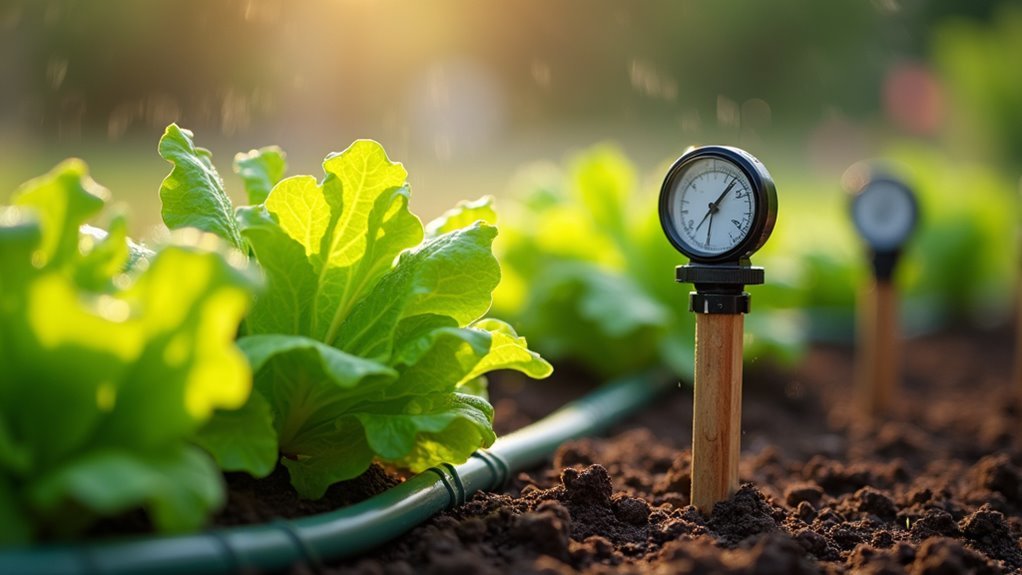
You’re probably watering your garden based on guesswork or a rigid schedule, but there’s a smarter approach that’ll save you time, money, and prevent plant stress. Irrigation scheduling isn’t just for commercial farmers—it’s a systematic method that considers your soil type, plant needs, and weather patterns to determine exactly when and how much to water. The difference between thriving plants and struggling ones often comes down to understanding one critical concept.
Understanding Evapotranspiration and Plant Water Needs
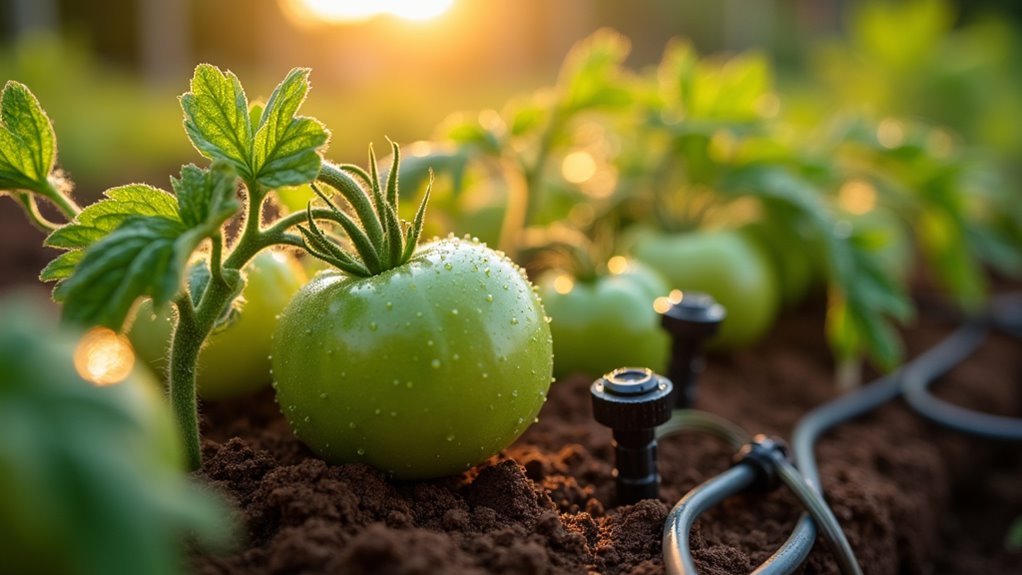
How much water does your garden actually need, and when should you provide it? Understanding evapotranspiration (ET) is essential for answering this question. ET combines water evaporation from soil surfaces and transpiration from plants, determining ideal water needs for growth.
Reference Evapotranspiration (ETo) provides your baseline measurement—typically 1/5 inch daily during summer for well-watered cool-season grass. You’ll need to adjust this based on your specific plants’ water requirements.
Established woody plants usually need 50-60% of ETo, while other plants vary considerably.
Your soil’s available water holding capacity helps determine irrigation timing by showing how much water plants can access before stress occurs.
Monitor soil moisture regularly and watch for plant symptoms to guarantee you’re providing adequate water without overwatering.
Soil Types and Their Impact on Irrigation Timing
Your soil type fundamentally determines how often you’ll need to water your garden. Understanding your soil’s characteristics is essential for effective irrigation scheduling since different textures hold and drain water at varying rates.
Soil texture directly impacts watering frequency—sandy soils need frequent irrigation while clay soils require deeper, less frequent watering sessions.
Key soil drainage properties include:
- Sandy soils – Drain quickly, requiring frequent watering but less volume per session.
- Clay soils – Retain moisture longer, needing less frequent but deeper irrigation cycles.
- Loamy soils – Offer balanced drainage, providing moderate watering schedules.
- Available water capacity varies greatly, with fine soils holding more than coarse textures.
Field capacity timing differs dramatically between soil types. Sandy soils reach this point within 24 hours, while clay soils take 2-3 days.
Monitor soil moisture levels regularly to prevent reaching the permanent wilting point where plants can’t extract sufficient water.
Maximum Allowable Depletion for Different Garden Plants

While soil type determines your garden’s water-holding capacity, each plant species has its own threshold for how much of that available water can be depleted before you need to irrigate.
This threshold is called maximum allowable depletion (MAD), typically set at 50% for most garden plants. However, you’ll need to adjust this percentage based on your specific crops.
Shallow-rooted plants require more frequent watering, while deep-rooted vegetables with 12-24 inch root zones can tolerate greater depletion. Drought-tolerant species can handle MAD levels of 70-80%.
You should monitor soil moisture regularly and trigger irrigation when depletion reaches your plant’s specific MAD threshold. This approach helps you create effective watering schedules tailored to each plant’s needs.
Calculating Available Water Holding Capacity in Your Soil
Understanding your plant’s maximum allowable depletion tells you when to water, but you’ll need to know your soil’s available water holding capacity (AWC) to determine how much water to apply.
AWC represents the water your soil retains between field capacity and permanent wilting point.
Your soil texture dramatically affects AWC:
- Sandy soils hold 1-3 inches of water per foot of depth
- Clay soils retain 2-5 inches of water per foot
- Loamy soils fall somewhere between these ranges
- Organic matter amendments increase your soil’s water-holding ability
Calculate AWC by determining the difference between field capacity and permanent wilting point water content.
This measurement becomes essential for effective irrigation scheduling, helping you apply the right amount of water without over-watering or leaving plants drought-stressed.
Field Capacity Vs Permanent Wilting Point Explained
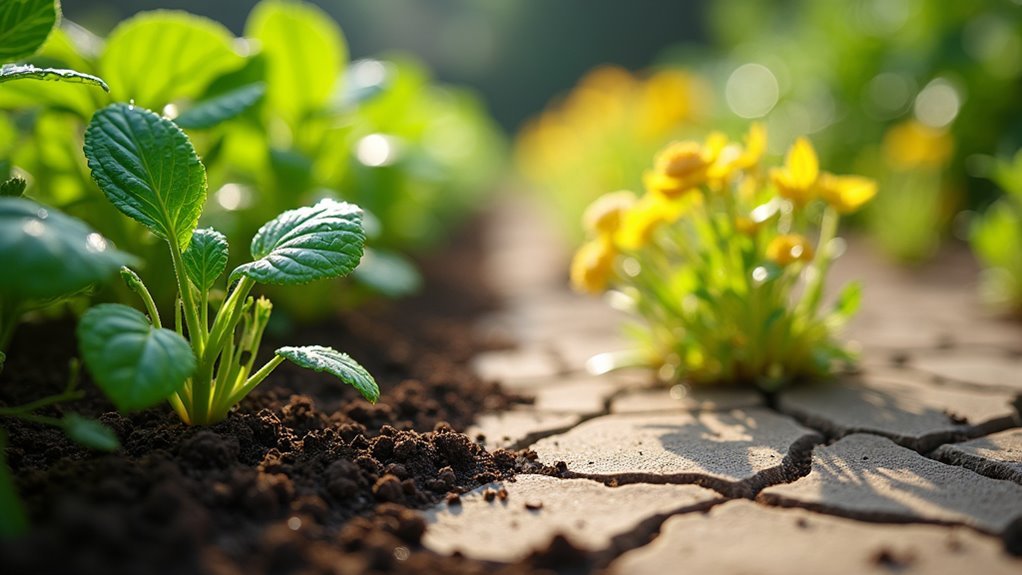
Although both terms describe soil moisture conditions, field capacity and permanent wilting point represent opposite ends of your soil’s water availability spectrum. Field capacity represents the maximum water your soil can retain after gravity drains excess moisture away. Sandy soils reach this state within 24 hours, while clay soils need 2-3 days. Permanent wilting point is when soil moisture drops so low that plants can’t extract enough water to survive.
| Soil Condition | Your Plants’ Reality |
|---|---|
| At field capacity | Thriving with ideal water access |
| 50% available water | Growing well, no stress visible |
| 25% available water | Beginning to show drought stress |
| Near permanent wilting point | Struggling to survive |
| At permanent wilting point | Dying from dehydration |
Understanding this relationship is essential for effective irrigation scheduling.
Root Zone Depth Analysis for Effective Water Management
Since your plants’ roots determine how much soil water they can actually access, knowing their rooting depths becomes essential for timing your irrigation scheduling effectively.
Different crops have varying root zone characteristics that directly impact their water needs and stress tolerance. Understanding these depths helps you optimize soil moisture management:
- Most vegetables develop roots 12-18 inches deep, requiring frequent monitoring
- Deep-rooted crops like trees extend 36+ inches, accessing more water reserves
- Shallow-rooted plants need more frequent irrigation to prevent stress
- Monitor soil moisture at multiple depths to guarantee water reaches the entire root zone
You’ll need to adjust your maximum allowable depletion based on rooting depth.
Shallow crops can’t tolerate as much water depletion before experiencing stress, while deeper-rooted plants can access moisture from lower soil layers.
Smart Controllers and Weather-Based Irrigation Adjustments
While knowing your plants’ root depths forms the foundation of proper irrigation timing, smart controllers take this knowledge and automate the entire process for you.
These advanced systems revolutionize irrigation management by continuously analyzing real-time weather data, historical evapotranspiration rates, and current climatic conditions to enhance your watering schedule automatically.
You’ll benefit from integrated soil moisture sensors that prevent unnecessary watering during rainy periods, while connections to local weather stations provide instant updates on rainfall, temperature, and humidity.
Smart controllers calculate your plants’ precise water needs using reference evapotranspiration data, ensuring efficient water usage without waste.
You can program these systems to operate during ideal times like early morning or evening, minimizing evaporation losses and maximizing water efficiency for healthier plants.
Catch Can Testing to Measure Your System’s Output
Even with smart controllers managing your irrigation automatically, you’ll need to verify that your system actually delivers the right amount of water where your plants need it.
Catch can testing provides the most accurate way to measure your irrigation system’s actual output.
Here’s how to perform this essential test:
- Place multiple containers throughout your watering zones
- Run your system for exactly 15 minutes
- Measure the water depth collected in each container
- Calculate the average depth to determine hourly output
Your irrigation system should deliver approximately one inch of water weekly for most lawns and gardens.
Programming Multiple Irrigation Zones for Diverse Plant Types
Once you’ve determined your system’s output through catch can testing, you’ll need to create customized watering programs for each zone based on your plants’ specific needs.
Group plants with similar water use requirements together—low, moderate, and high water demand varieties should each have their own zones. Assign each zone a program that matches its plants’ unique irrigation requirements to maximize efficiency and promote healthy growth.
Schedule start times before 9 a.m. or after 7 p.m. to minimize evaporation losses. Implement multiple cycles per day with 30-60 minute gaps between start times to reduce runoff and encourage deeper soil penetration.
Monitor each zone’s moisture levels regularly and adjust your irrigation systems’ programming based on seasonal changes, landscape characteristics, and plant health indicators.
Seasonal Irrigation Scheduling Throughout the Growing Season
Throughout the growing season, you’ll need to adapt your irrigation schedule to match changing weather patterns, plant development stages, and seasonal water demands.
Irrigation scheduling using tools like the Irrigation Scheduling Tool (IST) helps you calculate the precise amount of water needed to replace moisture lost through evapotranspiration.
Smart irrigation scheduling tools calculate exact water requirements by measuring evapotranspiration rates, ensuring plants receive optimal moisture without waste.
Effective seasonal irrigation management requires monitoring these key factors:
- Spring startup: Begin with lighter watering as plants establish, gradually increasing as temperatures rise.
- Peak summer: Maximize watering frequency during hot periods while maintaining early morning or late evening schedules.
- Fall changeover: Reduce watering amounts as temperatures drop and plant growth slows.
- Weather adjustments: Account for rainfall and humidity changes throughout each season.
Regular soil moisture monitoring and plant health assessments guarantee your seasonal changes maintain ideal growing conditions while conserving water efficiently.
Soil Moisture Monitoring Tools and Techniques
While seasonal scheduling provides the framework for irrigation timing, accurate soil moisture monitoring gives you the precise data needed to make informed watering decisions.
Soil moisture monitoring tools like tensiometers and digital sensors deliver real-time data on your soil’s water levels, preventing water waste through precise irrigation management.
You can conduct simple catch can tests by placing containers throughout your garden to measure water distribution from your irrigation system.
Soil moisture probes offer continuous readings at various depths, while handheld moisture meters help you assess water content at root level.
Regular monitoring helps you understand your soil’s unique water retention characteristics, enabling you to tailor watering schedules to specific plant needs and avoid both over-watering and under-watering situations.
Water Conservation Through Strategic Scheduling
Armed with accurate soil moisture data, you can now implement strategic scheduling practices that dramatically reduce water waste while maintaining healthy plants.
Effective irrigation scheduling aligns your watering times with plant needs and seasonal patterns, preventing unnecessary water application.
Strategic water conservation techniques include:
- Cycle and soak method – Apply water in short intervals to prevent runoff and promote deeper soil penetration
- Irrigation Scheduling Tool (IST) – Receive customized watering schedules based on specific plant requirements
- Mulch application – Reduce soil surface evaporation by up to 30% while retaining moisture
- Threshold-based watering – Only irrigate when soil moisture drops below ideal levels for your plants
These practices guarantee you’re maximizing water efficiency while promoting healthier root development through targeted irrigation scheduling.
Troubleshooting Common Irrigation Scheduling Problems
Even with careful planning, you’ll encounter irrigation challenges that can undermine your water conservation efforts and plant health.
Start by conducting a catch can test to identify uneven water distribution across your landscape. This reveals if certain areas receive insufficient water per irrigation cycle while others get too much.
Check your soil moisture regularly to prevent overwatering established trees, which typically need watering every two months, versus newly planted specimens requiring more frequent attention.
Adjust watering schedules based on plant requirements—low water use plants need only 10-30% of cool season turfgrass water per week.
Install smart irrigation controllers with rain sensors to automatically respond to weather conditions.
When plants show drought stress like wilting, increase frequency or duration immediately.
Optimizing Run Times Based on Plant Growth Stages
You’ll need to adjust your irrigation run times as your plants progress through different growth stages, since water requirements change dramatically from seedling to maturity.
During germination and early growth, you’ll run shorter, more frequent cycles to keep soil consistently moist, then shift to longer, less frequent watering as plants establish deeper roots.
You can optimize these timing adjustments by monitoring your plants’ development stages and watching for visual cues like leaf condition and overall plant vigor.
Growth Stage Water Needs
Understanding your plants’ water needs throughout their lifecycle transforms scattered guessing into strategic irrigation management.
Each growth stage demands different watering approaches to optimize plant health and resource efficiency.
Your plants and grass require varying moisture levels depending on their development phase:
- Seedlings need frequent, light watering to establish shallow root systems without waterlogging delicate stems.
- Mature plants require deeper, less frequent irrigation as established roots access moisture from lower soil layers.
- Flowering/fruiting stages demand consistent soil moisture with 1-1.5 inches weekly to prevent blossom drop and support fruit development.
- Established vegetation typically needs 50-60% of reference evapotranspiration, triggering irrigation when 50% of available soil moisture is depleted.
Monitor soil moisture levels regularly to match your watering schedule with each plant’s specific growth requirements.
Seasonal Runtime Adjustments
While plant growth stages determine baseline water needs, seasonal runtime adjustments allow you to fine-tune your irrigation system’s performance throughout the year.
Set your run times at 100% during peak summer months like July when water demand reaches its highest point. As plants shift from establishment to maturity, adjust durations to promote deep root growth—established plants need less frequent watering than newly planted ones.
Monitor soil moisture levels regularly and watch for plant health indicators like leaf drooping or discoloration to determine necessary adjustments.
Apply water using the “cycle and soak” method to optimize penetration and reduce runoff during active growth periods. Make weekly schedule adjustments based on changing weather patterns, ensuring you provide adequate water without overwatering your plants.
Plant Development Monitoring
Beyond adjusting for seasonal changes, tracking your plants’ development stages helps you enhance watering schedules for maximum growth and health.
Monitoring your plant’s growth phases guarantees you’re delivering the right amount of water when it’s needed most.
Different growth stages require specific watering approaches:
- Germination: Provide consistent daily moisture with about 1/4 inch of water to support sprouting
- Vegetative stage: Increase to 1 inch weekly as your plant’s roots expand and foliage develops
- Flowering stage: Boost to 1.5 inches weekly to support fruit and flower production
- Assessment indicators: Watch for leaf curling or wilting as signs to adjust your schedule
Regular monitoring allows you to respond to your plants’ changing needs, guaranteeing ideal development throughout each critical growth phase.
Frequently Asked Questions
What Is a Good Irrigation Schedule?
You’ll want to water lawns 2-3 times weekly with 1-1.5 inches total. Water shrubs and perennials weekly, newly planted trees weekly for two years, and established trees every two months during summer.
How Do You Determine the Irrigation Schedule?
You’ll determine your irrigation schedule by monitoring evapotranspiration rates, conducting catch can tests, understanding your soil’s water-holding capacity, checking soil moisture depth, and adjusting for seasonal changes and plant requirements.
What Are the Four Approaches Used for Irrigation Scheduling?
You’ll use four main approaches: time-based scheduling with seasonal adjustments, soil moisture monitoring through sensors, plant water needs assessment by categorizing requirements, and weather-based scheduling using evapotranspiration rates.
What Does Irrigation Mean in Landscaping?
You’ll use irrigation in landscaping to artificially apply water to your plants, ensuring they receive adequate moisture for healthy growth when natural rainfall isn’t sufficient for their specific needs.



Leave a Reply