
You’re tired of overwatering your crops and watching your water bills skyrocket while your plants still struggle. A weather-driven irrigation system can solve these problems, but integration isn’t as simple as plugging in a few sensors and hoping for the best. The process requires strategic planning across five critical steps that’ll determine whether you end up with a precision watering system or an expensive mess that creates more headaches than it solves.
Select and Configure Your Weather API Data Source
Several weather API providers offer the real-time data you’ll need to build an effective weather-driven irrigation system. OpenWeatherMap and Weatherbit stand out as reliable options, delivering essential weather data including precipitation forecasts and temperature readings.
You’ll need to sign up for an API key to authenticate your requests and access these data endpoints.
Study your chosen Weather API’s documentation thoroughly to understand available parameters for irrigation scheduling. Configure scheduled requests to collect timely forecasts, enabling your smart irrigation technologies to make real-time adjustments based on predicted rainfall and temperature changes.
Don’t overlook historical weather data integration—analyzing past patterns helps optimize water consumption and enhances your irrigation system’s efficiency while reducing waste.
Design Multi-Zone Irrigation Layout With Smart Controllers
Precision becomes your greatest ally when designing a multi-zone irrigation layout that maximizes water efficiency across diverse landscape areas.
Start by creating a detailed property map identifying zones based on plant types, soil conditions, and sun exposure. Each zone requires dedicated valves and irrigation lines for independent operation and tailored watering schedules.
Smart controllers integrate seamlessly with soil moisture sensors to monitor real-time data and environmental conditions. This combination enhances irrigation efficiency by automatically adjusting schedules based on actual moisture levels rather than preset timers.
Smart controllers and soil moisture sensors work together to automatically adjust watering based on real conditions, not timers.
The system’s intelligent water distribution prevents overwatering while promoting ideal plant health.
When properly configured, this weather-driven approach achieves significant water conservation, potentially reducing usage by up to 50% while maintaining healthier landscapes through precise, condition-responsive irrigation management.
Install Soil Moisture and Weather Monitoring Sensors
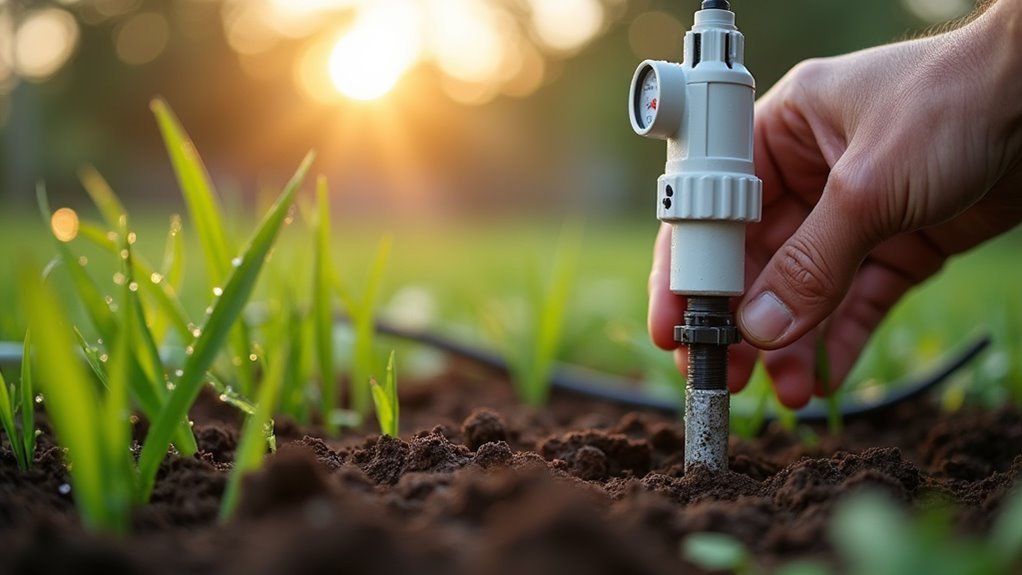
Once you’ve mapped your irrigation zones, installing soil moisture and weather monitoring sensors transforms your system from reactive to predictive.
Position soil moisture sensors in representative areas of each zone, avoiding interference from nearby structures. These sensors provide real-time data on volumetric water content, enabling your smart irrigation controllers to activate only when moisture drops below preset thresholds.
Install rain sensors and temperature monitors to prevent unnecessary watering during rainfall or freezing conditions. Proper calibration guarantees accurate readings that adapt irrigation schedules based on environmental factors.
This integration optimizes water usage by responding to actual soil conditions rather than preset timers. You’ll achieve water savings up to 72% during drought conditions while maintaining healthy landscapes through data-driven irrigation system management.
Program Automated Weather-Based Watering Schedules
After establishing your sensor network, programming automated weather-based watering schedules requires connecting your smart irrigation controller to real-time data APIs like OpenWeatherMap. You’ll input local climate parameters, plant types, and seasonal adjustments to optimize irrigation efficiency.
| Parameter Type | Configuration Settings |
|---|---|
| Weather Data | Precipitation forecasts, temperature ranges |
| Soil Moisture | Threshold levels, sensor calibration points |
| Plant Requirements | Evapotranspiration rates, root zone depths |
| Schedule Logic | Watering duration, frequency adjustments |
Your automated system calculates daily water needs using evapotranspiration rates while monitoring soil moisture sensors to prevent unnecessary watering. This weather-based approach can conserve water by 20-50% compared to fixed schedules. Regular monitoring guarantees your watering schedules adapt to changing conditions, enhancing plant health while minimizing waste through intelligent automation.
Optimize System Performance Through Data Analytics and Adjustments
While your automated irrigation system collects valuable data, you’ll need to analyze this information systematically to maximize water efficiency and plant health.
Smart controllers process real-time weather conditions and soil moisture sensors readings to deliver precise water amounts when plants need them most. You can adjust irrigation schedules based on evapotranspiration rates and local weather forecasts, helping reduce water waste by up to 43%.
During drought conditions, data-driven irrigation management saves an average of 72% in water usage. Regular assessment of your system’s performance reveals opportunities for fine-tuning delivery schedules and seasonal optimizations.
These analytics-based adjustments enhance your conservation efforts while promoting healthier plant growth and sustainable resource management practices.
Frequently Asked Questions
What Are the 5 Basic Components of the Irrigation System?
You’ll need a controller to schedule watering, valves controlling water flow to zones, pipes transporting water throughout, emission devices distributing water to plants, and backflow prevention protecting your water supply.
How Do Weather Based Irrigation Controllers Work?
Weather-based controllers analyze real-time data like precipitation and evapotranspiration rates to automatically adjust your watering schedules. They’ll skip irrigation when rain’s forecasted and increase watering during hot, dry periods, optimizing water usage efficiently.
What Are the Steps in Design of Drip Irrigation System?
You’ll assess your landscape zones, create a scaled design plan, select appropriate drip components, install tubing and emitters systematically, then program a weather-responsive controller for ideal irrigation scheduling.
What Is the Process of Smart Irrigation System?
You’ll install sensors to monitor soil moisture and weather conditions, then configure smart controllers that automatically adjust watering schedules based on real-time data, ensuring you’re only irrigating when plants actually need water.


Leave a Reply