
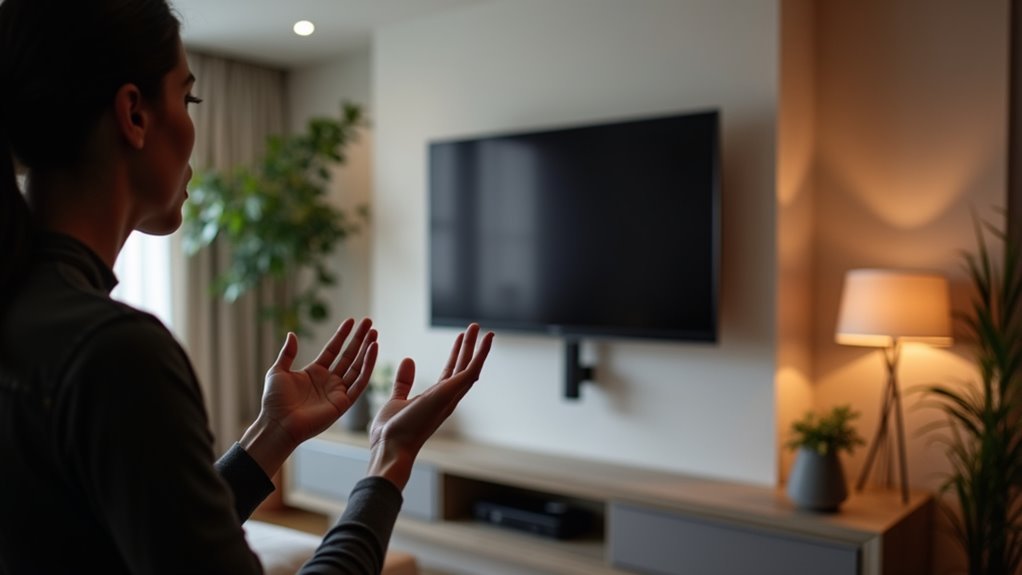
You’ve probably wrestled with your TV remote while your hands are full, or struggled to reach the perfect viewing angle from across the room. Voice-controlled TV mounts eliminate these daily frustrations by responding to simple spoken commands, but they offer far more than basic convenience. The real game-changer isn’t just the hands-free operation—it’s how this technology transforms accessibility, integrates with your smart home ecosystem, and adapts to your lifestyle in ways you haven’t considered.
What Makes Voice-Controlled TV Mounts Different

While traditional TV mounts require you to manually adjust your screen’s position, voice-controlled mounts let you change viewing angles with simple spoken commands.
You’ll find these mounts integrate seamlessly with smart home systems, working through Siri, Alexa, or Google Assistant to execute your requests instantly.
What sets these mounts apart are their advanced features like programmable presets. You can establish specific viewing positions and activate them using personalized voice commands.
The technology automatically remembers your last viewed position, creating a truly personalized experience each time you watch.
Voice control eliminates physical interaction with mechanical components, reducing wear and tear while adding convenience.
This hands-free operation proves especially valuable when you’re multitasking or have mobility challenges, transforming your entertainment setup into something genuinely futuristic.
Hands-Free Operation Benefits for Daily Use
When you’re cooking dinner with messy hands or holding a sleeping baby, voice-controlled TV mounts transform how you interact with your entertainment system. You’ll never need to fumble for remote controls or physically adjust your mount again.
Hands-free operation delivers practical benefits that enhance your daily routine:
- Accessibility support – You can easily adjust viewing angles if you have mobility limitations or physical challenges.
- Safety improvement – Voice commands eliminate reaching and stretching that could cause strain or injury.
- Convenience during multitasking – You’ll adjust your TV while cooking, exercising, or caring for children without interruption.
- Quick preset switching – You can instantly change between programmed viewing positions with simple voice prompts.
This technology seamlessly integrates into your smart home ecosystem, making entertainment control effortless and intuitive.
Enhanced Accessibility for Users With Mobility Challenges

You’ll find that voice-controlled TV mounts transform your viewing experience when mobility challenges make physical adjustments difficult or impossible.
These systems let you command your TV’s position without reaching for remotes or straining to manually move the mount, giving you complete control from wherever you’re seated.
Independence Through Voice Commands
Since traditional TV mount adjustments require physical manipulation of heavy equipment or remote controls with small buttons, voice-controlled motorized mounts represent a breakthrough for users with mobility challenges.
Voice control transforms how you interact with your entertainment setup, eliminating the need for physical assistance or struggling with manual adjustments. You can independently manage your viewing experience through simple spoken commands, promoting autonomy in your daily activities.
Key independence benefits include:
- Instant positioning adjustments – Tilt, swivel, or lower your TV without leaving your seat
- Reduced caregiver dependency – Handle entertainment needs without waiting for assistance
- Enhanced confidence – Control your environment through intuitive voice commands
- Improved quality of life – Enjoy entertainment on your terms, when you want
This technology empowers you to take charge of your viewing experience while maintaining dignity and self-reliance.
Reducing Physical Strain
Physical strain from manually adjusting heavy TV mounts can worsen existing mobility challenges and create unnecessary discomfort during what should be relaxing entertainment time. Voice control eliminates the physical effort required to adjust viewing angles, preventing unnecessary strain on your neck, back, and joints during prolonged viewing sessions.
| Traditional Manual Adjustment | Voice Control Benefits |
|---|---|
| Requires physical reach and strength | Hands-free operation from any position |
| Causes neck/back strain | Eliminates physical effort completely |
| Difficult for mobility aid users | Accessible regardless of mobility limitations |
When you can adjust viewing angles through simple voice commands, you’ll avoid the repetitive motions that contribute to muscle fatigue and joint discomfort, creating a more comfortable and sustainable viewing experience.
Seamless Smart Home Integration Capabilities
You’ll find that voice-controlled TV mounts work seamlessly with popular assistants like Siri and Google Assistant, letting you adjust your viewing angle with simple commands.
Your smart home ecosystem can automatically position your TV based on daily routines, such as tilting it to the perfect angle when you start your evening movie.
This integration means you won’t need separate apps or controls – everything works together through your existing voice assistant setup.
Voice Assistant Compatibility
When you integrate your motorized TV mount with voice assistant compatibility like Amazon Alexa, Google Assistant, or Apple Siri, you’ll transform how you interact with your entertainment setup.
This ease of use eliminates the frustration of searching for multiple remotes while delivering intuitive control through natural language commands.
Voice assistant compatibility offers several key advantages:
- Hands-free convenience – Adjust your TV’s position without interrupting your viewing experience
- Customizable commands – Program specific phrases to control height, angle, and positioning preferences
- Simplified interface – Reduce remote clutter by centralizing control through voice commands
- Automated routines – Create preset configurations that activate with single voice phrases
You’ll experience seamless control that makes adjusting your TV mount feel effortless and natural.
Automated Home Ecosystem
As your smart home ecosystem expands, motorized TV mounts become central orchestrators that synchronize with lighting systems, window treatments, and climate controls to create perfectly tailored viewing environments.
You’ll find these intelligent mounts seamlessly integrate with your existing automation protocols, allowing single voice commands to trigger multiple simultaneous adjustments. When you say “movie time,” your motorized mount can lower your TV to ideal viewing height while your smart home dims lights, closes curtains, and adjusts temperature settings automatically.
This synchronized approach eliminates the need for multiple manual adjustments, creating effortless shifts between different entertainment scenarios.
Your voice-controlled mount becomes the foundation for sophisticated automation sequences that adapt your entire living space to match your viewing preferences, delivering truly personalized entertainment experiences.
Voice Command Types and Functions Available

Modern voice-controlled TV mounts respond to several basic command types that make adjusting your viewing experience remarkably simple.
Your motorized TV mount can execute voice commands across multiple categories, giving you extensive control without touching any physical controls.
The most common voice commands include:
- Position adjustments – “Raise TV,” “Lower TV,” or “Tilt down” for immediate angle changes
- Preset activation – “TV movie position” or “Gaming setup” to instantly switch to saved configurations
- Fine-tuning controls – “Move TV up two inches” for precise positioning adjustments
- Routine integration – “Start movie night” to automatically adjust TV position alongside other smart home devices
You’ll find these commands work seamlessly with popular voice assistants, transforming how you interact with your entertainment setup while enhancing accessibility for users with mobility limitations.
Popular Voice Assistant Compatibility Options
The success of voice-controlled TV mounts depends heavily on which voice assistant platforms they support, and you’ll find three major options dominating the market.
Amazon Alexa leads the pack with widespread compatibility across most electric mount models, letting you seamlessly integrate your TV positioning into existing Echo ecosystems.
Google Assistant offers robust voice control integration for Android users and Google Home setups, providing natural language processing for mount adjustments.
Apple Siri compatibility is growing, particularly appealing if you’re already invested in HomeKit automation.
Each platform eliminates the need for traditional remote control by enabling hands-free commands like “raise the TV” or “tilt screen down.”
This compatibility guarantees your voice-controlled mount works harmoniously with your preferred smart home ecosystem.
Installation Requirements for Voice-Activated Systems
Installing voice-activated TV mounts requires more technical preparation than standard mounting systems, and you’ll need several key components working together for seamless operation.
The installation requirements for voice-activated systems extend beyond basic mounting hardware to include smart home integration and network connectivity.
Essential components you’ll need include:
- Compatible smart home system (Amazon Alexa, Google Assistant, or Apple HomeKit)
- WiFi-enabled relay or smart controller connected to your home network
- Properly positioned microphone or voice assistant device within reasonable distance
- Dedicated mobile app installed and configured on your smartphone
You’ll also need to establish reliable WiFi connectivity and guarantee proper microphone placement for accurate command recognition.
Regular software updates for both the mount’s control system and your smart home platform will maintain ideal performance and compatibility with new voice command features.
Cost Comparison Between Voice and Manual Controls
Beyond technical setup considerations, voice-activated TV mounts carry considerably higher upfront costs than their manual counterparts.
When conducting a cost comparison, you’ll find the price differential ranges from $100 to over $500, depending on specific features and brand selections. Manual mounts offer budget-friendly alternatives with lower initial investment and reduced maintenance requirements over time.
However, voice-controlled systems can offset their higher purchase price through potential installation savings, as many models don’t require professional setup assistance.
You’ll also gain significant convenience benefits that may justify the premium cost. While electronic components in voice systems might increase future maintenance expenses, the time and effort savings from effortless adjustments could make the investment worthwhile for your specific needs and preferences.
Safety Features and Wall Protection Technology
You’ll find that voice-controlled TV mounts incorporate sophisticated Electronic Screen Protection Systems (ESPS) that automatically return your TV to a safe position when powered off, preventing costly wall damage.
These advanced systems also feature automated collision prevention technology that stops movement when obstacles are detected, protecting both your investment and surrounding furniture.
You can further enhance safety by programming preset controls that establish safe viewing angles and movement boundaries, ensuring your mount operates within predetermined limits that won’t risk contact with walls or nearby objects.
Electronic Screen Protection Systems
A guardian angel for your expensive display, Electronic Screen Protection Systems (ESPS) automatically move your TV to safety when trouble’s brewing.
These intelligent systems retract your screen to a protected position whenever you turn off your electric TV or detect potential hazards. You’ll appreciate how ESPS technology safeguards your investment while delivering seamless operation.
Modern TV wall mount offers now include advanced ESPS features that provide extensive protection:
- Obstacle Detection – Sensors prevent contact with surrounding objects during movement
- Automatic Retraction – Screen moves to safe position when powered off
- Mechanical Failure Prevention – Reduces risk of accidental drops or crashes
- Surface Protection – Maintains integrity of both display and installation wall
You’ll enjoy peace of mind knowing your valuable OLED and QLED screens remain protected.
Automated Wall Collision Prevention
Three critical sensors work together in automated wall collision prevention systems to protect both your TV and surrounding surfaces from costly damage.
These advanced detection systems continuously monitor your TV’s movement path, instantly stopping motion when they identify potential obstructions like walls or furniture.
You’ll benefit from programmable presets that let you establish safe viewing angles while preventing contact with nearby objects.
The motorized mechanisms incorporate smooth, precise movements that eliminate sudden jerks or misalignment issues that could cause accidental wall damage.
Your automated wall collision prevention technology requires regular maintenance to function effectively.
Programmable Safety Preset Controls
When you configure programmable safety preset controls on your motorized TV mount, you’re establishing multiple secure viewing positions that eliminate guesswork and protect against wall damage.
These intelligent controls work seamlessly with voice commands to deliver precise positioning every time. You can customize the viewing angle through seven different preset options, each designed with safety parameters that prevent overextension.
The system’s Electronic Screen Protection System (ESPS) guarantees your TV never contacts the wall surface.
Key benefits include:
- Instant positioning – Access preferred angles with simple voice commands
- Wall protection – Built-in safeguards prevent scratches and structural damage
- Automated safety – TV automatically returns to wall position when powered off
- Maintenance alerts – Regular system checks maintain ideal protection effectiveness
Programming Custom Voice Commands and Presets
Since motorized TV mounts can integrate with smart home systems like Amazon Alexa and Google Assistant, you’ll discover that programming custom voice commands alters how you interact with your entertainment setup.
You can create specific phrases like “TV up” or “TV down” that control your mount’s adjustable height without manual effort. Through user-friendly apps or control panels, you’ll customize commands that are intuitive and easy to remember, enhancing your overall experience.
You can establish programmable presets that recall specific viewing angles based on content type or lighting conditions. These voice control capabilities often include automatic adjustments to your last viewed position, providing convenience and personalization.
Programming custom voice commands enables seamless shifts between different viewing scenarios while maintaining ideal comfort.
Troubleshooting Common Voice Control Issues
Even with perfectly programmed custom commands, voice control systems can encounter technical hiccups that disrupt your seamless viewing experience.
Despite meticulous setup and configuration, even the most advanced voice control systems may experience unexpected technical disruptions during operation.
When your voice control device stops responding to commands or fails to execute mount adjustments, systematic troubleshooting will restore functionality.
Start by addressing these common issues:
- Compatibility conflicts – Verify your voice control device works with your mount’s control system and supports required integration protocols.
- Network connectivity – Confirm both devices connect to the same Wi-Fi network for proper communication.
- Microphone positioning – Check for obstructions and adjust distance to improve voice command capture.
- Firmware updates – Install latest updates for both your voice control device and mount app to resolve bugs.
Proper command phrasing according to your system’s requirements guarantees reliable recognition and execution.
Maintenance Needs for Motorized Voice Systems
Although motorized voice-controlled TV mounts offer convenient hands-free operation, they require consistent maintenance to preserve their mechanical precision and electrical reliability. Professional installation guarantees proper setup, but ongoing maintenance needs remain your responsibility.
| Component | Maintenance Task |
|---|---|
| Wiring & Connections | Check for wear, loose connections quarterly |
| Control Board & Power Supply | Inspect integrity, test functionality monthly |
| Voice Recognition System | Update firmware, calibrate settings regularly |
| Motorized Mechanisms | Dust components, lubricate moving parts |
You’ll need to keep control interfaces updated for smart home compatibility. Regular cleaning prevents interference with mounting mechanisms while maintaining aesthetics. Follow manufacturer guidelines for specific maintenance intervals and procedures. Checking these systems consistently prevents potential malfunctions and extends your motorized voice system’s lifespan, guaranteeing reliable hands-free TV positioning.
Energy Consumption and Power Requirements
Beyond regular upkeep considerations, you’ll want to understand the power demands of voice-controlled TV mounts before installation.
These devices operate efficiently on low-voltage systems, making them ideal for energy consumption management in your home.
Voice-controlled mounts offer several energy advantages:
- Low standby power – Only 1-2 watts when inactive, minimizing impact on energy bills
- Energy-efficient motors – Consume less power than traditional electric mounts during operation
- Programmable presets – Reduce unnecessary adjustments by saving preferred viewing angles
- Smart monitoring capabilities – Track power usage through integrated systems
Integration with smart home systems enables you to monitor and optimize energy consumption effectively.
The minimal power requirements guarantee these mounts won’t greatly increase your electricity costs while providing convenient voice control functionality.
Future Innovations in Voice-Controlled TV Technology
You’ll soon experience TV mounts that learn your viewing habits through AI integration advances, automatically adjusting to your preferred angles and heights without any commands.
Gesture recognition technology will let you control your mount with simple hand movements, making voice commands just one of several intuitive options.
Your entire smart home ecosystem will work together seamlessly, with your TV mount coordinating with lighting, blinds, and audio systems to create the perfect viewing environment.
AI Integration Advances
When advanced AI systems take control of voice-activated TV mounts, you’ll experience a level of personalization that adapts to your unique viewing habits and preferences.
This voice-controlled TV technology revolutionizes how you achieve ideal viewing by learning from your behavior patterns and automatically suggesting the perfect position for different content types.
Machine learning algorithms continuously refine their understanding of your commands, making interactions more intuitive and responsive.
You won’t need to repeat yourself or struggle with misunderstood commands anymore.
Key AI integration advances include:
- Context-aware adjustments based on your viewing history
- Natural language processing for complex command interpretation
- Smart home ecosystem synchronization with lighting and audio
- Predictive positioning for enhanced accessibility and convenience
These innovations transform your entertainment setup into an intelligent, adaptive system.
Gesture Recognition Technology
Gesture recognition technology takes voice-controlled TV mounts to the next level by interpreting your physical movements through advanced sensors and cameras. You’ll control your mount through simple hand motions, providing an intuitive hands-free experience that’s perfect when frequent adjustments are needed during viewing sessions.
| Feature | Traditional Control | Gesture Recognition Technology |
|---|---|---|
| Accessibility | Limited mobility support | Enhanced for mobility challenges |
| User Learning | Static functionality | Adapts to your preferences |
| Multi-device Control | Single device focus | Seamless smart home integration |
| Multi-user Support | Basic customization | Individual gesture profiles |
| Response Method | Button/voice dependent | Physical movement interpretation |
Machine learning algorithms will enable your system to adapt to individual preferences over time. You’ll seamlessly control lighting, sound, and other smart home devices through simple gestures, while multi-user environments allow personalized viewing preferences for different family members.
Seamless Smart Home
As voice-controlled TV mounts evolve beyond standalone devices, they’ll become central command hubs that orchestrate your entire entertainment ecosystem.
You’ll experience unprecedented integration where your mount communicates with lighting, sound systems, and climate controls to create the perfect viewing environment.
Future smart home integration will deliver these revolutionary capabilities:
- Predictive adjustments – Machine learning algorithms study your viewing habits and automatically optimize mount positioning based on time, content type, and previous preferences.
- Natural language processing – You’ll use conversational commands instead of rigid voice prompts for more intuitive interactions.
- Cross-device synchronization – Voice-controlled TV mounts will coordinate with streaming devices, speakers, and ambient lighting simultaneously.
- Personalized profiles – Individual family members receive customized viewing experiences through voice recognition technology.
This seamless smart home evolution transforms entertainment from passive consumption into intelligent, responsive experiences.
Frequently Asked Questions
What Is the Rule of Thumb for Mounting a TV?
You should mount your TV’s center at eye level when seated, typically 42-48 inches from the floor. Place seating 1.5-2.5 times the TV’s diagonal size away for ideal viewing comfort.
What Is the Point of Mounting a TV?
You’ll save floor space, reduce neck strain, and create a sleeker look when you mount your TV. It’s safer for kids and pets while eliminating glare for better picture quality.
What Are the Rules for Mounting a TV on the Wall?
You’ll need to check your TV’s VESA compatibility, use proper mounting hardware for your wall type, verify the wall can support the weight, and mount at eye level around 42-48 inches high.
What Are the Disadvantages of Wall Mounted TV?
You’ll face limited furniture flexibility, potential installation costs, restricted port access, safety risks with children or pets, and possible wall damage that’s problematic if you’re renting or moving frequently.

Leave a Reply