
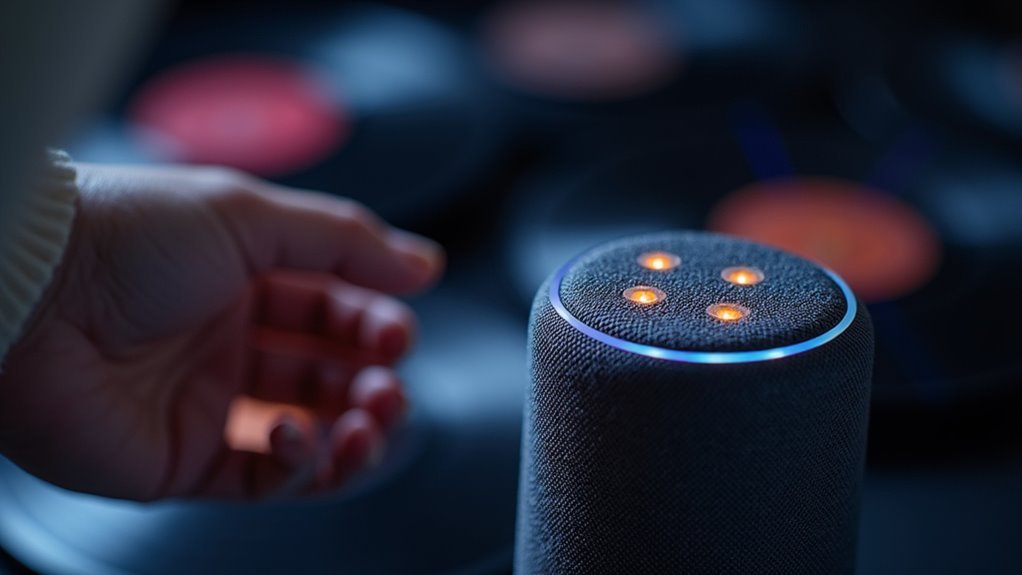
You’ve probably wondered how your smart speaker instantly recognizes your voice among multiple family members and retrieves exactly the playlist you’re craving. Voice-controlled media libraries rely on intricate layers of technology working behind the scenes—from analyzing your unique vocal patterns to processing natural language commands in real-time. But there’s more complexity involved than you might expect, especially when it comes to balancing performance with privacy concerns.
Understanding Voice Recognition Technology Fundamentals

Voice recognition technology transforms how you interact with digital devices by analyzing the unique characteristics of your speech. This artificial intelligence (AI) system examines your speech patterns, cadence, and tone to differentiate your voice from others accurately.
Voice recognition AI analyzes your unique speech patterns, cadence, and tone to accurately distinguish your voice from others.
When you set up smart speakers like Google’s “Voice Match” or Apple’s “Hey Siri,” you’re training the device to recognize your specific vocal markers. The technology uses template matching methods, comparing your current speech against previously stored voice data to identify you.
This creates highly personalized interactions with your devices. Major companies like Google, Apple, and Amazon have perfected these systems to enhance user experiences.
As voice-enabled devices continue growing, you’ll see increasingly sophisticated voice profiles that enable secure transactions and deliver tailored content based on your unique vocal signature.
AI-Powered Speech Pattern Analysis Systems
Building on those vocal recognition foundations, AI-powered speech pattern analysis systems take voice technology several steps further by employing sophisticated machine learning algorithms that dissect the nuances of how you speak. These AI and Machine learning systems don’t just recognize words—they analyze your unique vocal characteristics like tone and cadence, creating a personalized voice recognition profile.
| Feature | Capability |
|---|---|
| Individual Recognition | Identifies users by vocal characteristics |
| Context Understanding | Follows conversational flow naturally |
| Adaptive Learning | Improves through continuous dataset analysis |
| Multilingual Support | Handles diverse accents and languages |
Similar to smart home devices, these systems enable intuitive voice-controlled catalog searches and real-time language translation, making library interactions more accessible and engaging for everyone.
Personalized User Voice Profile Creation

You’ll find that voice recognition accuracy forms the foundation of effective personalized user profiles, as the system must reliably distinguish your unique vocal characteristics from other users.
Your library’s multi-user profile management becomes essential when multiple family members or colleagues share the same device, requiring seamless switching between individual preferences and borrowing histories.
The system’s adaptive learning capabilities continuously refine your profile by analyzing your search patterns, genre preferences, and interaction habits to provide increasingly relevant recommendations over time.
Voice Recognition Accuracy
Although modern voice recognition systems achieve impressive baseline accuracy rates, creating a personalized user voice profile greatly enhances your media library’s ability to understand your unique speech patterns and vocal characteristics. Template matching techniques allow artificial intelligence (AI) to distinguish your voice from others, enabling secure access and preventing unauthorized usage.
| Recognition Feature | Standard System | Personalized Profile |
|---|---|---|
| Accuracy Rate | 85-90% | 95-98% |
| Error Frequency | Higher | Markedly Reduced |
| Accessibility Support | Basic | Enhanced for Disabilities |
Personalized voice profiles require repeated voice inputs during training phases, teaching the system your specific cadences and pronunciation patterns. This AI-powered customization delivers tailored recommendations and information retrieval while greatly improving accessibility for users with disabilities through more reliable voice command recognition.
Multi-User Profile Management
When multiple family members or colleagues share the same voice-controlled media library system, establishing distinct user profiles becomes essential for delivering truly personalized experiences.
Multi-user profile management allows devices like Amazon Echo and Google Home to identify individual speakers and provide customized responses based on their unique voice signatures.
You’ll benefit from voice recognition technology that distinguishes between different users, ensuring each person receives tailored information such as personal event calendars, customized catalog searches, and relevant library advocacy details.
This personalization markedly improves user satisfaction and accessibility to library resources.
As smart speakers become increasingly common in homes, libraries must implement multi-user profile management to meet growing demand for personalized voice access among patrons, particularly incoming students seeking enhanced library interactions.
Adaptive Learning Systems
Building upon multi-user recognition capabilities, adaptive learning systems take personalization further by continuously analyzing your vocal patterns, speech preferences, and interaction history to refine your unique voice profile.
Voice recognition technology learns from each interaction, creating increasingly accurate personalized voice profiles that understand your specific pronunciation, accent, and speaking style. These adaptive learning systems enhance your library experience by delivering targeted content recommendations and responses tailored to your individual needs.
You’ll notice improved accuracy when querying event calendars, searching catalogs, or accessing advocacy information. The system anticipates your preferences and streamlines information access based on past interactions.
This continuous learning process guarantees your voice-controlled media library becomes more intuitive over time, ultimately increasing your satisfaction and engagement with library resources.
Natural Language Processing for Media Commands

Since voice-controlled media libraries rely on understanding human speech patterns, Natural Language Processing (NLP) serves as the critical bridge between your spoken words and the system’s ability to retrieve the exact content you’re seeking.
Voice assistants like Alexa and Google Assistant use sophisticated NLP techniques to analyze your syntax and semantics when you request music, audiobooks, or catalog searches. These systems excel at handling contextual conversations, processing follow-up questions without requiring you to repeat previous context.
| NLP Capability | Media Library Function |
|---|---|
| Syntax Analysis | Interprets command structure |
| Semantic Understanding | Grasps meaning and intent |
| Context Retention | Handles follow-up queries |
| Personalization | Adapts to user preferences |
Modern media libraries integrate these natural language capabilities to streamline your access, whether you’re checking out titles or finding event information.
Content Organization and Cataloging Methods
You’ll need robust metadata schema standards to guarantee your voice-controlled library system can accurately interpret and retrieve content based on natural language queries.
Your cataloging methods must incorporate voice search optimization techniques that account for how users actually speak when requesting materials, rather than how they type traditional searches.
This means you’re structuring your metadata to recognize conversational phrases, synonyms, and the varied ways patrons might describe the same resource when speaking to voice assistants.
Metadata Schema Standards
When implementing voice-controlled media libraries, you’ll need robust metadata schema standards that serve as the backbone for content organization and cataloging methods. These metadata schema standards guarantee seamless interoperability between voice assistant platforms while enhancing digital accessibility for all users.
You’ll find that standardized frameworks like Dublin Core and MARC enable your voice technology to deliver accurate responses to spoken queries.
Your library can leverage services from OverDrive and EBSCO, which rely on consistent metadata structures to connect voice commands with catalog searches. You’ll also benefit from customizable metadata fields that let you tailor content organization to your community’s specific needs.
This approach improves user engagement by allowing seamless access to event calendars, holds, and advocacy resources through natural voice interactions.
Voice Search Optimization
Building on standardized metadata frameworks, voice search optimization transforms how patrons discover and access your media collection through natural language queries. You’ll need to restructure your content organization around conversational keywords that match spoken requests rather than typed searches.
| Voice Search Element | Traditional Method | Voice-Optimized Approach |
|---|---|---|
| Query Structure | Keyword-based | Natural language phrases |
| User Identification | Login credentials | Voice recognition technology |
| Content Discovery | Browse categories | Voice commands for recommendations |
| Response Format | Visual results | Audio-first interactions |
Your library should develop custom voice applications that connect patrons directly to catalog information and events. Voice recognition technology enables personalized responses by differentiating between users. Apps like OverDrive’s Libby demonstrate effective voice search implementation, allowing spoken title searches and recommendations that streamline resource access.
Smart Device Integration and Compatibility
As libraries embrace voice-controlled technology, you’ll need to contemplate how well these systems integrate with your existing smart device integration ecosystem and infrastructure.
Popular voice assistants like Amazon Alexa and Google Assistant are becoming standard platforms for library access. OverDrive’s Libby app demonstrates this compatibility by supporting voice queries through Google Assistant, letting you search catalogs hands-free.
EBSCO’s voice-enabled content access and Demco’s custom Alexa skill show how libraries develop tailored solutions for their communities.
However, you must carefully assess compatibility between different systems and devices. Privacy concerns become paramount when integrating smart devices into library services, requiring secure connections that protect patron data while maintaining seamless functionality across multiple platforms and user preferences.
Voice Command Accuracy and Response Optimization
Although voice-controlled systems offer tremendous potential for library access, their effectiveness hinges on accurate speech recognition and enhanced response mechanisms that can handle the complexities of library patron interactions.
You’ll find that voice command accuracy depends on artificial intelligence that differentiates between speakers and analyzes speech patterns for best identification.
Voice assistants like OverDrive’s Libby app demonstrate practical applications through catalog searches and title recommendations via voice queries. You can benefit from personalized interactions since systems like Amazon’s Alexa and Google Home recognize multiple user profiles, adapting responses based on your preferences and previous queries.
However, you’ll encounter challenges with mispronunciations and query variations that require continuous development and updates to improve functionality and response accuracy.
Multi-User Household Voice Identification
Voice recognition systems face an additional layer of complexity when multiple people share the same device, requiring advanced identification capabilities that can distinguish between different household members.
Multi-user voice identification technology enables smart speakers like Amazon’s Alexa and Google Assistant to recognize individual voices, delivering tailored responses for each user. Google Home supports up to six different accounts, ensuring you receive customized interactions based on your unique voice pattern.
Smart speakers distinguish between household members’ voices to deliver personalized responses tailored to each user’s unique vocal patterns.
This personalization becomes vital as 41% of U.S. consumers owned smart speakers by 2018’s end. Beyond improving user experience, voice identification addresses privacy concerns by preventing household members from accessing each other’s personal information.
Amazon continues enhancing Alexa’s voice recognition capabilities to provide better household personalization.
Privacy Protection and Data Security Measures
When you implement voice-controlled media libraries, you’re trusting third-party companies like Amazon and Google to store and process your patrons’ voice data on their servers.
You’ll face significant voice recognition vulnerabilities since these systems can’t always distinguish between authorized users and unauthorized household members or potential intruders.
You must understand that even when library service providers claim they don’t store patron data, the underlying voice platforms still collect and retain interaction information.
Third-Party Data Storage
How secure is your personal information when you interact with voice-controlled systems in today’s digital libraries?
When libraries implement voice-controlled media systems, they’re often relying on third-party data storage solutions that create significant privacy and security vulnerabilities. Your interactions with voice assistants like Alexa and Google Home don’t stay within the library’s walls – they’re transmitted to the parent companies for analytics and improvement purposes.
This data sharing creates potential exposure points for your personal information. The regulatory landscape remains murky, making it difficult for libraries to guarantee full compliance with data protection standards.
You should understand that these systems may inadvertently compromise your privacy through unauthorized access or remote commandeering of compromised accounts, putting your personal data at risk.
Voice Recognition Vulnerabilities
Beyond third-party storage concerns, voice recognition systems themselves harbor inherent vulnerabilities that can expose your private conversations and personal data.
Smart speakers equipped with voice recognition software create multiple entry points for unauthorized access, whether from household members or malicious hackers attempting remote infiltration.
You’ll face several critical security challenges:
- Real-time surveillance risks – Smart speakers maintain wiretap capabilities that enable continuous monitoring of your environment.
- Unauthorized device access – Compromised email accounts can grant hackers remote control over your voice-controlled systems.
- Factory reset necessity – You must restore devices to original settings before disposal to prevent data breaches.
Libraries implementing these technologies need skeptical approaches, prioritizing patron privacy while educating users about adjusting permissions and disabling unnecessary voice features.
Media Discovery Through Conversational Interfaces
Why scroll through endless catalogs when you can simply ask for what you want? Conversational interfaces transform how you discover media in voice-controlled libraries.
Voice assistants integrated by library vendors like OverDrive’s Libby app enable hands-free catalog searches and personalized recommendations through Google Assistant. You’ll find the smart speaker market driving innovation as libraries develop custom Alexa skills for enhanced accessibility.
These conversational tools let you request specific titles, explore event calendars, and access advocacy information using natural language queries. Spokane Public Library’s Alexa skill exemplifies how you can engage with community information effortlessly.
As demand for voice access grows, libraries are prioritizing these technologies to meet tech-savvy patrons’ expectations, making media discovery intuitive and accessible through simple voice commands.
Real-Time Audio Processing and Feedback
As you speak commands into voice-controlled library systems, real-time audio processing algorithms instantly analyze your speech patterns and tone to deliver immediate, accurate responses.
Advanced voice recognition algorithms process your spoken requests in milliseconds, transforming how you interact with digital library collections.
This sophisticated voice recognition technology guarantees your requests are interpreted correctly, creating seamless interactions with library services.
Natural language processing enhances these systems by understanding complex queries, making library resources more accessible than ever.
When you use apps like OverDrive’s Libby, you’ll experience how real-time processing transforms your library experience:
- Immediate catalog searches respond to your voice commands without delay
- Personalized title recommendations adapt based on your speaking patterns
- Dynamic feedback provides timely updates during your browsing session
These capabilities enable libraries to offer truly responsive, conversational interfaces that understand and anticipate your needs.
Cloud-Based Vs Local Storage Solutions
When choosing storage solutions for your voice-controlled media library, you’ll face a fundamental decision between cloud-based and local storage systems.
Cloud-based solutions offer exceptional scalability and remote access, letting you reach your content anywhere with internet connectivity. They’re easier to integrate with voice-controlled systems since they receive remote updates and maintain compatibility with emerging technologies.
You’ll also benefit from built-in encryption and backup features while avoiding hefty upfront hardware costs through subscription models.
Local storage provides faster access times and reduced latency, making it perfect for high-speed environments or areas with limited internet.
However, you’ll need significant initial investments and additional security measures to protect against physical damage or theft.
Voice Assistant Platform Selection Strategies
When you’re selecting a voice assistant platform for your media library, you’ll need to evaluate how well each option integrates with your existing systems and user devices.
You must also assess whether your team has the technical expertise and budget to develop custom skills or actions that meet your library’s specific needs.
These compatibility and resource considerations will determine which platform can effectively serve your patrons while staying within your operational constraints.
Platform Compatibility Assessment
Before you commit to a specific voice assistant platform, you’ll need to evaluate how well each option aligns with your library’s existing digital infrastructure and patron demographics.
Platform compatibility directly impacts how effectively you can deliver library services through voice assistants.
Start by examining these critical compatibility factors:
- Technical integration capabilities – Assess whether your current catalog system, databases, and digital collections can seamlessly connect with Amazon Alexa or Google Assistant APIs.
- Patron device preferences – Survey your community to understand which smart speakers they’re already using at home.
- Vendor support alignment – Verify that your library management system providers offer voice-enabled features for your chosen platform.
OverDrive’s success with Libby demonstrates how proper platform compatibility guarantees smooth user experiences across voice assistants.
Development Resource Requirements
Since voice assistant platform selection directly impacts your development timeline and budget, you’ll need to carefully evaluate the resource commitments each option demands. Building custom Alexa Skills or Google Assistant actions requires substantial investment in technical expertise and ongoing maintenance.
| Resource Type | Amazon Alexa | Google Assistant | Multi-Platform |
|---|---|---|---|
| Initial Development | 2-4 months | 3-5 months | 4-8 months |
| Technical Expertise | Voice UI design, AWS | Conversational AI, GCP | Cross-platform skills |
| Ongoing Maintenance | Monthly updates | Bi-weekly patches | Weekly coordination |
| Vendor Collaboration | Moderate | High | Extensive |
| Privacy Compliance | Standard protocols | Enhanced security | thorough auditing |
The development process demands continuous collaboration with local developers who understand your community’s specific needs. You’ll also need dedicated resources for addressing user query variations and implementing regular updates that enhance functionality while maintaining strict data privacy standards throughout your voice assistant implementation.
Performance Monitoring and System Maintenance
Although voice-controlled media libraries offer impressive functionality, they’ll only maintain their effectiveness through consistent performance monitoring and proactive system maintenance. You’ll need to track system responsiveness and analyze user interactions to identify areas for improvement.
Your monitoring strategy should include:
A comprehensive monitoring strategy encompasses automated testing, user engagement analytics, and regular software updates to ensure optimal system performance.
- Automated testing frameworks that identify issues in voice skills before they impact users, minimizing downtime and enhancing overall experience.
- User engagement metrics tracking to monitor query frequency and request types, helping you adapt and expand service offerings effectively.
- Regular voice recognition software updates to accommodate varying speech patterns and improve command accuracy.
You must also prioritize data privacy through regular audits of handling practices.
This thorough approach guarantees your voice-controlled system remains reliable, secure, and user-friendly while maintaining compliance with legal standards.
Frequently Asked Questions
How Do Voice Controlled Devices Work?
When you speak, voice-controlled devices use AI to convert your speech into digital signals. They analyze patterns, tone, and cadence to recognize your unique voice, then process commands through speech recognition algorithms for personalized responses.
Why Is Voice Control Important?
You’ll find voice control essential because it makes accessing information effortless and hands-free. You can search catalogs, place holds, and navigate resources naturally while multitasking, creating a more personalized and efficient experience.
What Are Voice Controlled Assistants Powered By?
Voice-controlled assistants you use are powered by advanced artificial intelligence algorithms. They’ll analyze your speech patterns, cadence, and tone to differentiate between speakers and comprehend your spoken commands effectively.
Which of the Following Devices Commonly Use Voice Search Technology?
You’ll find voice search technology in smart speakers like Amazon Echo and Google Home, smartphones with Siri or Google Assistant, and various other connected devices that respond to spoken commands.

Leave a Reply